By the time I arrived at my parents’ house, the rain had turned the front walk into a dark ribbon beneath the oak trees.
People stood beneath black umbrellas, speaking in the hushed, careful voices reserved for hospitals and graves. Someone had left the porch light on even though it was still afternoon. Its yellow glow fell across the brass knocker my mother had polished every Sunday until her hands became too weak to hold the cloth.
Evelyn’s memorial had been arranged in the living room.
That was what everyone called it—a memorial, as if changing the word could make the house feel less empty. Her photograph stood on a folding table beside a vase of white lilies. In the picture, she was smiling toward the camera with one hand lifted against the sun. I knew the dress she wore. I had taken the picture myself, years ago, in the backyard, after she had chased me around the apple tree because I had stolen a strawberry from the kitchen.
I stopped in front of it and pressed my fingers against the edge of the table.
For one painful second, I expected her to come in from the hallway and complain that the flowers were too dramatic.
Then Arthur’s voice reached me from behind.
“Clara, you need to come upstairs before the guests leave.”
I turned.
My father stood near the doorway with a paper cup in one hand and a folded packet of documents in the other. He was wearing the charcoal suit he had worn to the funeral three days earlier. His tie was loosened, but everything else about him looked controlled—the smooth gray hair, the straight shoulders, the expression that made every request sound like an order already obeyed.
“I just got here,” I said.
“You’ve been here long enough to greet everyone.”
“I haven’t even seen Aunt Beatrice.”
Arthur glanced toward the crowded dining room. “She’s somewhere around. This is more important.”
The packet in his hand made a dry scraping sound when he shifted it.
I looked at it, then back at him. “What is it?”
“The house papers.”
The room seemed to contract around us. Behind me, two of my mother’s neighbors murmured over the lilies. A spoon struck the rim of a coffee cup. Somewhere near the kitchen, a child began to cry and was quickly carried outside.
Arthur held out the packet.
“You and I need to settle this today,” he said. “Your mother would not want this dragged out.”
I didn’t take it. “Settle what?”
His mouth tightened. “Don’t make this difficult.”
“Then explain it.”
He lowered his voice, but not enough to make it private. “The house is half yours now. I’m asking you to sign your share over to me so I can handle the mortgage, taxes, and repairs.”
I stared at him.
The house behind him seemed to tilt—the staircase where I had hidden during childhood games, the hallway where Mother had measured my height against the wallpaper, the living room where she had sat beside me while I filled out college applications. It was not just a building. It was the place where every version of my mother still seemed to exist.
“You want me to sign over my half of the house?” I asked.
Arthur’s fingers tightened around the packet. “I want you to be sensible.”
“You didn’t mention this at the funeral.”
“That was not the time.”
“Apparently today is.”
“Today is the only time people are here who can witness that you understand what you’re doing.”
The words landed harder than he seemed to intend. Or perhaps he had intended them exactly that way.
I looked past him toward the dining room. The guests were close enough to hear us, but no one was looking directly at me. That was how people behaved around Arthur. They gave him privacy even when he was the one taking it from someone else.
“I’m not signing anything,” I said.
His eyes narrowed. “You don’t know what you’re refusing.”
“I know you’re asking me to give up my share of my mother’s home during her memorial.”
“It’s not your mother’s home anymore. It’s an estate with obligations.”
“Then I’ll read the papers.”
“You’ll sign them.”
“No.”
The single word seemed to surprise him. It surprised me too. Since Mother’s illness, I had grown accustomed to saying yes before Arthur finished speaking. Yes, I would come over. Yes, I would call the insurance company. Yes, I would let him handle the bank. Yes, I understood that he knew what was best.
But this was the house.
His expression hardened into something almost calm.
“Your mother trusted me to manage things,” he said.
“I’m not Mother.”
“No. You’re being emotional.”
“I’m grieving.”
“And I’m trying to protect you from making a financial mistake.”
He extended the packet again. “Sign the transfer. We can have it notarized before everyone leaves.”
I stepped away from his hand.
A chair scraped behind me.
Aunt Beatrice stood near the archway to the kitchen, watching us. She was my mother’s older sister, small and straight-backed, with silver hair pinned tightly at the nape of her neck. Her face had the pale, sharpened look of someone who had not slept.
Arthur noticed her and immediately turned his body, placing himself between Beatrice and me.
“Clara and I are discussing private business,” he said.
Beatrice looked at the packet in his hand. “At Evelyn’s memorial?”
Arthur’s jaw moved once. “This concerns the estate.”
“It concerns Clara,” Beatrice replied.
He gave a humorless smile. “That’s what I said.”
Beatrice did not look away from him. “Then let her decide when she wants to discuss it.”
For a moment, neither of them moved.
My father had always been able to make silence feel like punishment. Beatrice met it without flinching. I saw his hand curl around the packet until the pages bent at the corners.
Then someone called his name from the dining room.
“Arthur? Could you help us with the photographs?”
He kept his eyes on Beatrice.
“I’ll be back,” he told me.
It was not a promise. It was a warning.
He walked into the dining room, carrying the unsigned papers with him.
I watched until the crowd swallowed him.
Beatrice crossed the room quickly. She did not embrace me. She only reached behind the long coat rack beside the door and pulled out a small blue suitcase.
It was old-fashioned, with rounded corners and two dull metal latches. A strip of black tape had been wrapped around the handle. I had never seen it before.
She placed it against my legs.
The suitcase was heavier than it looked.
“What is this?” I whispered.
“Take it.”
I glanced toward the dining room. Arthur was standing with three guests near the windows, pretending to study a collection of photographs someone had placed on the mantel. His back was to us, but I had the uneasy feeling he could hear every movement in the room.
“Why are you giving me a suitcase?”
“Because your mother wanted you to have it.”
My throat tightened. “When did she say that?”
Beatrice’s eyes moved to Evelyn’s photograph on the memorial table.
“Not in words.”
That answer frightened me more than a direct one would have.
I crouched and tried one of the latches. It did not open. The other latch was locked too. There was no key attached to the handle or tucked beneath the tape.
“Where’s the key?”
Beatrice’s gaze flicked toward the living room.
“Later,” she murmured.
“Beatrice, I need to know what this is.”
“You need to get it out of this house.”
The suitcase seemed to grow heavier against my knees.
Arthur laughed from the dining room. It was a short, polished sound, the kind he used when other people were watching.
Beatrice leaned closer to me. Her perfume smelled faintly of violets and the cold rain outside.
“The key is hidden inside the nineteen ninety-eight family photograph,” she whispered.
I looked toward the living room.
The photograph.
I knew exactly which one she meant. It hung above the low bookcase near the fireplace, inside a dark wooden frame. My mother, my father, Beatrice, and I stood together in the backyard, all of us squinting into the summer sun. I had been eight years old. My front teeth were uneven, and Mother’s arm was wrapped around my shoulders.
I had not thought about that picture in years.
“How do I get it?” I asked.
Beatrice’s fingers closed around my wrist. They were cold.
“Don’t let Arthur see you take it.”
“Why?”
Her grip tightened.
“Because he will stop you.”
Before I could ask anything else, she released me and moved toward the hallway.
“Wait,” I said.
She turned only halfway.
“What’s in the suitcase?”
Her face changed. Not fear exactly. Something more exhausted than fear.
“Your mother’s truth.”
Then she disappeared through the hallway door.
I stayed crouched beside the blue suitcase, staring after her.
The words should have sounded theatrical. Instead, they sat inside me with the weight of a stone.
I lifted the suitcase and carried it toward the small study beneath the stairs. Nobody stopped me. The guests were busy gathering around the memorial table, and the rain had driven everyone closer together. I slipped the case behind a stack of folded card tables and returned to the living room before Arthur could notice it was gone.
He was no longer looking at the photographs.
He was looking at me.
“What did Beatrice give you?” he asked.
“Nothing.”
His gaze went to my empty hands.
“I saw you carrying something.”
“A coat.”
“You weren’t carrying a coat.”
“Then you saw wrong.”
His face flushed. “Don’t start lying to me in my own house.”
I felt the old instinct to apologize. It rose quickly, automatically, like a hand reaching to cover a bruise.
I swallowed it.
“I’m going to look at the family photographs,” I said.
Arthur stepped into my path.
The portrait hung behind him, above the bookcase. Its glass reflected the windows and the gray daylight, making the faces difficult to see.
“Why?” he asked.
“Because I want it.”
“It belongs here.”
“So do I.”
His eyes sharpened.
For a moment, the room around us faded. I could hear only the rain tapping the windows and the faint clink of dishes in the kitchen.
“You’re upset,” he said. “You’re not thinking clearly.”
“I’m thinking clearly enough to know I don’t need permission to look at a picture.”
“You’re not taking anything from this house.”
“I didn’t say I was.”
“You don’t have to say it.”
He moved closer to the bookcase, blocking the portrait completely.
My pulse began to beat in my throat.
“Move,” I said.
Arthur let out a low breath through his nose. “Clara, this is not the time for one of your scenes.”
“One of my scenes?”
“You come in here, refuse to help with the estate, start arguing in front of guests, and now you want to take family property.”
“It’s a photograph.”
“It’s part of the house.”
“Then why are you blocking it?”
His expression flickered.
It lasted less than a second, but I saw it. The quick calculation. The glance toward the hallway. The sudden awareness that he had revealed too much by standing where he stood.
Then his face closed again.
“Because I said no.”
My hands curled at my sides. “You don’t get to decide everything.”
“I have been deciding everything because someone has to.”
“Mother was still alive when you started doing that.”
The color drained from his face.
I regretted the words as soon as they left me, but not enough to take them back.
Behind us, one of the guests called, “Clara, could you come sign the memorial book?”
I did not turn.
Arthur leaned toward me. “Go sign the book.”
“I’m taking the photograph.”
“No, you’re not.”
He planted one hand on the bookcase beside my shoulder. His other arm blocked the portrait. He did not touch me, but there was nowhere to pass without brushing against him.
The closeness made my skin prickle.
“Move,” I said again.
His voice dropped. “You will not rummage through this house looking for things your mother never intended you to have.”
I stared at him.
The sentence hung between us.
“What things?” I asked.
He blinked once.
I saw the mistake land inside him.
Then his hand shot toward the frame.
I moved faster.
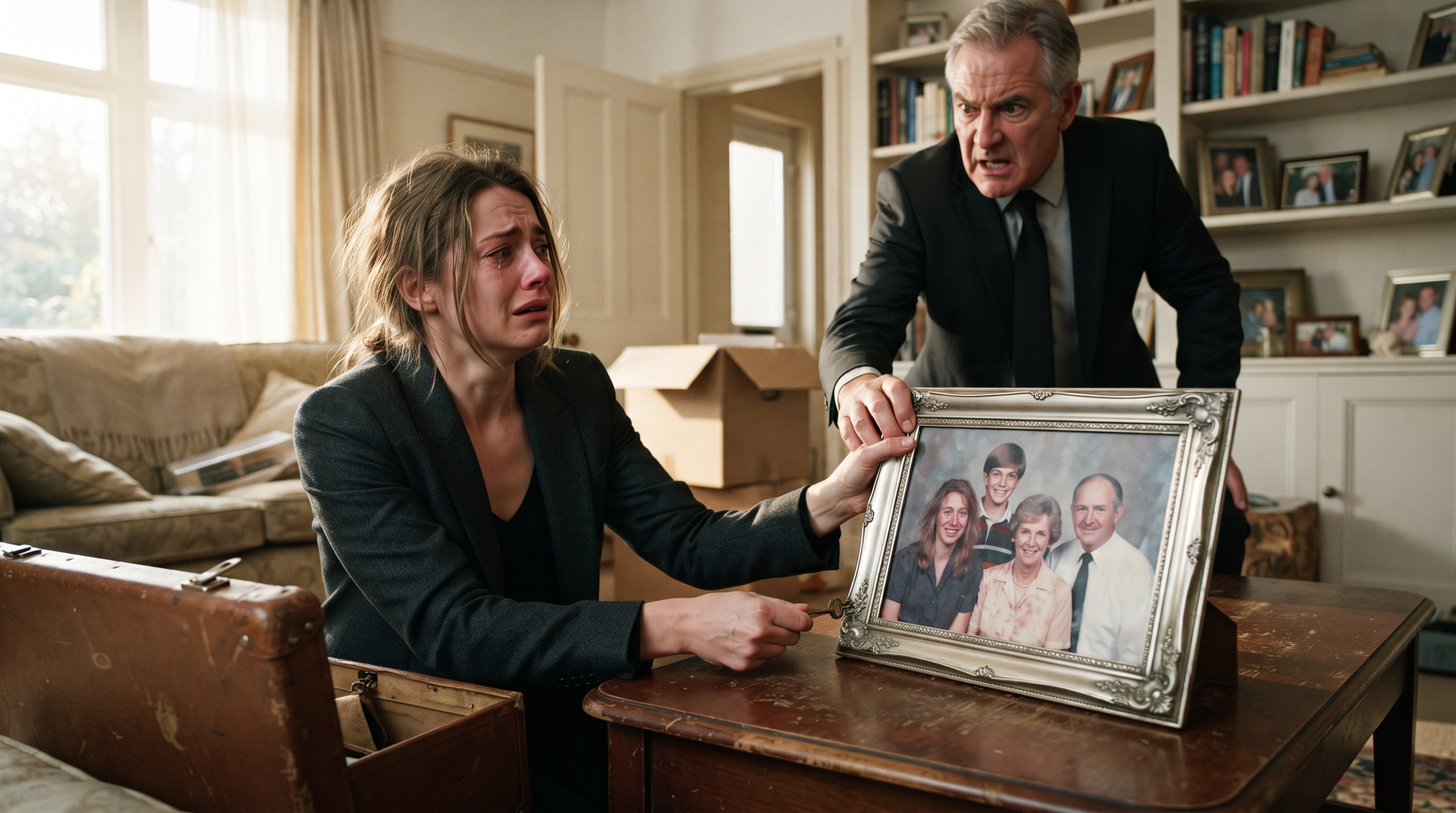
My fingers caught the lower edge of the portrait, but Arthur seized the opposite side. The wooden frame jerked between us. The glass rattled against the backing.
“Let go,” he snapped.
“You let go.”
“Clara.”
A woman near the mantel turned toward us. “Is everything all right?”
Arthur’s face changed instantly. The anger vanished behind a strained smile.
“Of course,” he said. “The frame is loose.”
I kept my grip on it.
“It’s coming with me,” I said.
“No.”
He pulled the portrait toward his chest. His knuckles pressed white against the wood.
I tugged back.
The frame slid several inches off the wall, and a small puff of dust fell onto the bookcase. My mother’s smiling face flashed between us, distorted by the glass.
Arthur’s eyes dropped to the back of the frame.
That glance told me more than his refusal had.
I released the portrait.
He stumbled half a step backward, clutching it.
The guests stared.
I forced my voice to remain steady. “Fine.”
Arthur held the picture against his chest. “Good.”
I turned away before he could see how badly my hands were shaking.
For the next hour, I stayed among the mourners and pretended to listen. I signed the memorial book. I accepted a cup of coffee I never drank. I answered the same questions about Mother’s final days until the details blurred together.
Arthur kept the portrait within reach.
He placed it on the mantel with the front facing the room, then stood nearby whenever someone approached it. Once, when I passed through the living room, I saw him run his fingers along the frame’s lower edge.
My stomach tightened.
I needed to get the picture out of the house.
But every time I looked toward it, Arthur looked back.
The guests began leaving as the afternoon dimmed. Coats were gathered. Umbrellas opened. People hugged me and murmured condolences, their hands lingering on my shoulders as though grief might make me collapse if they let go.
Arthur was drawn into conversation near the front door by two of my mother’s former colleagues. He turned his back to the living room and began explaining something about the cemetery arrangements.
I watched the angle of his shoulders.
Then I looked at the portrait.
The room had thinned. Beatrice was still nowhere in sight. The kitchen door swung gently on its hinges, and somewhere outside, a car started, then faded down the road.
I moved toward the mantel.
One step.
Arthur continued talking.
A second.
The blue suitcase waited behind the folding tables beneath the stairs.
I reached for the portrait.
The frame came free without resistance.
I tucked it against my chest, turning the glass toward my coat so the faces would not catch the light. My heart was beating so hard I was certain Arthur would hear it.
At the edge of the living room, I paused.
He was still speaking to the guests.
I walked through the side hallway instead of the front room, keeping close to the wall. The portrait dug into my ribs. Dust brushed my sleeve. I slipped into the study, retrieved the blue suitcase, and carried both objects through the back door.
Cold rain struck my face.
For several seconds, I stood beneath the narrow overhang, unable to move. Behind me, voices drifted through the house. In front of me, my car waited beside the wet hedge.
I ran.
The suitcase banged against my knee as I crossed the yard. I opened the trunk, placed the portrait flat beneath an old blanket, and set the blue suitcase on top of it. Then I slammed the trunk shut.
“Clara!”
Arthur’s voice cracked across the rain.
I turned.
He stood in the open back door, one hand braced against the frame. The rain darkened the shoulders of his suit.
For one suspended moment, we stared at each other across the yard.
His eyes moved to the trunk.
I felt the truth of Beatrice’s warning settle into place—not as an explanation, but as a certainty.
Arthur knew I had taken the photograph.
I got into the car and locked the doors before he reached the steps.
He came down the porch, shouting something I could not hear through the rain and the glass. His hand struck the driver’s-side window once.
I started the engine.
He struck it again.
I backed out of the driveway, tires slipping on the wet pavement, and did not look toward the house until I reached the road.
Arthur remained on the porch.
The memorial lights glowed behind him. Above his shoulder, through the open doorway, I could see the empty space where the portrait had hung.
I drove three blocks before I realized I was holding my breath.
The rain blurred the house in my rearview mirror, turning its windows into pale, trembling squares. Arthur’s figure disappeared behind the bend, but I could still feel the impact of his hand against my window.
I kept both hands on the steering wheel.
The portrait lay beneath the blanket in the trunk. The suitcase rested on top of it, blue metal corners pressing into the photograph that had hung over our mantel for more than two decades.
I had taken them from my mother’s house.
Not borrowed. Not rescued.
Taken.
The thought made my stomach tighten, but another thought came harder behind it.
If they were harmless, Arthur would not have tried to stop me.
I drove to my apartment instead of the motel where I had planned to stay after the memorial. My hands were shaking by the time I parked beneath the weak yellow light beside the building. I sat there with the engine off, listening to rain tick across the roof.
Then my phone began to ring.
Arthur.
His name filled the screen.
I let it ring until the call ended. Before I could put the phone down, another call came through.
I turned the phone facedown.
The third call was followed by a message.
Call me immediately. You have no right to remove anything from the house.
I read it twice.
The words should have made me feel guilty. Instead, they made something inside me go still.
I got out of the car and opened the trunk.
The portrait’s glass reflected the parking-lot light. My mother stood in the center of the image, squinting into the sun with her arm around my shoulders. I stood beside her, missing one front tooth. Arthur and Beatrice stood behind us, with my father’s hand resting on my other shoulder.
I had always remembered that hand as protective.
Now, looking at the photograph, I noticed how tightly his fingers curved.
I carried the portrait and suitcase upstairs.
My apartment smelled faintly of coffee and dust. I put the suitcase on the kitchen floor and leaned the portrait against the wall, glass turned toward me. For several minutes, I stood between them, unable to decide which one frightened me more.
The portrait had given me the suitcase.
The suitcase had been locked for a reason.
I took a kitchen knife from the drawer and set it beside the frame.
The backing was brown cardboard, held in place by small metal tabs. I had dismantled frames before, but never with my pulse beating in my throat. I slid the knife beneath the first tab and lifted.
The metal squealed.
I froze.
Rain tapped the windows. A car passed below. Somewhere in the building, pipes groaned.
No one came.
I bent the tab back and moved to the next one. The cardboard loosened gradually, revealing a layer of gray paper beneath it. The photograph had been sealed against the backboard with strips of brittle tape.
I peeled one corner away.
The smell of old paper rose from the frame.
My mother had kept recipes in this frame once. I remembered watching her slide them behind photographs whenever she needed both hands to knead dough. She had told me that important things belonged close to the people who mattered.
I pulled the backing free.
Something small and hard struck the floor.
It made a bright, delicate sound against the tile.
I dropped to my knees.
A brass key lay beneath the table, no longer than my smallest finger. A strip of yellowed tape clung to its stem. When I picked it up, the tape left a sticky residue on my thumb.
For a moment, I could only stare at it.
Beatrice had not been speaking in riddles to frighten me. She had known exactly where the key was.
I turned the portrait over.
On the reverse of the cardboard, beneath the place where the key had been taped, my mother had written one word in blue ink.
Blue.
The word was faded, but unmistakable.
I looked at the suitcase.
Its paint was the same deep blue as the ink.
My mouth went dry.
I carried the key to the kitchen and placed it in the lock. The suitcase had two latches, both rusted at the hinges. The key fit the left one perfectly.
I did not turn it.
Not yet.
Arthur called again.
I watched his name pulse across the screen while the key rested between my fingers.
Then I turned the lock.
The latch sprang open.
The sound was quiet, but it seemed to divide my life into two clean parts.
Before.
And after.
I opened the second latch by hand.
Inside, beneath a folded wool blanket, were neat stacks of paper tied with cotton ribbon. The top bundle held bank statements. The envelopes were yellowed and softened at the corners, but the names and account numbers remained legible.
Evelyn Hart.
My mother’s name appeared on every page.
I reached for the first stack and saw dates from years before her illness had begun. Deposits. Withdrawals. Transfers between accounts I did not recognize.
My eyes moved over the figures without understanding them.
Then I saw the diary.
It lay beneath the papers, covered in dark green cloth. The corners were worn white, and the elastic band around it had gone slack with age. My mother’s handwriting was visible on the first page through the gap.
I knew that handwriting better than I knew my own.
I had seen it on school lunch notes, permission slips, birthday cards, and the grocery list she left beside the telephone.
My fingers touched the cover.
I almost closed the suitcase.
The reasonable part of me said I should call Beatrice. It said I should take everything to a lawyer, or the police, or anyone who knew what to do with documents that looked like they belonged in a courtroom.
But the unreasonable part—the part that had watched Arthur hit my car window—wanted to hear my mother’s voice, even if the only place I could find it was on paper.
I opened the diary.
The first pages were ordinary. My mother had written about weather, appointments, and the roses she was trying to keep alive along the side fence.
One entry described the morning I left for college.
Clara left for orientation today. She pretended not to be afraid. I pretended not to be afraid for her. The account is ready. Every semester is covered. She will never have to choose between the education she wants and the life her father thinks she should accept.
I swallowed.
I remembered that morning. Arthur had driven us to the train station because my mother had been working. He had complained about the tuition before I boarded.
Too expensive.
Too far away.
A waste if I changed my mind.
I had believed he was worried about me. I had believed the arguments were about distance and responsibility.
I turned the page.
The next entry was dated two months later.
Arthur says the bank made an error. He says the college account was moved temporarily because he knows how to manage investments better than I do. I asked to see the statements. He became angry and told me I was accusing him of stealing from our daughter.
My fingers tightened around the page.
The apartment seemed to contract around me.
I read the entry again, slower this time. Then I reached for the bank statements and spread them across the floor.
The account my mother had mentioned was listed on one of the pages. I recognized my name beneath hers.
There had been a balance large enough to cover four years of tuition, housing, books, and the expenses my mother had always insisted I would need.
The balance was gone.
Not reduced.
Gone.
The statement showed a series of withdrawals beginning the month after I left for school. Each one had been made by Arthur.
I pressed my palm against my mouth.
My first year of college, I had worked nights at a diner because my financial aid had not covered everything. I had told my mother not to worry. I had told her I was learning independence.
Arthur had known there was money.
He had watched me take out loans.
He had watched me bring home secondhand textbooks and count coins beside the washing machine.
The diary continued.
I asked him again about the account. He said Clara had not earned the money and that giving it to her would make her careless. He says I am emotional because of the diagnosis. He says I am turning against him.
The word diagnosis stopped me.
I looked at the date.
My mother had not been receiving treatment then. Not the treatments Arthur had always described as consuming every spare dollar. She had not even told me she was seriously ill.
I kept reading.
He transferred the remaining amount this morning. He did not ask me. He did not tell me. He signed my name where the bank required it.
The page blurred.
I set the diary down and stood too quickly. A wave of dizziness sent me against the counter.
Arthur had taken my college fund.
The fact settled into the room with a weight I could feel in my bones.
For years, I had blamed myself for the loans. I had believed I had been immature, unprepared, and too proud to ask for help. I had believed my parents had done what they could.
My mother had tried.
Arthur had taken it.
I walked to the sink and ran cold water over my hands. The brass key remained on the counter behind me, catching the light whenever I moved.
My phone began ringing again.
This time, I answered.
I did not say hello.
Arthur spoke first. His voice was rough with anger. “Where is the portrait?”
“Why do you care?”
“I asked you a question.”
“You already know where it is.”
There was a pause. I could hear voices in the background on his end, and the faint clink of dishes. He was still at the house.
“Bring it back,” he said. “And the suitcase.”
“You tried to stop me from taking it.”
“I tried to stop you from making a scene at your mother’s memorial.”
“You put your hand on my car.”
“I touched the window.”
“You hit it.”
Arthur exhaled sharply. “You’re upset. I understand that. But you have no idea what you’re doing.”
I looked down at the diary lying open on the floor.
“I know you took my college money.”
Silence.
It was not the shocked silence of someone hearing a false accusation. It was the silence of someone searching for the safest answer.
When he spoke again, his voice had changed.
“Where did you get that?”
My knees weakened.
The answer was there before he said anything else.
“You knew,” I whispered.
“Clara, listen to me.”
“You knew what was in the account.”
“Your mother was sick.”
“The money was for my education.”
“Your mother was sick,” he repeated, louder. “Do you think treatments are free? Do you think I could just let her go without care because you wanted to live in a dormitory?”
I looked at the bank statements scattered across the kitchen floor.
The withdrawals had begun years before the treatments I remembered.
“You said the money was gone because the bank made a mistake.”
“I said many things because you were a child.”
“I was nineteen.”
“You were nineteen and selfish.”
The insult landed with the force of something familiar. Arthur had used versions of it my entire life. Selfish when I chose a school he disliked. Selfish when I moved away. Selfish when I asked my mother to come visit me without him.
My grip tightened around the phone.
“Did you take it?”
“Every dollar went to your mother’s medical bills.”
The answer came quickly now, practiced and complete.
I glanced back at the diary.
The pages did not move. My mother’s handwriting stayed fixed beneath the kitchen light.
He says the money went to my care. I know it did not.
I had not read that entry yet. It was below the fold of the page, hidden by the angle at which I had held the diary. I bent over it, my phone still pressed to my ear.
Arthur continued speaking.
“I paid doctors. I paid specialists. I paid for medication you never bothered to ask about. Your mother did not want you burdened with it.”
“Then why did she write that you lied?”
His breathing changed.
Only slightly.
But I heard it.
“You’re reading her private things?”
“You put me in debt.”
“I kept your mother alive.”
“You stole from me.”
“I used family money for family.”
“Was it family money when you signed her name?”
The line went completely quiet.
I felt the floor beneath me.
Arthur had not heard that from me. I had not mentioned a signature. I had only read it in the diary.
His silence answered before his words could.
Then he said, “You need to stop this.”
“Did you sign her name?”
“Your mother gave me permission to handle everything.”
“That isn’t what she wrote.”
“Your mother was confused.”
“She wrote the dates.”
“She was sick.”
“She wrote that you stole the money.”
His voice hardened. “You will bring the suitcase back tonight.”
“No.”
“Clara.”
“No.”
I ended the call.
For several seconds, I stood with the phone in my hand and listened to the dead line.
Then a message appeared.
You are making a terrible mistake.
Another followed before I could put the phone down.
That house belongs to your father now. Do not force me to protect it from you.
I read the second message until the words lost their shape.
The house.
This was not only about my college fund. Arthur had been pushing me to sign over my half of the house at the memorial. He had told me it was paperwork, an ordinary transfer, a way to simplify things after my mother’s death.
I had nearly signed.
A cold pressure gathered beneath my ribs.
I returned to the diary.
The entries grew shorter after that. My mother’s handwriting became smaller and more crowded, as if she had been trying to fit too much truth into too little space.
Arthur emptied the account. He says Clara will never know.
A later entry read:
He has begun asking about the deed.
I stopped breathing.
My eyes moved to the next line.
If he takes the house, she will have nothing left that is hers.
The phone rang again.
I did not answer it.
The diary rested in my lap. Outside, the rain had slowed to a thin, steady whisper against the window. On the wall, the portrait leaned beneath the light, its glass cracked from where I had pried at the frame.
My mother’s face stared back at me.
I had spent years believing she had failed to protect me because she had been too weak, too ill, or too frightened of Arthur.
Now I understood that she had been leaving a trail.
The key.
The suitcase.
The diary.
Each one had survived because she expected me to need them after she was gone.
I touched the page with the tip of my finger.
At the bottom, beneath the sentence about the deed, my mother had written one final line in darker ink.
I have found someone who can prove it.
I leaned closer.
The rest of the sentence continued onto the next page.
Before I could turn it, headlights swept across my ceiling.
A car had pulled into the lot below.
I went to the window, keeping my body out of the light.
The car stopped beneath the entrance.
Arthur’s car.
I watched him get out.
He stood in the rain and looked up at my apartment building, one hand gripping his phone. Even from the fourth floor, I could see the set of his shoulders.
He knew where I lived.
He had always known.
I looked back at the open suitcase, the diary, and the bank statements spread across my floor.
Then I turned off every light in the apartment.
My phone began to ring in my darkened hand.
I stared at the screen.
His name glowed against the black room.
For one wild second, I considered answering. I wanted to hear how he would explain the car beneath my window. I wanted to hear whether he would still call the money medical expenses now that I knew my mother had written the truth in her own hand.
The ringing stopped.
A second later, a message appeared.
Pick up, Clara. We need to talk.
I locked the phone and set it facedown on the floor.
My hands were shaking. I told myself it was because of the cold, though the apartment was warm. I told myself I was still grieving, still exhausted, still reacting to the shock of finding out that my father had stolen my college fund.
But the truth was sharper.
Arthur had come because he knew something else was in the suitcase.
I looked at the blue case beside me. The diary and bank statements were scattered around it, but the inside was empty now. I had wiped the bottom with my palm earlier, searching for anything I might have missed.
Nothing had been there.
I pulled the suitcase into the center of the room and examined it again.
The blue fabric was scuffed at the corners. One brass clasp hung slightly crooked. My mother had owned it for years, using it whenever she traveled to visit relatives or took me away for a weekend after one of Arthur’s worst moods. I remembered the smell of her lavender soap inside it. I remembered lying across the open case as a child while she folded sweaters around me and threatened to pack me permanently if I did not stop complaining.
Now the lining looked unnaturally smooth.
I ran my fingers along the bottom seam.
The fabric gave a little beneath my thumb.
I froze.
I pressed again, harder this time. Something beneath the lining shifted with a faint, dry scrape.
My heartbeat stumbled.
I searched for the edge and found a narrow gap near the back corner. The lining had been stitched over a second panel, one that did not belong to the original suitcase. I slid the tip of a butter knife beneath it and worked carefully along the seam.
The thread snapped.
I stopped and listened.
Rain whispered against the glass. Far below, a car door slammed.
I kept cutting.
The lining lifted in one piece, revealing a thin wooden board beneath it. The board had been fitted into the suitcase as a false bottom. There was no handle, but one corner had a shallow notch. I hooked my fingernail into it and raised the panel.
A small flash drive lay in the hollow.
Beside it was a folded envelope.
For a moment, I could not touch either one.
My mother had hidden the diary and the bank statements where I would find them. This was different. This had been concealed beneath the suitcase itself, beyond the place where ordinary searching would stop.
I reached for the envelope first.
My name was written across the front in my mother’s handwriting.
Clara. Read this only when you understand that your father is lying.
The words blurred.
I wiped my eyes with the heel of my hand and opened it.
Inside was a single sheet of paper folded twice. The paper smelled faintly of dust and the cedar chest in my mother’s bedroom. I unfolded it beneath the lamp, then remembered the headlights outside and switched the lamp off again.
I read by the light from the kitchen.
My darling Clara,
If you are reading this, then Arthur has discovered that I kept records. He will tell you the money was spent on my treatment. He will insist that I was confused, frightened, or too sick to remember what happened. Do not believe him. I checked the accounts myself.
I covered my mouth.
The sentence did not surprise me. Not anymore.
Still, seeing the words made the lie feel physical, something I could hold between my fingers.
I continued.
I knew about the college account before the doctors told me how little time I had left. I also know he has been asking questions about the deed to the house. He believes grief will make you obedient. He believes you will sign whatever he places in front of you.
My gaze moved to the locked door.
That was exactly what Arthur had expected.
I hired a private investigator named Marcus. He has been following the money and checking the documents Arthur brought to the bank. I did not tell you because I was afraid Arthur would use you to find out what I knew. Marcus has evidence that cannot be destroyed as easily as paper.
Below that was one final paragraph.
The drive contains the first part of what he found. Trust the evidence, not the voice he uses when he says he is protecting you.
There was no signature, only my mother’s name at the bottom.
Evelyn
I read the letter a second time.
Marcus.
The name settled into the room.
A private investigator. My mother had not merely suspected Arthur. She had hired someone to follow the money and examine the deed. She had been working against him while I believed she was too weak to stand up from her bed.
A vibration rattled across the floor.
I flinched so hard that I nearly dropped the letter.
Arthur was calling again.
I watched his name appear on the screen. Then the call ended. Another message came through.
Open the door.
I looked toward the apartment entrance.
He was no longer only beneath my window.
I picked up the flash drive.
My laptop sat on the desk near the kitchen. I carried it there, keeping the curtains closed, and inserted the drive into the side port. A folder appeared on the screen with one audio file inside.
There was no label except a date.
I clicked it.
At first, all I heard was static. A chair scraped against a hard floor. Someone coughed in the distance.
Then a man spoke.
Arthur.
His voice sounded lower than it did at home, stripped of the warm, patient tone he used whenever he wanted to make me doubt myself.
“I told you, the mortgage was necessary,” he said.
Another man answered. His voice was muffled and cautious. I could not make out every word, but I heard enough to understand that he was a loan officer asking about the paperwork.
Arthur exhaled sharply.
“The house had equity. Evelyn was sick. I needed the loan approved before the hospital bills buried us.”
The audio crackled.
I leaned toward the laptop.
The loan officer asked something. The words were unclear, but Arthur’s answer came through.
“She would never have agreed to it.”
My fingers tightened around the edge of the desk.
Arthur continued, “That is why I signed for her.”
The room seemed to contract around me.
I stopped the recording.
For several seconds, I heard only my own breathing.
Then I played it again.
The same chair scraped. The same cough sounded in the distance. Arthur’s voice came through the speakers, impatient and certain.
“She was in treatment. She couldn’t even hold a pen some days. The bank wanted her signature, so I gave them one.”
The loan officer said something about authorization.
Arthur laughed once.
“Her name is on the account. Her name is on the deed. Who do you think they’re going to believe?”
I pressed pause.
My hand had gone numb.
The forged signature was not an implication. It was not a suspicion my mother had left me to decode. Arthur had said it himself. He had admitted that he signed Evelyn’s name so he could borrow against the house.
I looked at the portrait leaning against the wall.
The glass caught the faint light from the laptop. My mother’s painted smile remained calm and distant, but I could no longer see it as weakness. She had hidden the key in the one picture Arthur could not bear to let me take. She had placed the diary where I would find the financial trail. Then she had hidden the recording beneath the suitcase.
She had known he would come for it.
A hard knock struck the apartment door.
I closed the laptop.
Another knock followed, louder.
“Clara,” Arthur called from the hallway.
His voice was calm.
That frightened me more than shouting would have.
I pulled the flash drive from the laptop and closed my fist around it. The letter went into the diary. I shoved both into the blue suitcase, then carried the case to the bedroom and pushed it beneath the bed.
The pounding began again.
“Clara, open the door.”
I stood in the middle of the apartment, unable to move.
He knew I was home. He had seen the lights go out. He had watched me refuse his calls. The peephole was only a few steps away, but I did not want to look through it. Seeing his face would give him something from me, even if it was only the knowledge that he had made me afraid.
His fist struck the door.
“Return your mother’s suitcase.”
The words traveled through the wood.
I looked at the locked suitcase beneath the bed.
He knew.
My mouth went dry.
Arthur hit the door again, hard enough to rattle the chain.
“You have no right to keep it,” he shouted. “That belongs to me.”
I moved silently to the entryway and stood several feet from the door.
The hallway light showed beneath it in a thin yellow line.
I could see the shadow of his shoes.
“Clara,” he said, lowering his voice. “I know you’re there.”
I held my breath.
The shadow shifted closer.
“Open this door and give me the case,” he said. “We can still handle this as a family.”
I looked toward the bedroom, where the evidence waited under the bed.
Then I looked back at the door.
For the first time in my life, I understood that keeping quiet would not protect me. It had protected him. Every time I accepted his explanation, every time I signed without reading, every time I let him turn my mother’s fear into proof that she was unreliable, I had helped him build the wall around me.
Arthur knocked once more.
“Clara, return Evelyn’s suitcase.”
“Clara, return Evelyn’s suitcase.”
I kept my hand on the wall beside the door and forced myself to breathe.
“No,” I said.
The hallway went quiet.
It was the first time I had refused him without softening the word afterward. No explanation. No apology. No promise to discuss it later.
Arthur’s shadow shifted beneath the door.
“You don’t understand what you’re doing,” he said.
“I understand that you came to my apartment demanding something that belongs to me.”
“It belongs to the estate.”
“It belonged to Mom.”
“And I am her husband.”
His voice had regained its old shape—the measured patience he used when he wanted me to feel childish for resisting him.
I looked at the chain across the door. It was thin, decorative, and useless against anyone determined to come inside. Still, it marked a boundary. I had put it there. I had locked it.
“Leave,” I said.
Arthur let out a short, humorless breath.
“If you don’t open this door, I’ll call the police.”
I said nothing.
“I’ll tell them you stole property from your mother’s home.”
My fingers tightened against the wall.
“You gave me the suitcase,” I said.
“I did no such thing.”
“You saw Beatrice hand it to me.”
“Beatrice is confused. She has been confused for years.”
The lie landed with such ease that it almost made me laugh. He had used that explanation for my mother. He had used it for Beatrice. He had used it for anyone whose memory threatened him.
Arthur struck the door with the flat of his hand.
“Open it, Clara.”
“No.”
“Then I’ll sue you for theft.”
The words pushed through the door and settled in the apartment around me.
I glanced toward the bedroom. The blue suitcase was hidden beneath the bed, but I could suddenly picture every object inside it: the diary with my mother’s narrow handwriting, the bank statements showing withdrawals from the college account, the letter that named Marcus, and the flash drive containing Arthur’s voice.
I had spent years believing that evidence belonged to people with authority. Lawyers. Judges. Accountants. Men who spoke in rooms where I was expected to sit quietly.
But the truth was in my apartment.
It was under my bed.
And Arthur was afraid of it.
“You can call whoever you want,” I said. “I’m not opening the door.”
For several seconds, he did not answer.
Then he said, “You think your mother loved you enough to protect you from reality?”
My throat closed.
“She left you nothing but debts and a house you can’t afford. I was the one who kept this family together.”
“You stole my college fund.”
His silence came so quickly that I knew he had heard me.
I had not planned to say it. The accusation had risen from somewhere deeper than fear.
“You stole money meant for my education,” I continued. “Then you told me there had never been enough.”
“That money paid for your mother’s treatment.”
“Her diary says otherwise.”
Another silence.
This one was heavier.
“You went through her private things,” he said at last.
“She left them for me.”
“She was sick.”
“She was afraid of you.”
The shadow beneath the door jerked backward.
For one brief second, I imagined him opening the door himself, breaking the chain, forcing his way into the apartment as he had forced his way into every decision my mother and I had ever made.
Instead, he lowered his voice.
“Clara, you are grieving. You don’t know what you’re saying.”
“I know exactly what I’m saying.”
“You need to give me the suitcase.”
“No.”
“You’ll regret this.”
“I already regret trusting you.”
His shoes moved away from the door. I heard the elevator bell, then the slow retreat of his steps.
I remained where I was until the hallway fell silent.
Only then did I let my knees weaken.
I sat on the floor with my back against the wall, staring at the lock. My body shook, but beneath the fear was something harder and steadier. Arthur had threatened me because he was cornered. He had called the suitcase stolen because he could not call it evidence.
I took out my phone and searched the letter again.
Marcus’s number was written below my mother’s final paragraph.
I had avoided calling him because I was afraid of what he might confirm. Now I was more afraid of what would happen if I waited.
He answered after the second ring.
“Marcus?” I asked.
“Yes.”
“My name is Clara. Evelyn was my mother.”
There was a pause on the line.
“I know,” he said.
The answer made my stomach tighten. “You know?”
“She told me to expect you if Arthur tried to take the house.”
I closed my eyes.
“Then you know about the suitcase?”
“I know that Evelyn prepared one. I don’t know what you found inside it.”
“I found her diary. Bank statements. A letter. And a recording of Arthur admitting he forged her signature on a mortgage.”
Marcus did not react with surprise. His breathing remained even.
“Do you still have the recording?”
“Yes.”
“Do you have a safe place to keep it?”
“I have copies.”
“Good. Don’t send them to anyone yet. Can you meet me tomorrow morning?”
I looked at the blue suitcase beneath the bed.
“Yes.”
“Bring the diary, the financial documents, and the flash drive. Leave the original recording untouched if you can.”
“I already listened to it.”
“That’s fine. Bring the device.”
“What can you tell me about the mortgage?”
“Not over the phone.”
His caution unsettled me, but it also gave the situation a shape. This was no longer only a family argument. There were documents, signatures, records, and consequences beyond the apartment door.
“Where should I meet you?” I asked.
He gave me the address of a small office above a row of closed shops. I wrote it on the back of an envelope, then repeated it to make sure I had not misunderstood.
Before we ended the call, I asked, “Did my mother know he would come after me?”
“She believed he would try to control the estate before anyone examined the paperwork,” Marcus said. “She was right.”
The next morning, I carried the blue suitcase into his office with both hands.
Marcus was older than I had expected, though not old. His gray hair was cut close to his head, and his suit jacket had been repaired at one elbow. He stood when I entered and looked at the suitcase before he looked at me.
“You look like Evelyn,” he said.
I had heard that all my life, but from him it felt different. He had known her when she was making plans instead of lying in a hospital bed.
“Did she hire you to investigate Arthur?” I asked.
He nodded and closed the office door.
“She came to me after she found a notice from a lender. The notice referred to a mortgage she said she had never signed.”
I set the suitcase on a chair.
“Why didn’t she confront him?”
“She did. He told her she had forgotten signing it.”
My hands went cold.
“That’s what he said when I asked about the money.”
Marcus took a folder from a locked filing cabinet and placed it on his desk.
“She didn’t believe him. She brought me copies of the notice, her bank records, and several documents Arthur had asked her to sign over the years. I started tracing the loan.”
“Did you find the original deed?”
“I found something more important.”
He opened the folder.
Inside was a document protected by a clear sleeve. The paper was yellowed at the edges, but the ink remained dark. At the top, I recognized the legal description of our family home. Beneath it were my mother’s name and the name of the previous owner.
My eyes moved to the signature.
It was my mother’s name, but it was not her handwriting.
I knew because I had seen her write grocery lists, birthday cards, and the entries in the diary. Evelyn’s signature curved upward at the end. The signature on the mortgage was stiff and compressed, as if someone had copied it from a form and practiced until it looked convincing.
“What am I looking at?” I asked.
“The original, un-forged deed to the house,” Marcus said. “Your mother retained ownership of her half. Arthur never had the authority to mortgage it.”
I stared at the page.
“But he said the house was already pledged.”
“He submitted a forged mortgage document to the lender. The lender accepted it because the paperwork appeared complete. Your mother’s signature was notarized by someone who had no valid record of witnessing it.”
“The mortgage is fraudulent.”
“Yes.”
The word settled between us.
I touched the sleeve but did not lift it.
“Why did he keep telling me to sell?”
“Because a sale would have concealed the problem. The lender would have been paid, Arthur would have taken his share, and no one would have examined how the mortgage was created.”
The pressure in my chest became almost unbearable.
He had not been trying to save the house.
He had been trying to turn it into one final payment.
Marcus opened another section of the folder.
“Evelyn asked me to preserve the evidence in case she died before the investigation was complete. She was worried Arthur would destroy anything he could find.”
“She hid the key in the portrait.”
“I told her to use something he considered sentimental. He searched drawers and cabinets. He never searched the photograph of the family.”
I thought of Arthur’s hand closing around the frame, his face changing when I said I wanted to take it home.
“The suitcase was the first trail,” I said.
Marcus nodded. “The diary established motive. The bank statements established the missing money. The recording established intent. This deed establishes that the mortgage was not merely disputed. It was built on fraud.”
I looked down at the blue case.
“She knew he would come for it.”
“She knew he would come for anything that could be used against him.”
The office seemed too small for the weight of what my mother had done. She had been ill, frightened, and running out of time. Yet she had built a path through the danger and left it where I could follow.
I took the flash drive from my bag.
“Can you use the recording?”
Marcus did not reach for it immediately.
“Did Arthur know he was being recorded?”
“I don’t know.”
“Where did it come from?”
“His conversation with a loan officer. He was discussing the signature.”
Marcus placed the drive on the desk.
“We’ll preserve it properly. But your lawyer should be the one to decide how it is introduced.”
I looked at him. “You already found me a lawyer?”
“Evelyn made arrangements.”
The words struck me so sharply that I had to sit down.
“She planned for me.”
“She planned for the possibility that you would need help.”
I wanted to be angry with her for leaving me to do this without her. Instead, I felt the old ache open beneath my ribs.
Marcus slid a card across the desk.
“Your lawyer can meet you this afternoon. If Arthur contacts you, don’t argue with him. Don’t sign anything. Keep every message.”
“He threatened to sue me.”
“That means he knows you have something.”
I put the deed, the letter, and the financial records into a new folder. The suitcase remained open between us, empty except for the torn lining and the brass key.
I picked up the key.
It was so small that it could disappear beneath a fingernail.
All of this had begun with an object that fit inside my palm.
When I left Marcus’s office, I carried the original deed against my chest.
My lawyer’s office was in a stone building downtown. The waiting room smelled of paper and coffee. I sat across from a window overlooking traffic while my lawyer read the diary excerpts and reviewed the deed.
She listened to the recording twice.
The first time, Arthur’s voice filled the room.
“I signed for her because the bank wouldn’t approve it otherwise,” he said in the recording. “She would have refused, and the house was the only asset left.”
The loan officer’s voice asked, “You’re saying she authorized you?”
“I’m saying she’s my wife. I had permission.”
The recording ended with the scrape of a chair.
My lawyer removed her headphones.
“He admits signing in her place,” she said.
“He also took my college money.”
“The bank statements and diary support that. We’ll address it as part of the estate accounting.”
“Can he go to prison?”
She looked at me carefully.
“The evidence could expose him to criminal charges. But our immediate goal is to protect the house and secure your legal ownership.”
I looked at the original deed.
“I want him out of it.”
“Then we need him to surrender his claim voluntarily, with the fraud evidence held over him.”
The words made my stomach turn.
“Is that legal?”
“It is legal to offer a civil resolution instead of pursuing criminal charges. He will have the choice.”
“And if he refuses?”
“Then we file everything.”
We arranged the meeting for the following afternoon.
Arthur arrived twenty minutes late.
He wore the dark suit from my mother’s memorial, though the collar was open and his tie hung crookedly. He looked older than he had at my apartment. For the first time, I saw not the father who had filled every doorway, but a man who had run out of places to stand.
My lawyer sat beside me. Marcus sat across the table with a copy of the deed in front of him.
Arthur stopped when he saw Marcus.
“You,” he said.
Marcus did not rise.
“Mr. Vale.”
Arthur looked at me. “You hired him?”
“My mother did.”
That answer weakened him more than an accusation could have.
He took the chair opposite me and placed both hands on the table.
“Clara, this has gone far enough.”
“It went too far when you took the money.”
“I told you why I used it.”
“You lied.”
“I paid for Evelyn’s care.”
My lawyer opened the folder and turned the bank statements toward him.
“These withdrawals occurred before Evelyn’s treatment began,” she said. “They were transferred into an account controlled solely by Arthur.”
Arthur did not look at the statements.
“You’re twisting ordinary family finances into something criminal.”
Marcus placed the original deed on the table.
Arthur’s eyes went to the page.
The room changed.
He reached for it, but Marcus put one hand over the sleeve.
“Don’t touch it,” Marcus said.
Arthur stared at him.
“You have no authority over me.”
“No,” Marcus replied. “But the document belongs to Clara’s estate.”
Arthur looked at the signature. His face drained of color.
My lawyer spoke calmly.
“This is the original deed. It establishes Evelyn’s ownership interest. The mortgage submitted to the lender contains a forged signature and an invalid notarization. The recording on this flash drive captures your admission that you signed on her behalf.”
Arthur turned toward me.
“You recorded me?”
“I didn’t.”
“Then who did?”
“My mother arranged for the evidence to be preserved.”
His jaw tightened.
“She was unstable.”
“She was careful,” I said.
He leaned toward me.
“Do you have any idea what you’re doing to this family?”
I felt the familiar pull to comfort him. It was almost automatic, a reflex built from childhood. I had spent years accepting guilt whenever he made his consequences sound like my cruelty.
I held his gaze.
“You did this to the family.”
My lawyer placed a prepared agreement on the table.
“This document transfers Arthur’s remaining claim and interest in the family home to Clara. In exchange, Clara will not immediately refer the mortgage fraud evidence to the prosecutor.”
Arthur laughed once, but there was no strength in it.
“You’re blackmailing me.”
“We’re offering you a civil resolution,” my lawyer said. “You can reject it. If you do, the evidence will be submitted with the rest of the estate records.”
Arthur pushed the document away.
“You can’t force me to sign.”
“No,” I said. “But you can’t force me to protect you.”
His eyes moved from me to the flash drive.
“You would send your own father to prison?”
“You forged Mom’s signature.”
“I was trying to save the house.”
“You were trying to take it.”
He stood so abruptly that the chair struck the wall.
For a moment, I thought he would overturn the table. Marcus remained still, but his attention sharpened.
Arthur pointed at me.
“You think owning that house will make you something? Your mother filled your head with lies, and now you’re punishing me because she died.”
The words hurt. They were meant to.
I let them hurt without obeying them.
“My mother left me proof,” I said. “You left me a choice.”
His hand fell.
My lawyer pushed the agreement back toward him.
Arthur read it. The room stayed quiet except for the ticking clock above the door.
He read the transfer clause again.
“All rights to the property,” he muttered.
“Yes,” my lawyer said.
“And I walk away with nothing?”
“You retain no ownership interest in the home,” she replied. “You may avoid criminal referral if you sign and comply with the agreement.”
Arthur’s face twisted.
“You planned this before she died.”
“My mother planned for the truth to survive her.”
He looked at me then, and for a second I saw the father I had spent my life waiting for—the man who might finally understand the damage he had done.
He did not apologize.
He asked, “Do you really want me gone?”
The question was quieter than anything else he had said.
I thought of the apartment door. The threat of police. The shadow of his shoes beneath it. I thought of my mother writing in the diary while he emptied the account meant for my future.
“Yes,” I said. “I want you to leave the house. I want you to leave my finances. And I want you to leave my life.”
His mouth opened, but nothing came out.
He sat down again.
My lawyer placed a pen beside the agreement.
Arthur signed the first page with a shaking hand. Then the next. His signature grew smaller as he moved through the document, as though he were trying to shrink beneath it.
When he finished, he pushed the papers across the table.
My lawyer checked each page. Marcus examined the signatures and dates. Only after they both nodded did I let myself touch the agreement.
Arthur stood.
“Clara.”
I did not rise.
He waited for me to look at him.
I did, but I felt no obligation to fill the silence.
He picked up his coat.
“You’ll regret cutting me off.”
“I’ve regretted letting you close.”
His face hardened again.
Then he walked out.
The door shut behind him with a soft click.
No one spoke for several seconds.
I kept my hand on the signed agreement.
The house was mine.
Not because Arthur had given it to me. Not because he had finally recognized what I deserved. It was mine because my mother had protected her ownership, and because I had refused to let him bury the proof.
My lawyer gathered the documents.
“We’ll file the transfer and update the estate records,” she said. “Once that is complete, the property will be registered solely to you.”
I nodded.
Marcus lifted the blue suitcase from the floor.
“Do you want to keep this?”
I looked at the worn leather handle and the scratches along the side.
“Yes,” I said. “But not for the reason I once thought.”
He waited.
“I thought it was something dangerous she left behind. Now I think it was the first thing she gave me back.”
Marcus’s expression softened.
“She wanted you to have a future that belonged to you.”
I took the suitcase from him.
The locks had been broken open, the false bottom torn apart, and the lining still bore the marks of everything hidden beneath it. It was no longer secret. It did not need to be.
A week later, I went to the family home with the new transfer papers in my bag.
Arthur had already removed his clothes and personal belongings. He had left behind several empty shelves, a stain on the garage floor, and a row of small holes where he had taken photographs from the walls.
The rooms felt larger without him.
I walked through the kitchen first. The cabinets were the same pale wood my mother had chosen. Her chipped blue mug still sat beside the sink because I had not yet decided whether moving it would feel like losing her again.
In the living room, the space above the fireplace was empty.
I carried the nineteen ninety-eight portrait from the car and set it there.
The frame had never been properly repaired after I opened it. I had replaced the backing, but I left the brass key in a small dish beneath it instead of putting it back. The key no longer needed to hide.
I called a locksmith and waited outside while he changed every lock.
When he finished, he handed me the new keys on a metal ring.
“Make sure everyone who needs one gets a copy,” he said.
I thought of Arthur.
“No copies for him,” I replied.
He nodded and drove away.
I stood on the front step with the keys in my palm. The afternoon was clear, and sunlight lay across the windows my mother had polished every spring.
For years, I had believed home was the place where I had to keep earning my right to stay.
Now I understood that home was the place I could protect.
I went inside and locked the door behind me.
Then I carried my mother’s blue suitcase to the bedroom, placed it beneath the portrait, and set the brass key on top of it.
The last light of day touched the photograph’s glass.
My mother’s painted smile looked different there—not secretive, not frightened, but certain.
I sat on the floor beneath her face and rested my hand against the suitcase.
The house was quiet.
For the first time, the quiet did not belong to Arthur.
It belonged to me.