Saturday was ninety covers. Greens, spring onions, the pea dish people drove in from Halstead for.
I called the yard from the alley. A boy answered, said Mr. Rao was on the route, and when I gave him the address he went quiet.
“He’s not sending anything to Weller Street,” he said. “Not until it’s settled.”
At quarter past nine Theo came up the office stairs with two glasses and set one by my elbow.
“Saturday,” he said. “Ninety. This is the night this place turns into something.” He looked out the window at his own sign, lit from below. “Did you go to the bank?”
I had the statement folded in my apron pocket, against my hip, where I could feel the edge of it.
“No,” I said.
It was the first lie I ever told him, and it came easier than the truth ever had.
Sunil Rao’s yard sat behind a fence with no sign on it, off the ring road, and he was in the cold room at six with his coat still buttoned.
Onions in sacks stacked to the ceiling. Spring onions with the roots still on, which is how you know they were cut yesterday.
“You want the onions,” he said. Not a question.
“I want to know why you stopped the truck without calling me.”
“I called that office eleven times. A man answers, says he’ll see to it. Then a registered letter says the account’s with a new company and the old one’s closed. Brannigan and Company. I’ve got your father’s name in the front of my book and a letter from a company I never heard of.”
“You’d have got your money if you’d walked up the alley and knocked on my door.”
“I did knock.” He said it quietly, which was worse. “April. There was a man in a good coat at the pass who told me the rebrand would settle everything by June. He said it twice. Then he offered me a coffee.”
He pulled a book off the shelf behind the invoices, bound in green cloth, the spine taped at both ends.
Twenty-five years of Tuesdays. Date, item, weight, price, and then, in the margin, one word in pencil.
Carried.
“Since the stroke,” he said. “Your father’s stroke. The restaurant paid what it could and I carried the rest, because he asked me once and I said yes.”
I turned pages. From about eighteen months back a second hand had started in the margins, blue ink, a looping forward slant I knew from a hundred menus.
after the rebrand
after the rebrand
when the rebrand’s done
I counted thirty-one of them. Thirty-one Tuesdays where Sunil had sent food he was not paid for, and Theo had written the same promise beside the debt and gone back to designing a new logo.
“He told me June,” Sunil said. “Then September. Then he stopped writing and just let it run.”
Near the back, taped in, was a loose sheet gone the color of weak tea, in my father’s small slanted hand.
Sunil. If the roof goes, carry her. One year. I won’t forget it. D.M. 1998
The roof had gone in 1998. I was eleven.
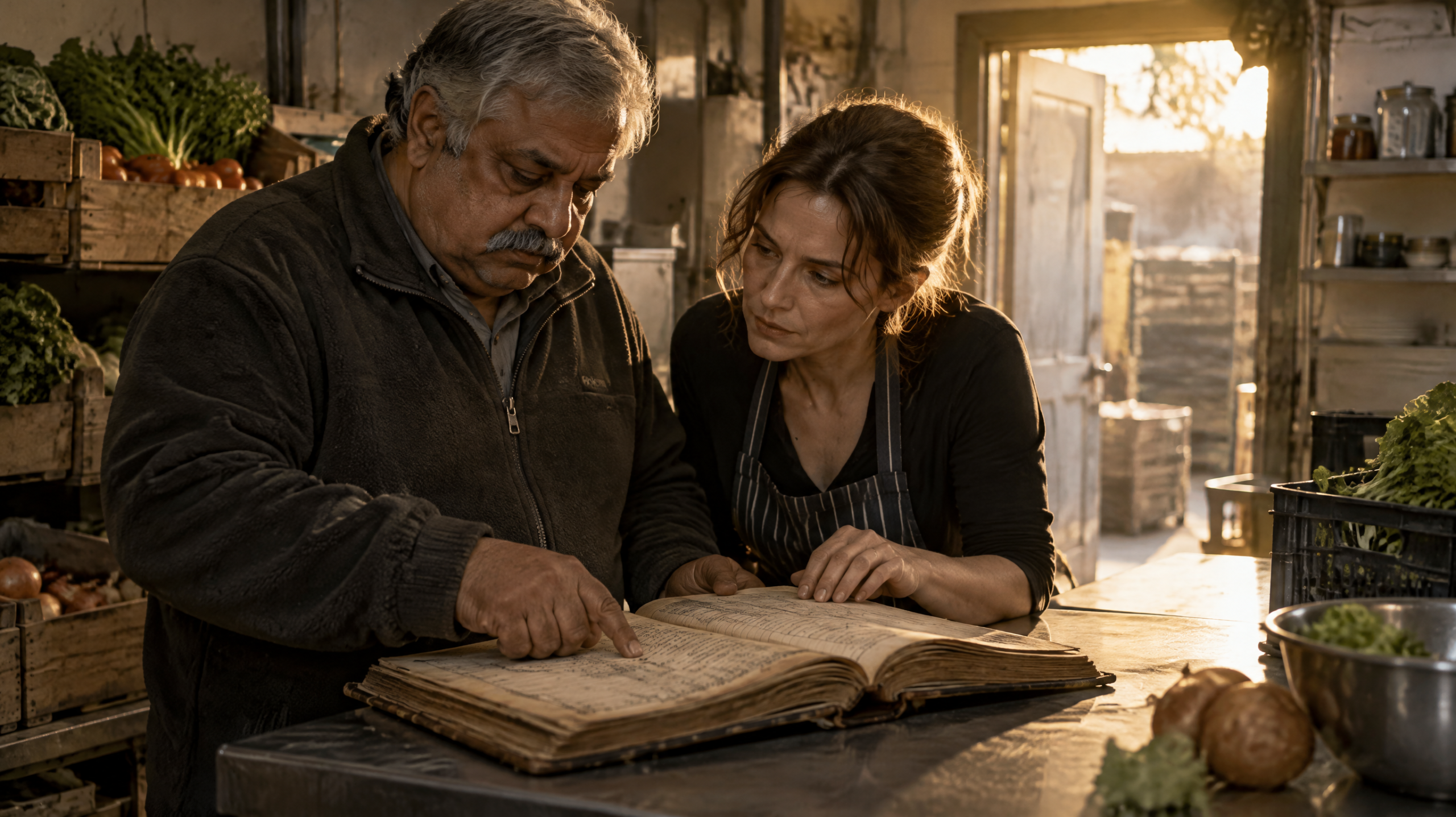
“He paid me back inside a year,” Sunil said. “Every cent, and a bottle of whiskey I never opened. Then he carried half this street through the bad winter and never told anyone. So when the invoices stopped being paid, I thought, well. The daughter doesn’t know. Somebody should tell her.”
The restaurant had not been saved by the loan, or by the rebrand, or by the man who proposed to me over a rack of short ribs. It had been saved by a man in a wet coat who had never once been invited to eat in the dining room.
He sent the onions that afternoon. Everything else came Friday, on credit, and he wrote it in the book himself while I watched. On the Friday he also gave a statement at the county, standing up in his coat.
Theo was in the office when I got back, with two pages on the desk and a pen laid across them.
“Forty thousand,” he said. “Sign the dissolution, and after Saturday we go our separate ways. You keep the flat, I keep the name, nobody’s lawyer gets rich.”
“Why Saturday?”
“Because there are ninety people coming.”
“Who notarised my signature, Theo?”
He picked up the pen and put it down. “Some woman at the county. They have a rota.”
I put the photocopy of the journal page on top of his two pages. Withdrawal of interest. 2:15 p.m. Personally known to the notary.