Joel nodded. “No explanation about you.”
“Evan,” Celia said.

“No. I’m not asking him to protect your job.” My voice sounded too loud in the corridor. I lowered it. “Stop the presentation. Without naming Mara.”
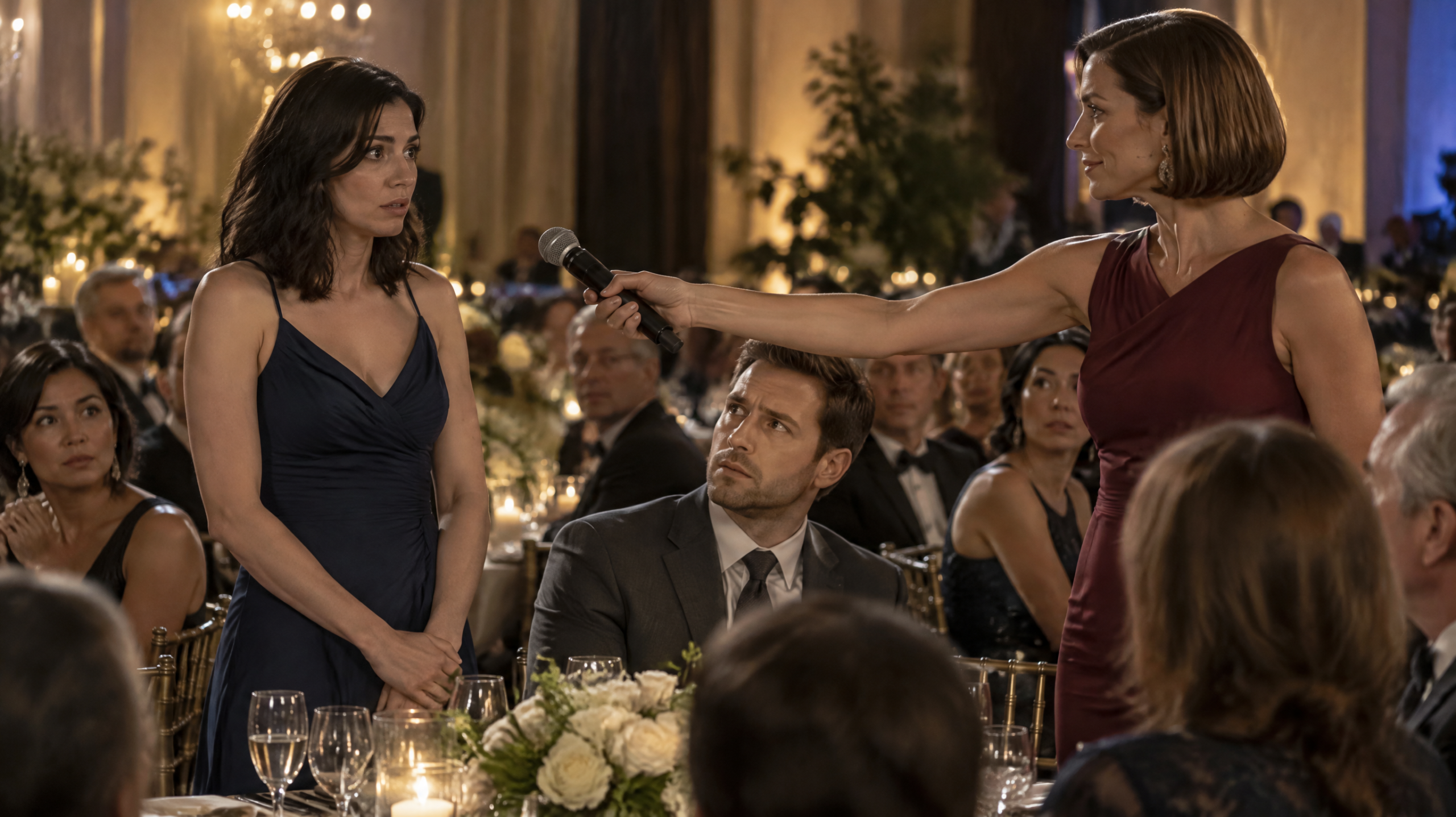
Joel opened the ballroom door and called a staff member over. He instructed her to collect the programs from every table and the entrance desk. Then he led us just inside, beside the rear doors, while he spoke to the production desk.
I could see Mara’s photograph on one of the screens. She kept her eyes on Joel.
“Remove the featured-alumna segment entirely,” he said. “Slides, introduction, broadcast files. Hold the livestream until you’ve checked the revised order.”
The photograph disappeared. Both screens changed to the charity’s plain logo.
That should have made me feel better. Instead I watched a man at the nearest table turn a page in his program. He had already seen it. There was no instruction Joel could give that would make him unread it.
A staff member approached with an empty tray and asked for my copy. I handed it over. She moved to the nearest table, collecting programs between water glasses while guests asked what was wrong. She said they were being withdrawn. Nothing about Mara.
Celia stepped toward Joel. “I can fix the running order.”
“You’re not handling it,” he said. “Your communications duties are suspended pending disciplinary review. Your access to beneficiary accounts and stories ends now.”
“You need someone who knows the files.”
“I need the files left alone.”
He used his tablet to contact the administrator, then stayed on the call while Celia’s access was disabled. I heard him confirm her name and the restrictions. Celia stood beside me, holding her staff badge between two fingers. She stopped asking me to intervene.
At the production desk, Joel checked the revised sequence. He asked for confirmation that Mara’s photographs and account were also out of the broadcast materials, not merely hidden on the room screens. I heard the answer, and then he came back to us.
“The segment is canceled. Her materials are removed. Nothing has gone out on the livestream.” He looked at Mara. “We can collect what we distributed. We can’t promise nobody photographed a page or remembers it.”
“I know,” she said.
“Can we leave?” I asked her.
“Yes.”
I didn’t look at Celia for permission.
Outside, Mara walked ahead until we reached my car. I unlocked it, but neither of us opened a door.
“I’m sorry I asked if it was nerves,” I said. “You told me no. I treated Celia’s version like it needed less proof than yours.”
Mara rubbed the place on her arm where her bag strap had pressed into it.
“You know her better,” she said.
“That wasn’t a reason.”
“No,” she said. “It wasn’t.”
I wanted her to take my hand. I kept mine at my sides.
“Thank you for apologizing,” she said eventually. “I accept it. But I’m still upset with you.”
“I know.”
She opened the passenger door herself. I took her home, as I should have offered to do when she first refused the microphone.
A month later, Mara let me read Joel’s written resolution at her kitchen table. After the disciplinary review, Celia had accepted reassignment away from beneficiary communications. Joel had also explained that change to us directly. She would no longer have access to the stories she had used to build the gala.
The letter confirmed that Mara’s segment had never aired. One paragraph was specific: No future publicity approach or use of your account will proceed without your prior written approval. Declining will not affect any relationship with the charity.
Mara kept the letter. I didn’t ask for a copy.
Celia invited me to a reconciliation dinner that same week. I declined. I told her I wasn’t ready for contact and wouldn’t discuss Mara’s childhood with her. I didn’t publish the emails or send them around our family. They were proof of what Celia had done, but they were also Mara’s correspondence. I wasn’t going to distribute another piece of her life to win an argument.
Mara and I kept seeing each other. Some evenings she was quieter than before. I stopped trying to turn those silences into questions about everything she hadn’t told me.
That Friday, we made dinner in her small kitchen. She complained about a customer who had asked for soup without onions after finishing the bowl. I burned the first piece of garlic bread while listening.
We scraped the black edge off and split it anyway. Mara pulled her chair closer to the table, tucked one foot beneath her, and passed me the serving spoon.