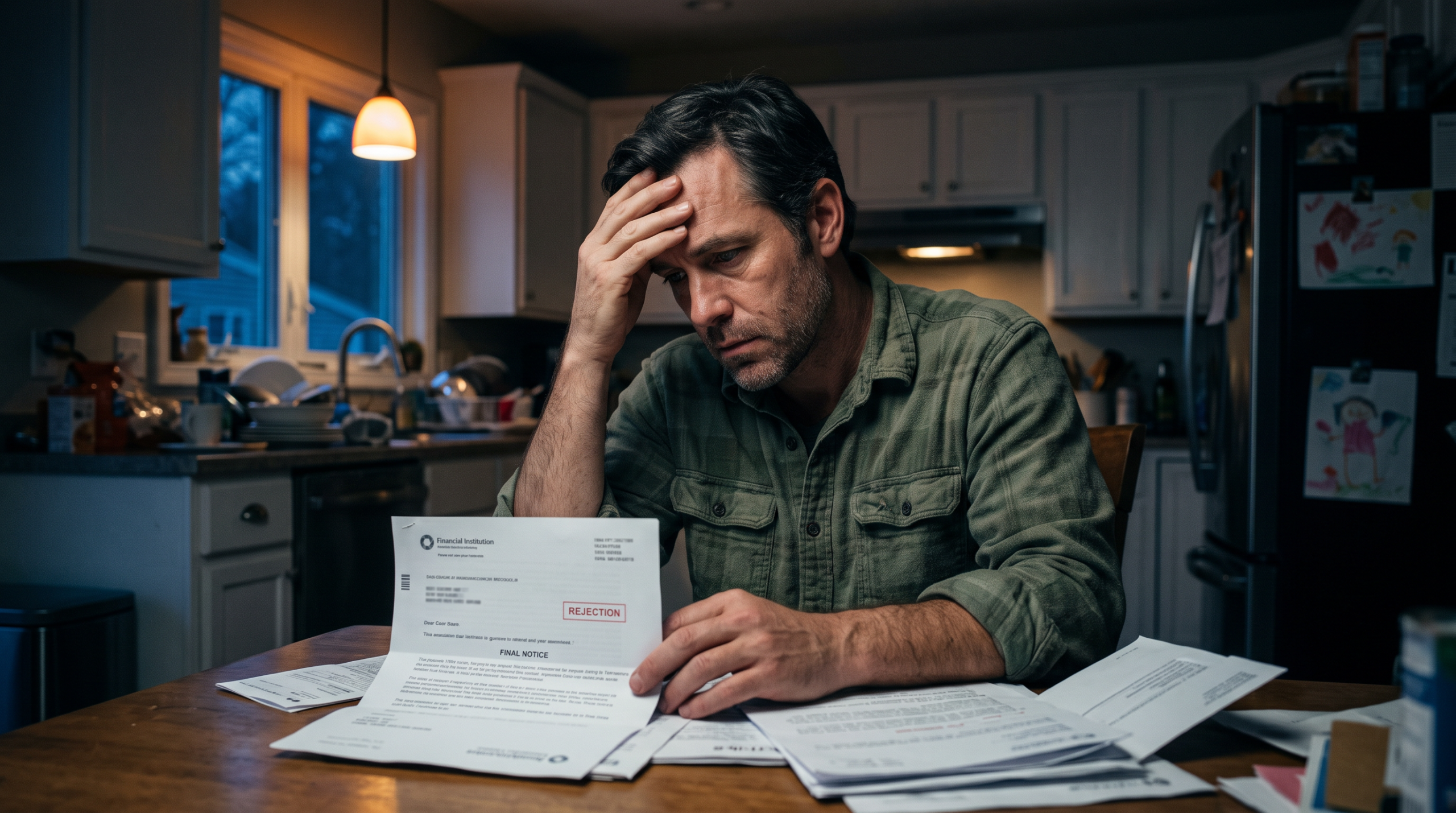
The envelope came in on a Tuesday, and I already knew what it was before I slit it open with the paring knife I keep by the register. Third notice. Red bar across the top. The kind of letter that stops being a letter and starts being a countdown. I stood there in the front of the bistro, apron still tied, the smell of last night’s garlic clinging to my sleeves, and I read the words twice even though the numbers had not changed since the second notice, and would not change now.
Ninety days. That is how far behind I was on rent. Three months of promises I had made to a landlord I had never met, a shell of a management company whose phone tree always dumped me at the same tired voicemail. Please leave your name and property address after the tone. I had left my name so many times I had begun to hate the sound of it. Julian. Julian Reyes. Julian at Fig and Ash, the bistro on Grant and Ninth, the one with the copper lamps and the tasting menu no one under forty came for anymore.
I folded the letter into the pocket of my apron and pretended I had not read it. That is a skill you learn as an owner. You fold bad news small enough that you can still smile at a four‑top when they ask what the fish is.
Marcus came in through the kitchen door with a stack of invoices under his arm and that careful look he wears when he has already added them up in his head. He is forty‑something, gray at the temples, been running my floor for six years, and he loves this place the way I love it, which is stupidly and without an exit plan.
“Wine guy is holding the order,” he said. “Says he’ll release it Thursday if we pay Monday’s balance first.”
“Tell him Monday,” I said.
“Julian.”
“Tell him Monday, Marcus.”
He set the invoices on the bar and did not push it. He knows my faces. He knows the one I was wearing.
The building had been listed for sale for almost a year. I had watched the sign go up on the lamppost, watched it fade in the sun, watched a leasing agent stop bothering to wipe the pigeon droppings off the corners of it. Nobody wanted a narrow brick two‑story with a bistro in the ground floor and two dead apartments above it. Nobody except, apparently, somebody. That morning, the sign was gone. I had walked past the empty pole on my way in and felt something in my stomach that was not hunger.
“Building sold,” Marcus said, as if he had just remembered. “Danny at the hardware store said the crew came at six to pull the sign. New title on file at the county yesterday.”
“Who,” I said.
“He didn’t know. Some LLC.”
Some LLC. Of course. In this city no one owns anything with their own name anymore. Everything is a corridor of paper leading back to a person who never has to look you in the face while they raise your rent.
I told myself it did not matter. A new landlord was still a landlord. Maybe they would want the tenant in place. Maybe they would negotiate. Maybe they would give me until spring. Maybe, maybe, maybe. I chopped shallots for two hours to shut up the maybes.
She came in at four fifteen, an hour when the room is empty and the light is honest.
I heard the door before I saw her, that soft brass chime we keep because I refuse to install a buzzer, and then I heard heels on the reclaimed oak, unhurried, and then I looked up from the pass and I forgot for a full second how to breathe.
She had not changed the way people change. She had refined. Her hair was shorter, cut at the jaw, darker than I remembered. She wore a camel coat that probably cost what I owed my fishmonger, and underneath it a slate dress that did not try to impress anyone in the room because it did not need to. She stopped between the second and third table and looked around the way a person looks at a house they used to live in.
“Julian,” she said, and my name in her mouth was twenty years old and yesterday at the same time.
“Elena,” I said, because there was nothing else to say.
I came around the pass with my hands still smelling like shallots, and I stopped with the bar between us the way a man stops with a river between himself and a fire. She smiled, but it was not the smile I remembered. That smile had been eighteen years old and full of stupid, generous plans. This one had been earned somewhere I had not been.
“You kept the copper,” she said, looking up at the lamps. “I always liked the copper.”
“You never saw the copper. I put it in six years ago.”
“I looked at pictures.”
That should have told me something, right there. That she had looked at pictures. That she had been looking. I did not hear it the way I should have. What I heard was the girl on the porch on Ridgemont Avenue in the summer after junior year, telling me she wanted to open a bakery someday with a striped awning and a dog named Butter. What I heard was myself at nineteen telling her I could not do long distance, could not do the plan she had drawn on the back of a diner napkin, could not do her. What I heard was the sound of my own voice ending something that had not deserved to end.
“What are you doing here,” I said.
She set her handbag on the bar, which was a small gesture and a large one. She sat on the stool the way a person sits when they intend to stay.
“I bought your building,” she said.
The room did a thing rooms do when the floor tilts. Marcus, from the corner by the coffee station, stopped moving. I heard the espresso hopper click and go quiet.
“You bought,” I said.
“The building. Yes. Yesterday. The paperwork closed at two.” She was watching my face the way a doctor watches a patient hear a diagnosis. Not unkind. Very awake. “I wanted to tell you myself. Before a letter arrived. I know how you feel about letters.”
I did not remember telling her how I felt about letters. Maybe I had, once, in a park, in another century. Maybe she just knew because she had always known.
“You own the building,” I said, and I heard my own voice from a long way off.
“I own the building.”
“Since yesterday.”
“Since yesterday.”
“And you’re my landlord.”
“I am your landlord.”
I put both palms flat on the bar. I could feel every knot in the wood. I had refinished this bar myself, with Marcus, on a Sunday two winters ago, and I had cursed every one of those knots. Now I was grateful for them. They were the only things holding the room down.
“Elena,” I said, and I stopped, because I did not know what came after her name.
“You’re behind on rent,” she said, gently. It was not a threat. She said it the way you tell someone their shoelace is untied. “Ninety‑one days as of this morning. The management company already forwarded me the file.”
“I’m working on it.”
“I know you are.”
“I have a plan.”
“I know you don’t.”
She smiled again, and this time there was a flicker in it of the girl on the porch, and I hated that the flicker still moved something in my chest. Twenty years is supposed to be enough time. Twenty years is supposed to file the edges off. Whoever tells you that has never had their high school girlfriend walk into their failing restaurant holding the deed to the roof over their head.
Marcus, behind me, cleared his throat and said, very carefully, “I’ll be in the back, chef,” and slipped through the kitchen door. I did not turn to watch him go. I could not take my eyes off her.
“Why,” I said. It was the only word that fit.
Elena tilted her head. She reached into her handbag and took out a slim leather folio and set it on the bar between us, unopened, like a card she was not yet ready to play.
“Have dinner with me,” she said. “Friday night. Here. After close. Just us.”
I laughed once, without meaning to. It came out ugly.
“Elena.”
“Have dinner with me,” she said again, and now the softness was gone from her voice, replaced by something level and businesslike that scared me more than anger would have. “Have dinner with me on Friday, Julian, and I will waive the ninety‑one days. All of it. Zero balance. Clean slate. We start from the new lease as if the old one never existed.”
I stared at her. I stared at the folio. I stared at the woman I had broken up with on a Tuesday in August when I was nineteen years old, who had cried on a porch on Ridgemont Avenue and then wiped her face and told me she hoped I would be happy, and who was now sitting at my bar offering to erase twenty‑seven thousand dollars of debt for the price of a plate of food across from her.
“Elena,” I said, “that is not a dinner. That is a contract.”
“Everything is a contract,” she said. “I just gave you better terms than the last one.”
I did not answer her that afternoon. I told her I needed a night. She nodded as if she had expected exactly that, gathered the unopened folio back into her handbag, and stood.
At the door, she turned.
“Regardless of Friday,” she said, “I’ll need a full property inspection of the bistro. Top to basement. My inspector will be here Thursday at nine. It’s in the transfer clause. I’m sorry, Julian. That part isn’t optional.”
The brass chime rang once behind her, and then the street took her, and I was left standing at my own bar with my apron pocket full of a red‑bar letter and my chest full of a girl I had not thought about in a decade, who had just become the most dangerous person in my life.
I did not sleep. I sat on the edge of my bed at two in the morning with the ceiling fan ticking above me and I turned the whole afternoon over in my hands like a stone I could not identify. Elena in my doorway. Elena at my bar. Elena saying *everything is a contract*, which was not a thing the girl on the porch on Ridgemont Avenue would ever have said, which was not a thing anyone I had ever known would have said, and which had come out of her mouth as smoothly as a person saying good morning.
By four I gave up. I made coffee I did not drink and I sat at the kitchen table and I read the new lease. I had signed it three weeks earlier without reading it, because the alternative was a padlock on my front door, because the transfer had been handled by a lawyer’s office in a city two states away, because the previous landlord had died and his estate had been in a hurry and I had been in a bigger one. I had signed forty‑one pages of small type on the promise that nothing material had changed.
I was three quarters of the way through when Marcus called me. It was six twelve in the morning. Marcus does not call at six twelve in the morning.
“Chef,” he said, “I’m at the restaurant. I couldn’t sleep either. I’ve been reading the lease.”
“So have I.”
“Page thirty‑four.”
I flipped. Page thirty‑four was a dense block of text under a header that read Schedule C — Tenant Obligations, Structural.
“Read it out loud to me,” Marcus said. “Slowly.”
I read. The tenant shall, upon written notice from the landlord and within thirty (30) calendar days thereof, undertake and complete all structural renovations designated by the landlord as necessary for the continued operation of the premises, including but not limited to reinforcement of load‑bearing walls, replacement of subfloor materials, installation of ventilation infrastructure, and any additional works the landlord shall in her sole discretion determine.
I stopped. My mouth had gone dry somewhere around *sole discretion*.
“Keep going,” Marcus said.
I kept going. All such works shall be contracted through vendors of the landlord’s designation. Costs shall be borne by the tenant. Failure to complete within the stated period shall constitute material default and trigger immediate termination of the tenancy without cure period.
The kitchen was very quiet. The refrigerator hummed. Somewhere out on the avenue a garbage truck was working its way down the block.
“Marcus,” I said.
“Yeah.”
“That is not a standard clause.”
“No, chef,” he said, “it is not.”
I sat with the phone against my ear and I looked at the page and I thought about Elena’s face when she said the inspection was not optional. Thursday at nine. Which was tomorrow.
“Marcus,” I said, “I need you to pull every invoice from the last two years. Every contractor. Every permit. I want to know exactly what the bones of that building look like before her inspector walks through the door.”
“Already started,” he said, and hung up.
I got to the bistro at seven. Marcus had the invoices spread across two four‑tops in accordions of paper. He had also, without asking, printed out the entire lease and highlighted three passages in yellow. He looked like a man who had eaten a bad oyster.
“There’s more,” he said. He tapped a second highlighted block, on page thirty‑seven. In the event that the tenant declines to undertake designated renovations, the landlord shall retain the exclusive right to purchase the tenant’s business operations, including goodwill, at a valuation determined by a landlord‑designated appraiser, such sale to be executed within fifteen (15) business days of tenant declination.
I read it twice. I read it three times.
“She wrote a clause,” I said, “that says if I don’t gut my own restaurant on her schedule with her contractors on my dime, she gets to buy the whole thing off me at whatever price her guy names.”
“That’s what it says.”
“Marcus.”
“I know, chef.”
I went into the walk‑in and I stood between the racks of butter and shallots for a full minute with my forehead against the cold steel of the door, because if I did not put myself somewhere cold and enclosed I was going to break something in my own dining room. Then I came out, and I washed my face at the prep sink, and I picked up my phone and I called the number on Elena’s business card.
She answered on the second ring, in the voice of a woman who had already been awake for hours.
“Julian.”
“I’m looking at Schedule C,” I said. “And I’m looking at the buyout clause on thirty‑seven. And I need you to tell me, right now, what game you are playing.”
There was a small pause on the line. Then a small laugh. Not cruel. Almost tired.
“Julian, come to my office. This is not a conversation for the phone.”
Her office was on the eighth floor of a glass tower on Commerce Street. Her name was on a brushed steel plate by the elevator: E. Vasquez Holdings, LLC. The receptionist offered me water. I did not take it. Elena kept me waiting exactly four minutes, which I suspected was calibrated, and then a door opened and she was standing there in a charcoal suit with her hair pulled back and no jewelry except a thin gold chain I did not recognize, and she said, “Come in,” as if I were a client.
I did not sit. I put the highlighted lease on her desk and I put my finger on the yellow block.
“Explain this,” I said.
Elena looked at it. Her face did not change.
“It’s boilerplate,” she said.
“It is not boilerplate.”
“Julian, in commercial real estate every landlord in this city has a structural clause. Every one. If a building fails inspection it’s my liability, and I’m not carrying the exposure on a hundred‑year‑old brick facade without recourse. That’s the whole industry.”
“And the buyout on thirty‑seven?”
“Standard cure mechanism. If a tenant refuses required work, the landlord has to have some path to recover the asset. Otherwise the property rots and the bank takes it. You want to see three other leases with the same language? I can have my paralegal print them for you before you leave.”
She said all of this without breaking eye contact. She said all of this in the reasonable, weary voice of a woman explaining tax law to a nephew. And I stood there in front of her desk and I felt the ground shift a quarter inch under my shoes, because everything she was saying sounded true. Everything she was saying sounded like the answer a real landlord would give.
And still, still, under my sternum, something was wrong. Something in the *air* was wrong. She was not looking at me the way a landlord looks at a tenant. She was looking at me the way a person watches a pot they have already put on the burner.
“Elena,” I said, quieter. “If this is about what I did to you, when I was nineteen —”
Her face closed. It was the fastest thing I had ever seen happen on a human face. One second she was patient, and the next second there was a wall.
“Julian,” she said, “I do not think about you when I am at work. Please do not flatter yourself. I bought a building. You happen to be inside it. That is the entire relationship. Now, if there is nothing else, I have a call in six minutes.”
I left. I rode down eight floors in an elevator with a stranger who smelled like expensive cologne, and by the time I hit the lobby I had a bad taste at the back of my throat and a new certainty in my chest that whatever Elena Vasquez had come back into my life for, it was not a dinner.
I did not go back to the restaurant. I went to the county assessor’s office on Fourth Street, because my cousin’s wife is a paralegal and she had told me once, over a Thanksgiving I barely remembered, that anyone can walk into that office and pull the public record on any commercial buyer in the city, and that most people never do.
The clerk was a tired woman with reading glasses on a beaded chain. I gave her Elena’s LLC name. She typed. She frowned. She typed more.
“Vasquez Holdings,” she said. “Yeah, she’s been busy.”
“Busy how?”
The clerk turned her monitor a quarter turn toward me. It was a list. A long list. Property after property, all under the same LLC, all with sale dates in the last ninety days. A warehouse in the industrial park. A strip mall out by the interchange. Two apartment buildings on the north side. A parking structure downtown. Sold. Sold. Sold. Sold. Every one of them liquidated, at what looked, even to my untrained eye, like fire‑sale prices.
Every one of them, except the building on the corner of Grant and Ninth.
Every one of them, except mine.
I stood at that counter with the fluorescent lights buzzing over my head and I looked at the screen and I understood, in a slow cold way that started at my scalp and went all the way to my heels, that Elena Vasquez had not bought my building as one property in a portfolio. She had *emptied* her portfolio to buy my building. She had sold everything else she owned in this city, at a loss, to stand at my bar and offer me dinner.
And she had told me, an hour earlier, in a charcoal suit on the eighth floor, that I did not enter her mind at work.
I was still standing at the counter when my phone buzzed in my pocket. It was a text. It was from a number I had saved that morning as E.
Julian. My contractor will be at the bistro at four this afternoon with the renovation contract. I need your signature on it before he leaves. This is not a request. — E.
I read the text three times on the sidewalk outside the assessor’s office, and each time the words rearranged themselves into a smaller and uglier shape. *I need your signature on it before he leaves.* *This is not a request.* The woman who had spent a fortune to sit across from me at my own bar had, in the span of four hours, stopped pretending she was asking.
I did not answer her. I put the phone back in my pocket and I walked the fourteen blocks to the bistro because I could not stand the idea of sitting still in a cab. By the time I got there my shirt was stuck to my back and it was two forty‑seven in the afternoon and I had one hour and thirteen minutes before a stranger with a clipboard walked into my dining room and asked me to sign away something I did not yet understand.
Marcus was behind the bar, polishing a glass he had already polished. He looked up when the bell over the door rang and whatever expression I was wearing made him set the glass down very carefully.
“You look like a man who has seen a ghost,” he said.
“I have seen a spreadsheet,” I said. “It’s worse. Where are the old files?”
“Which old files.”
“All of them. The lease binders, the inspection reports, whatever the previous landlord left behind when he sold. Everything that came with this building.”
Marcus wiped his hands on the bar towel. “Basement. Back wall, past the wine racks. There’s a metal cabinet the last guy left. I have not opened it since I started.”
I went down the basement stairs two at a time. The bulb at the bottom had been dying for a month and it flickered when I pulled the string, throwing the shadows of wine bottles across the concrete floor in long lurching bars. The back wall was where he had said. A grey metal cabinet, four drawers, the kind you find in the back office of a body shop. It had a padlock on it but the hasp was loose, the screws half out of the wood behind. I put my thumb under the hasp and lifted, and the whole thing came away from the cabinet with the softness of something that had rotted years ago.
The top drawer was invoices from the nineties. The second was health department reports for a restaurant that had been in the space before mine, and before that one, going back to the seventies. The third was empty except for a dead spider and a rubber band. The fourth drawer stuck. I pulled harder. It came open with a jerk that sent me back on my heels, and inside, laid flat under a piece of butcher paper the color of an old tooth, was a bound green ledger.
It was the kind of book my grandfather used to keep. Cloth‑covered, ledger paper inside, ruled in that pale blue you only see in accountant’s offices. Someone had written on the front cover in black marker, in a hand I did not recognize, one word. Grant.
I sat down on an overturned milk crate and I opened it.
The first page was dated eleven years ago. Rent, utilities, insurance, taxes. The kind of columns any building manager keeps. But underneath the operating expenses, in a second set of columns, was a running list of deposits. Ten thousand dollars. Fifteen thousand. Eight. Twenty‑two. Each one labeled with a company name I had never heard of. Coastline Import Services LLC. Bright Meridian Consulting. Ridgefield Trade Partners. Vega Ninth Holdings.
Every entry was in the same handwriting. Every entry hit the same account. And when I flipped to the middle of the book, the pattern changed. The company names stayed. But now, on the receiving side, was a single line, over and over. Vasquez Holdings, LLC. Beneficial owner.
I did not understand it all. I understood enough.
Somebody had been running money into this building for years. Somebody had been sending payments from companies that almost certainly did not exist to a landlord who almost certainly had not asked questions. And somebody, sometime in the last ninety days, had bought the whole scheme wholesale and put her own name at the bottom of the chain.
The last entry in the book was six weeks old. It was for one hundred and forty thousand dollars. The company was Vega Ninth Holdings, which even I could hear had been named after a corner. The corner was Grant and Ninth.
I closed the ledger. My hands, I noticed, were not shaking. That was the strange part. They should have been. Instead they were very still, in the way hands go still when a body decides the situation is past trembling.
I sat in that basement with the flickering bulb over my head and I listened to the walk‑in cooler cycle on and off through the wall, and I did the arithmetic that a man does exactly once in a life. Elena had not bought my building to trap me into dinner. She had bought it because it was already the drain her money ran through, and she needed the drain to belong to her before someone else noticed the plumbing. The rent I owed her was pocket lint. The renovation contract was the point. Whatever a contractor was bringing to my door at four o’clock was not a schedule of work. It was a laundromat with a signature line.
I went back up the stairs holding the ledger against my chest like a small sick child.
Marcus was where I had left him, except he was no longer polishing. He was watching the front window and his mouth had gone a color I did not like.
“Julian,” he said.
“Sit down.”
“Julian, I —”
“Sit down, Marcus.”
He sat on a stool on the customer side of his own bar, which was a thing I had never seen him do in six years. I put the ledger on the wood between us. I opened it to the last page. I turned it so he could read it.
“Tell me,” I said, “why the account numbers in this book match the account number on the deposit slips you file every Friday.”
He looked at the page. He looked at me. He put his elbows on the bar and he put his forehead in his hands and he stayed that way for a long time.
“How much,” I said.
“Twenty,” he said, into his palms. “Twenty thousand. Up front. She came to see me three weeks before she bought the place. She said she was an old friend of yours. She said all I had to do was make sure the lease got signed without you talking to another lawyer, and make sure the renovation contract went through when she brought it in. She said you were going to lose the restaurant to the bank anyway and she was trying to save it. She said you’d thank her.”
“And you believed that.”
He looked up. His eyes were wet and he was not a man who cried easily.
“No,” he said. “I believed twenty thousand dollars. My kid starts college in the fall, Julian. I believed twenty thousand.”
I wanted, in that moment, to hit him. I wanted it in a physical, animal way that surprised me. Instead I took a very slow breath and I closed the ledger and I put my hand flat on top of it.
“What time is it,” I said.
He looked at the clock over the espresso machine. “Three forty‑one.”
“Then you have nineteen minutes to decide whether you want to be a man who took twenty thousand dollars from her, or a man who helped me stop her.”
He opened his mouth. He closed it. He was still trying to answer when the little bell over the front door rang.
Elena walked in.
She was not in a charcoal suit anymore. She was in jeans and a soft grey sweater and low boots, dressed the way a woman dresses when she wants to be remembered as a friend and not a landlord, and she was carrying a leather folio under her left arm and she was smiling the exact smile she used to smile at me in the parking lot of our high school when she had a secret she was going to make me guess.
Behind her, holding the door for a heavyset man in a fleece vest who was carrying a rolled set of blueprints, was the same driver from the black car.
“Julian,” she said, and her voice was warm, and her eyes went to the ledger under my hand and did not react at all, which told me everything I needed to know about how good she was at this. “I hope you don’t mind. We’re a little early.”
I took my hand off the ledger and slid it, casual as a menu, onto the shelf under the bar where we kept the reservation book. Marcus watched me do it. I watched him watch me. Behind Elena, the man in the fleece vest set his blueprints on table four without asking and started unrolling them across the linen, weighing the corners with the salt and pepper.
“You’re twenty minutes early,” I said.
“I couldn’t wait,” Elena said. She crossed the room the way she had crossed rooms at seventeen, like the floor had been laid down for her convenience, and she set the leather folio on the bar between us. “I brought Danny. He’s the contractor. I thought if the three of us walked the basement together it would go faster.”
“The basement,” I said.
“The load‑bearing wall,” she said. “Danny needs to see it before he can price the permit.”
Marcus said, from three feet away, in a voice I had never heard him use before, flat and empty of everything he usually carried in it, “I’ll get the key from the office.”
He went. He did not look at me on the way. I heard the office door open and I heard, under the office door opening, the click of him lifting the landline from its cradle. Elena did not hear it. She was watching my face.
“You look tired, Julian,” she said. She reached across the bar and touched two fingers to the back of my hand. Her fingers were cold. “When was the last time you slept.”
“Last night,” I said.
“Liar,” she said, and she smiled. “Sign the renovation contract and go upstairs and sleep. Danny can start Monday. By Christmas you’ll have a wine cellar. By spring you’ll have a private dining room. By this time next year you’ll wonder why you fought me.”
She opened the folio. The contract was on top, forty pages, the signature tabs pink and cheerful. Under it, I could see the corner of a cashier’s check.
“Read it to me,” I said.
“What.”
“The clause,” I said. “Page eleven. Read it out loud. I want to hear you say it.”
Her smile did not move but something behind her eyes did, a small shutter closing.
“Julian,” she said. “Don’t be dramatic. It’s four in the afternoon.”
“Read it.”
Danny, at table four, looked up from his blueprints. He had understood, before Elena had, that the temperature in the room had changed. He put his pencil down very slowly, as if a pencil making noise might set something off.
“Marcus,” Elena called, without turning her head. “Marcus, honey, bring the key. We’re going down.”
From the office there was nothing. Then the sound of the landline being set back in its cradle, gentle as a spoon on china. Then Marcus in the doorway, his face the color of the tablecloths.
“They’re on the way,” he said to me. Not to her. To me. “I told them everything. I told them about the twenty. I told them about the ledger. They said eight minutes.”
Elena went very still. It was not the stillness of a woman thinking. It was the stillness of an animal that has heard a branch break.
“Marcus,” she said, softly. “What did you do.”
“What I should have done in July,” Marcus said.
She turned to me then, and the warmth was gone out of her face the way heat goes out of a stove when you unplug it, all at once, complete.
“You have no idea,” she said, “what you’ve just done.”
“I have a very clear idea,” I said. “I have a ledger downstairs with years of shell company deposits in it. I have a lease with a renovation clause that funnels four hundred thousand dollars through a contractor you own. I have public filings that show you liquidated everything you had in the last ninety days to pull this off. And I have a manager who is going to tell the police, in his own words, how much you paid him and when.”
“Julian.” Her voice cracked on the second syllable. For half a second I saw her at seventeen again, in the parking lot, the night I told her I was going to culinary school in New York and she was not coming with me. That same crack. “Julian, listen to me. I did this for us. I did this so we could —”
“No,” I said. “You did this for you. You did this because someone somewhere is expecting four hundred thousand clean dollars to come back out of my basement in March and you don’t have another building to run it through. That’s not love, Elena. That’s an exit.”
She looked at Danny. Danny had already begun, quietly, to roll his blueprints back up.
“Danny,” she said. “We’re leaving.”
“Ma’am,” Danny said, “I’m not.”
She grabbed the folio off the bar. She did not grab the check. The check I noticed. She left the check because the check had her name on it and she was already, in her head, subtracting herself from this room.
She went for the door at a walk that wanted to be a run. She got the door open. The little bell rang. She got one boot onto the sidewalk and stopped, because a patrol car was already at the curb, and a second one was pulling in behind it, and the driver of the black car was standing very carefully with his hands where anyone could see them.
She turned around in the doorway. She looked back at me across the room, across twenty years, across the bar and the ledger and the folio in her arms.
“I would have given it back to you,” she said. “The building. After. I would have signed it over.”
“No,” I said. “You wouldn’t have.”
She didn’t argue. That was how I knew.
They came in polite. Two officers, then a woman in a navy coat who introduced herself as a detective and asked me if I was the complainant and asked Marcus if he was willing to give a statement and asked Danny if he’d stay. I gave them the ledger. I gave them the folio. I gave them the printouts of Elena’s asset sales that I had made at the assessor’s office and folded into the reservation book. The detective read the clause on page eleven while standing at my bar and she made a small sound in her throat that was almost a laugh.
“Structural renovations,” she said. “They always call it structural renovations.”
They took Elena out through the front. She did not fight them. She did not look at me again. The bell over the door rang a third time and then the street was quiet and the bistro was quiet and it was four twenty‑two in the afternoon on a Wednesday in October and my restaurant was still mine.
Marcus stood at the end of the bar with his hands hanging.
“I’ll pack my things,” he said.
“No,” I said. “You’ll finish your shift. You’ll give your statement. You’ll pay back every dollar of that twenty out of your wages over the next two years, and you will never lie to me again, and your kid will go to college. That’s the deal. Take it or leave it.”
He took a breath that seemed to use his whole body.
“I’ll take it,” he said.
The building went into receivership the following Tuesday. The bank, which three months earlier had been drafting the letter to foreclose on my lease, was suddenly a bank that owned a building with a scandal attached to it and no buyers in the queue. I went in on a Wednesday morning with the last of my savings, the small inheritance from my mother I had never touched, and a loan cosigned by two of my regulars who had eaten at my counter for eleven years, and I made an offer that was fair and not generous, and by Friday afternoon the deed to the building on the corner of Grant and Ninth was in a manila envelope on the passenger seat of my car.
I drove it home. I did not open it in the parking lot. I did not photograph it. I carried it upstairs to the apartment above the bistro and I put it in the drawer of the desk where I kept my mother’s recipe cards, and I closed the drawer, and I went downstairs.
Marcus was polishing glasses. The dining room smelled of butter and thyme. A couple I did not recognize was sitting at table four, reading the menu and holding hands across the corner of it, and the light through the front window was the low copper light of an October afternoon in a city I had lived in my whole adult life.
I picked up a clean towel. I picked up a wine glass. I stood behind my bar, in my building, and I polished the glass slowly, and I thought about a girl in a high school parking lot twenty years ago whose heart I had broken because I was seventeen and afraid, and I forgave her, and I forgave myself, and I set the glass down on the shelf where it belonged.