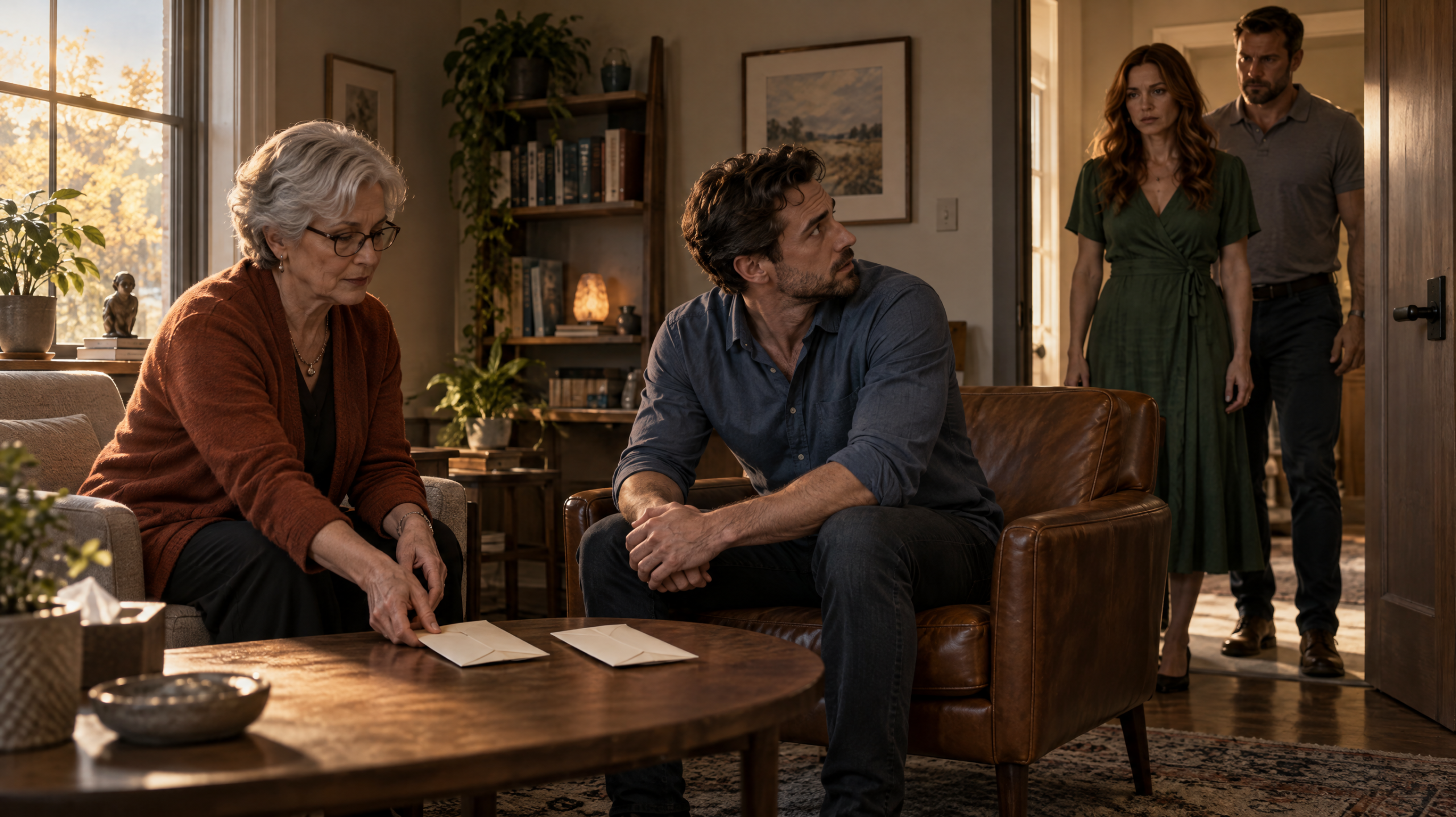
I took the second page out of my jacket. I had written it at my mother’s table on Sunday night with the good pen from the car.
“I, Owen Marchetti, will pay Carys Voss eleven thousand six hundred dollars.” I read it aloud because it was hers to hear. “Nine thousand four hundred in deposits from her savings, and the rest for rent I had no business taking out of that account. Four hundred a month until the number is gone.”
I signed it. Dr. Aline dated it, wrote her name under mine as a witness, and passed it to Carys, who held it in both hands.
“I don’t want a wedding turned into a payment plan,” she said.
“It isn’t the wedding. It’s the money.”
She folded it into her bag. “I called Renn Property Group this morning,” she said. “A woman named Petrakis in compliance has a file open and wants the work order and the building.” She looked at me. “Not because you left me. Because he used a key card to look at you and then sent me a picture, and I won’t keep that quiet because it helped me.”
“He did it to warn us.”
“Maybe. It cost him nothing until I made it cost him.”
Dr. Aline capped her pen. “Most people leave this room with one honest sentence and a bruise,” she said. “You have both been clear. This room will not keep it.”
Tobias came to Mill Street in the last week of October, standing in the lot in a coat too light for the weather.
“I’m not here to argue,” he said. “I was dismissed Friday. Access revoked, badge turned in, a note in my file.” He looked at the tire shop, not at me. “I told myself it was for her. Some of it was. Some of it was I wanted to be the man who was right.”
I wanted to be generous and couldn’t. “Good luck, Tobias,” I said, and went up, and he was still standing there when I turned the light on.
The seventh of November was a Saturday. I spent it in the studio with a broom and a bucket, and at four, the hour the barn doors would have opened, I sat on the one chair I owned and played a scale on a cornet, badly, and the sound came back off the bare wall. First note anyone ever played in that room.
Nine days later I drove to Carys’s mother’s house and told Doreen I wanted to sit down.
She did not offer me a chair. She stood at the counter with a dish towel over her shoulder and I told her all of it, number by number. The deposits were her daughter’s savings. Eleven hundred and fifty a month had come out of the account for a room above a tire shop. There was no shared bill in that wedding, and the story she had been telling her sisters for a year was a story I let her tell. That I ended it on a Tuesday and owed her four hundred a month until eleven thousand six hundred was paid.
Doreen listened with the towel in her hands. “I told ninety people it was both of you,” she said.
“I know.”
“At my sister’s in June. My neighbor asked how we were paying for the tents and I said, oh, they’re splitting it.”
She turned to the refrigerator. Under a magnet from the Outer Banks was the invitation, cream and gold, our names in raised ink. She took it down, looked at it a while, and set it on the counter between us. “Eleven thousand six hundred,” she said, like she was checking my arithmetic.
Then she filled the kettle, and when the coffee was ready she pushed a cup across to me. It was too sweet. I drank all of it, and neither of us said another word about the wedding.