“Then how do I know which of you is telling the truth?”
Ruth set the pot down. “You shouldn’t have to choose on that basis.” She sat opposite me. “I remember you being poorly. I used to enter sick children in the attendance book. Arrival and collection times, so we could account for everyone.”
“Would you have written mine down?”
“That was my routine. Ask Owen for the book, not my memory.”
She helped me describe which register to request. Before the end of the week, Owen confirmed the school still had it in the archive.
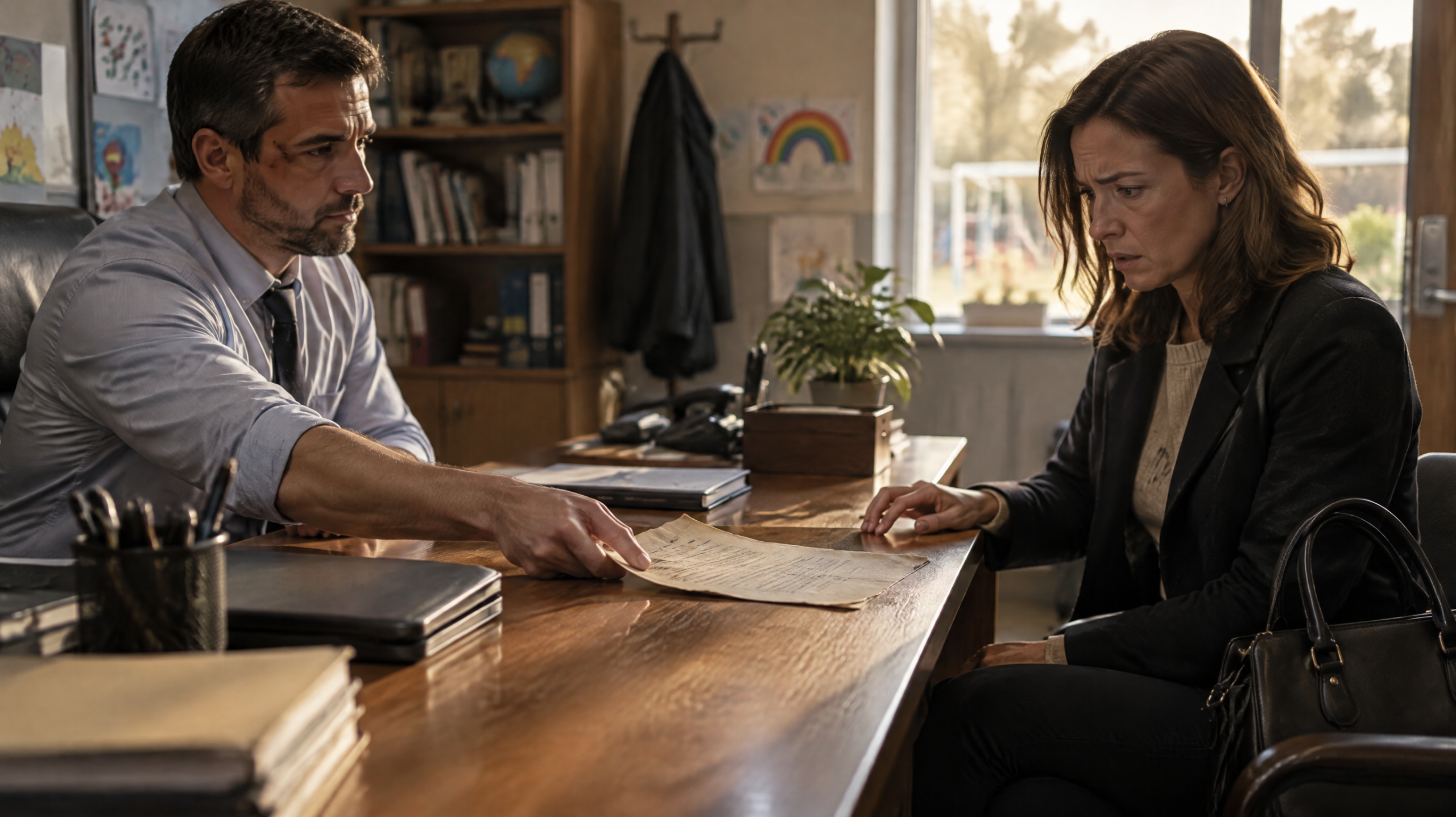
At our next appointment, he placed the book on a cleared table. Sheets of plain paper covered the other pupils’ entries. He asked me to read only my own.
I recognised Ruth’s handwriting before I finished my name.
10:05. Unwell. Remained in office until collected by mother, 10:55.
“Fifty minutes,” I said.
Owen opened the incident chronology beside it. “The packet was recorded as disappearing between ten fifteen and ten forty.”
I checked both sets of numbers again. My finger hovered over the page. I had remembered the bowl, the chair, Ruth opening a window. Nothing I had remembered had been precise enough to argue with.
“There’s another line,” Owen said.
Beneath the illness entry, in Ruth’s handwriting, was Remained with me; no corridor access.
I read it twice. Then I pulled the chair out and sat down. The woman I had been afraid to face had written down exactly where I was.
Owen moved the covering sheet a little farther down.
“Your mother signed directly underneath.”
There was Judith’s signature, the long tail on the final letter pressing into the line below. She had acknowledged the collection time beneath the sentence that said I hadn’t left Ruth’s sight.
Owen gave me an authorised copy showing only my entry. I carried it to Mother’s house flat between two pieces of cardboard, as though a crease could make it less true.
“Ruth is getting forgetful,” Mother said before I had taken my coat off.
“This isn’t her memory.”
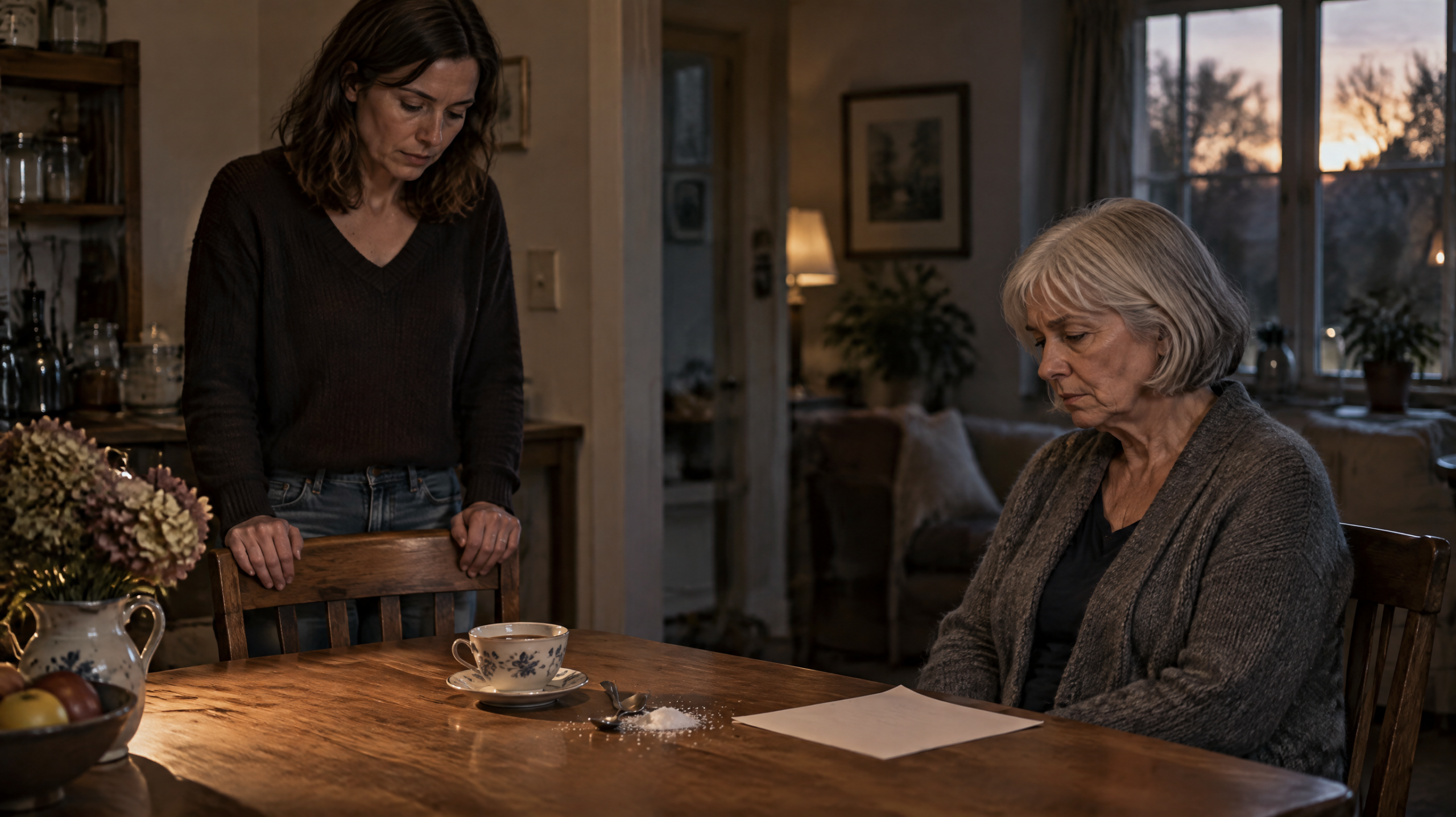
I put the copy beside her untouched tea. She read it, then pushed it back.
“People signed those things without looking.”
“Then look now.”
She kept her hands in her lap.
I had imagined that proof would make this easy. Instead, standing over her kitchen table, I wanted to accept an explanation that would let me sit down and have tea.
“Who took the packet?” I asked.
“You don’t understand the pressure there was.”
“On an eleven-year-old?”
“On me.”
She said she had taken it while sorting the office paperwork. She had meant to copy the questions and coach me at home, without telling me where they came from.
“Your marks were ordinary. You could do better. Other mothers would talk about their children, and I had nothing to say.”
I looked at the sugar grains around her teaspoon. She had wanted something to say.
“When they started asking which adults had access, I put it back,” she continued. “But they were still asking questions.”
“So you gave them me.”