
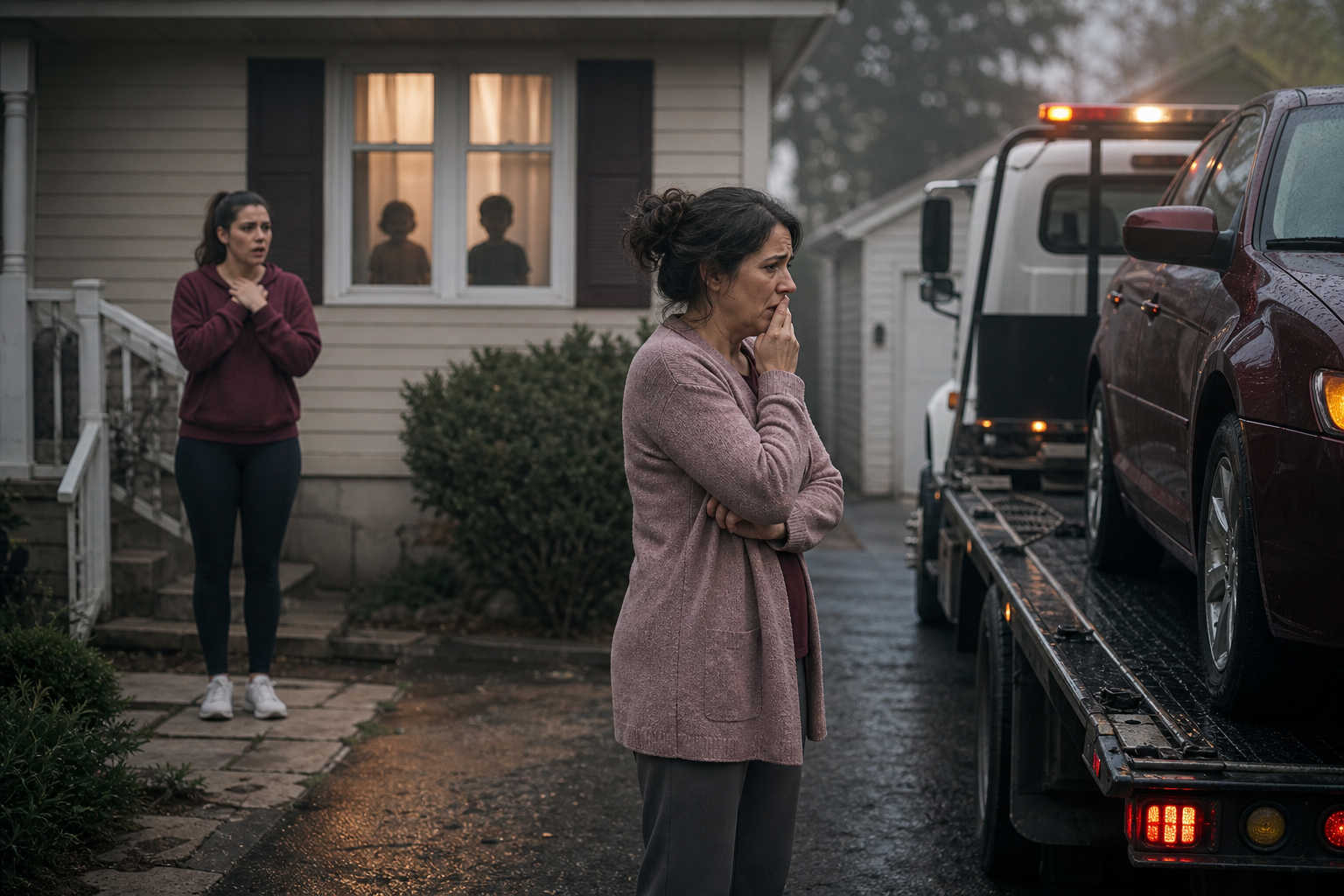
The repo man backed into my daughter’s driveway at 6:43 on a Wednesday morning, and that was how Maya learned I had lied to her again about her brother.
Her two boys were still in their pajamas, standing at the front window with cereal bowls in their hands, when the truck’s orange lights washed across the living room. I was reaching for my purse because I had promised to be gone before school drop-off. Instead, I watched a man in a gray jacket step out, check my license plate, and start lowering the ramp under the only car I had left.
“Mom,” Maya said behind me, already using the voice she saves for emergencies and broken promises. “Why is a tow truck here for your car?”
I should have told the truth right then. I should have told her that six months earlier I had signed a title loan because Luke stood in my kitchen crying and said one more missed chance would kill him. I should have told her I had been making partial payments with grocery money and prayer. I should have told her that when I kept saying he was back on his feet, what I really meant was that I was terrified of what would happen if he wasn’t.
Instead, I said the stupidest thing possible.
“It’s probably a mistake.”
Maya looked at me the same way she had looked at me three years earlier, when Luke had sworn he only needed to use her address for one piece of insurance mail and she ended up getting collection notices for a credit card she had never seen. It wasn’t anger first. It was that worse thing. Recognition.
She turned toward the stairs and told the boys to go upstairs and get dressed. The older one asked if Grandma’s car was being stolen. Maya said no too quickly, and I heard myself in her voice.
Luke is thirty-one. He was a funny, loose-limbed boy who could make a whole room laugh at eleven and talk a teacher out of keeping him after class at fourteen. At twenty-six, he hurt his back unloading tile at work. The pills came first because a doctor wrote the prescription. The lies came later because addiction likes to move into the same house and start rearranging the furniture.
By the time we understood what was happening, he had already learned how to sound sincere while asking for money.
Maya understood it before I did.
She is three years younger than her brother and somehow older in every way that matters. She is the one who keeps a real budget, shows up ten minutes early, and reads every line before she signs anything. She is also the one who had to change her front-door code after Luke let himself into her apartment and took eighty dollars from the coffee tin above her fridge. He said later he only meant to borrow it. She said if he had to steal from family to survive a weekend, then family was the exact place he didn’t belong until he got help.
I told her she was being harsh.
That was years ago, and I have been apologizing for that sentence in different ways ever since.
This spring, Luke called me from the parking lot outside a detox center forty miles away. He had checked himself in after disappearing for four days. His voice was hoarse and thin, and for once he did not sound rehearsed. He said a sober-living house had a bed open, but only if he could pay the deposit by five o’clock that afternoon.
“Mom, I know what I’ve done,” he said. “I know what I’ve cost everybody. I’m not asking you to trust me forever. I’m asking you to help me make it through this week.”
My husband had been dead for eight years by then, but I could still hear him in my head saying that sometimes people do tell the truth after they have worn theirs down to almost nothing. Luke was crying hard enough that he had to stop twice to breathe. I pictured him walking out of that center with a plastic bag of clothes and nowhere to go except the same motel where he had relapsed the last time.
I had some savings, but not enough. I had already paid for one lawyer, one emergency dentist, and two treatment intakes that had gone nowhere. What I did have was a Subaru that had been paid off for almost three years.
The woman at the title-loan office kept calling me ma’am and asking whether I was sure. I told her it was temporary. I told myself the same thing.
Luke got the deposit. He moved into sober living. For three weeks, he called every evening and told me about chores, group meetings, and a man named Terrence who made everybody clean the microwave if they left it dirty. He said he had an interview at a warehouse. He said he was tired of embarrassing himself. He said he wanted Maya to see he was serious before he asked to see the boys.
So when Maya finally asked me whether he was actually doing better, I said yes.
I said, “He’s back on his feet.”
That sentence bought me exactly two more months of peace.
Luke lost the warehouse job before he started because he missed the orientation. Then he told me he had another interview across town and needed to borrow my car just twice. Then it was three times. Then the title-loan payment was due, and he swore he would cover it after he picked up contract work. He showed me screenshots of deposit notifications that never seemed to stay in his account long enough to matter.
The envelopes started coming with red lettering in the corner.
I tucked them into the bottom drawer under the dish towels.
Every time Maya invited me over for Sunday dinner, I told myself I would say something after dessert. Then one of the boys would ask if Grandma was staying for movie night, or Maya would hand me a container of leftovers and tell me she was glad Luke had finally stopped calling her from random numbers, and I would think: not tonight. Let her have one quiet night.
That is the lie mothers like me tell ourselves. We say we are protecting the family from one more hard conversation, when really we are protecting ourselves from hearing out loud what we already know.
The repo man knocked on Maya’s front door while I was still standing there speechless.
He was polite. That somehow made it worse.
He asked whether I wanted to remove any personal items before he secured the vehicle. Maya folded her arms and stepped aside so I could walk past her. I opened the back door, pulled out my canvas grocery bags, an umbrella, and the cardigan I kept in the seat for church. The man waited without staring. My humiliation had room to breathe.
When he drove away, Maya shut the front door and leaned both hands on the kitchen counter.
“How bad is it?” she asked.
“I took out a loan on the car for Luke’s sober-living deposit,” I said.
She closed her eyes for a second. “That’s not what I asked.”
I hated that she knew me that well.
“I’m three payments behind,” I said. “And I let him use the car more than I told you.”
Maya laughed once, but there was no humor in it. “You told me he was working. You told me he was staying clean. You told me he was keeping his distance because he was ashamed.”
“Some of that was true at first.”
“Mom, that’s exactly the problem. You always live in the first version of his promises.”
There are sentences so accurate they sound cruel even when they are not. That was one of them.
She asked me whether he had used her address again. Whether he knew I was keeping the boys that morning. Whether there was anything else coming in the mail with my name on it, or his. I answered no to the first two and hesitated long enough on the third that she pushed away from the counter and started checking the stack of envelopes I had brought in with my purse.
There was nothing there but a church bulletin, a pharmacy receipt, and a gas bill. Still, the look on her face said the damage was done. Trust doesn’t need fresh evidence once it has learned the pattern.
Luke came by that afternoon.
He must have guessed what had happened because he walked in already defensive, saying the lender had no right to come that early and that he had been about to send me something by Friday. Maya was at the table helping the boys with spelling words. She sent them to the den, then stood up so fast her chair scraped the floor.
“Do not come into my house acting offended,” she said. “You used her again, and you made my kids watch her car get taken like we were living on a reality show.”
Luke looked at me instead of at her. That was his oldest trick. If he could make me answer first, he could turn the room into a negotiation instead of a boundary.
“Mom, tell her I’m fixing it,” he said.
And for one stupid, aching second, I wanted to. I wanted to smooth it over, buy him forty-eight more hours, say Maya was upset because she didn’t understand the pressure he was under. I wanted, more than anything, to go back to when my children were small enough that I could solve things with soup and a clean blanket.
But Maya’s boys were in the next room, quiet in the way children get when they know the adults are talking about something dangerous. And I saw, all at once, what I had been doing. I had called it hope. I had called it compassion. But too often it had been cowardice wearing a mother’s face.
“No,” I said.
Luke blinked. “What do you mean, no?”
“I mean I’m done translating your emergencies into everybody else’s problem.”
He started talking faster then, saying he had one bad week, saying sober living was impossible with no transportation, saying Maya had always wanted him to fail because she liked being the responsible one. Maya flinched, but she didn’t interrupt.
I did.
“Your sister has spent years protecting her children from chaos she did not create,” I said. “And I have spent years asking her to call that love.”
He stared at me like I had switched languages in the middle of a sentence.
I handed him a sheet of paper I had printed after the repo truck left: the number for his counselor, the intake line for county transportation vouchers, and the address of the walk-in recovery office near the bus station. It was not dramatic. It was just paper. That was the point.
“I will drive you nowhere because I have no car,” I said. “I will give you no cash. I will not let you use my address, your sister’s address, or her children’s peace as collateral for one more promise. If you want help, call the people on that page while you’re still standing here.”
He said I was choosing her over him.
“I’m choosing the version of help that doesn’t require another lie,” I said.
He left angry. I let him.
That night Maya and I sat at the table after the boys were asleep. The house smelled like dish soap and pencil shavings. She asked me why I hadn’t come to her before it got that far.
I told her the truth for once. Because I knew exactly what she would say, and because I was ashamed that she would be right.
She cried then, quietly, which was somehow harder to watch than if she had yelled. She said she was tired of being the daughter who only got included when it was time to clean up the damage. She said she missed her brother, but she missed me too, and she was tired of addiction swallowing both of us in different ways.
I did not defend myself. There was nothing left worth defending.
The lender auctioned the car the next week. I used part of my widow’s savings to cover the balance that remained. Maya drove me to the grocery store for a month until I figured out the bus route. Luke texted three days later from a county recovery program and asked if I still had the counselor’s number. I sent it with no extra words.
He has been in and out of contact since then. Some days I think this was the moment everything finally changed. Some days I know better than to make speeches about rock bottom. Addiction does not care about clean endings.
But something did change in my house.
I stopped confusing access with love.
Maya still checks my mail when I come over. I let her. She still asks direct questions when Luke’s name comes up. I answer them. Last Sunday, her younger son handed me a drawing of a bus and said, very seriously, that Grandma knows how to get places by herself now.
I laughed harder than that deserved, then went into the bathroom and cried.
Maybe some people would say a mother should never shut the door on a child who is struggling. Maybe they’re right. But I know what it costs when you keep opening the wrong door. In my family, it nearly cost me my daughter.
If loving my son requires me to lie to her again, then whatever that is, it isn’t love anymore.