
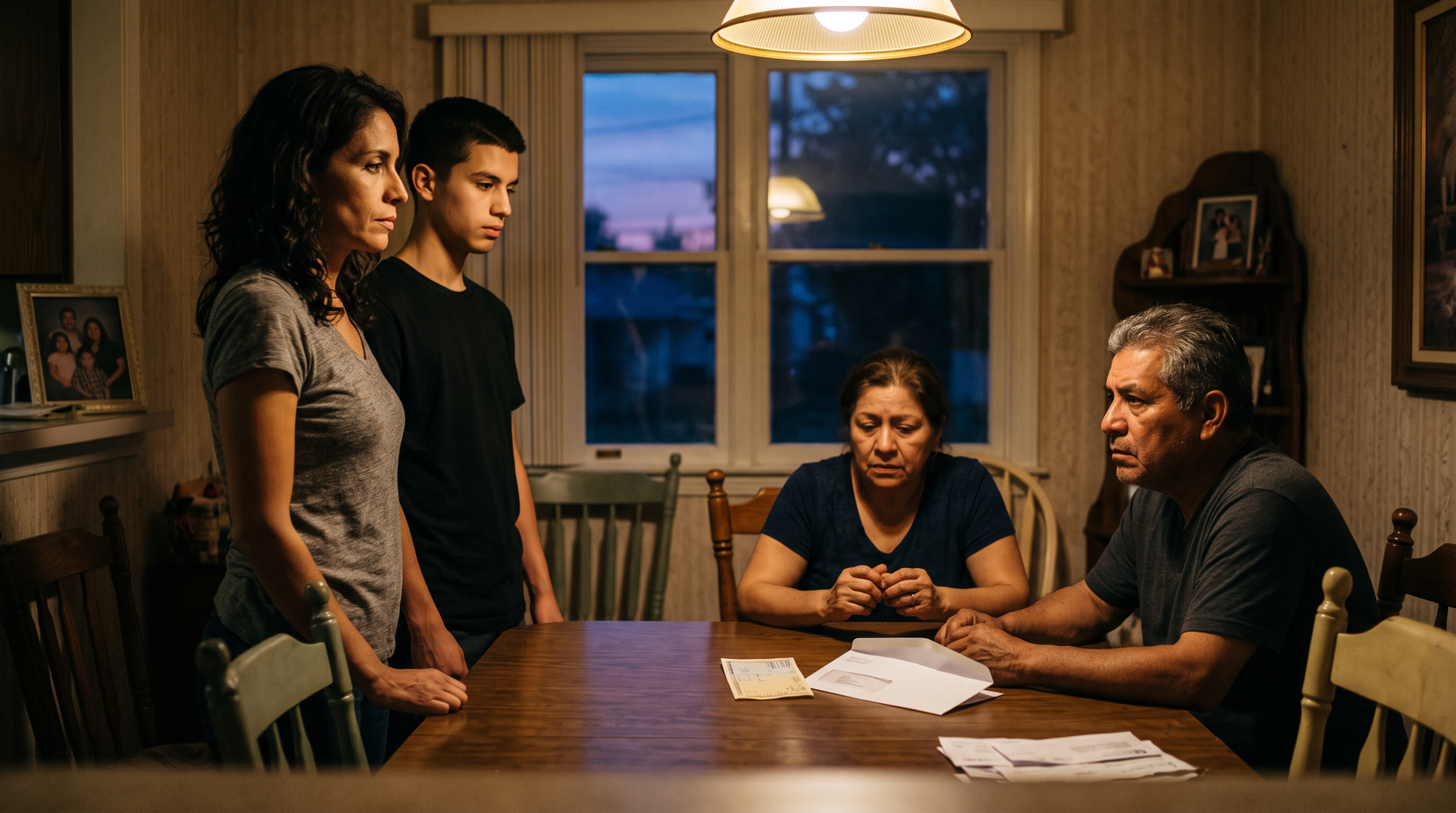
“Give it back, Eli.”
The raffle tickets were still spread across the folding table. A little girl in a paper crown stood beside her father, holding two dollars in one hand. Behind her, parents stopped talking.
My mother had one palm flat on the cash box. With the other, she pointed at my brother.
“There’s money missing from the activity fund,” she said. “You were in the office.”
Eli went pale, his eyes moving from the people watching to me.
I stepped between them before I could think better of it.
“Mom. Not here.”
She turned on me. “You don’t know what happened.”
That was true. I knew only what she’d said: cash was missing, and she was accusing Eli of taking it. I also knew the way the room had changed. People were waiting for him to prove he hadn’t done something, in front of everyone.
My hand tightened around the strap of my bag. I’d spent years telling myself that what happened when I was seventeen belonged to another version of my family, one I could keep at a distance. Then I saw my brother standing in the same kind of silence I remembered.
I led my mother a few steps away from the table. She came, but kept looking back at Eli.
“Let the school check the records first,” I said.
“What records?” she snapped. “The money was there. Now it isn’t.”
Nina Patel, the school office manager, was stacking paper plates near the gym door. I went to her while the parents began murmuring again.
“Could you hold off on filing anything until you’ve checked the records?” I asked. “Please.”
Nina set the plates down. “I’ll review them before I file a report.”
My mother heard her. “You’ve already decided he didn’t do it?”
“No,” Nina said. Her voice stayed level. “I’ve decided to check.”
I wanted that sentence to be enough. It wasn’t. My mother’s jaw was still set, and Eli was still surrounded by people who had heard the accusation.
The fundraiser kept going because the tables were full and the kids had worked all week on it. The raffle tickets had to be sold. Parents needed change. A volunteer asked where the extra napkins were. I answered, then watched Eli carry a stack of paper cups to the drinks table with both hands.
He didn’t look at me again until the crowd thinned.
“They all heard her,” he said.
“I know.”
My mother was close enough to hear that, too. She folded the cash box shut with a sharp click.
“You don’t have to take his side,” she told me.
I felt my face grow hot. For a second, I wanted to tell her this had nothing to do with taking sides. I wanted to say that being accused in front of a room full of people could stick, even if the accusation turned out to be wrong.
Instead I said, “I’m asking you to wait.”
Her mouth pressed into a thin line. “You always have to make things harder.”
The words landed in the same place as an old bruise. I had to put my hands in my coat pockets so nobody could see them shake.
I was seventeen when rent money went missing from the envelope my mother kept at home. I remember the envelope on the kitchen counter, its flap bent back. I remember my parents telling me to leave.
The next part comes back in pieces: my bag on the floor, my father by the door, my mother standing in the kitchen with her arms crossed. They told me to go after the money came up short. I left that night.
I’d lived on my own since. I didn’t tell the story often. There was never a neat way to explain why your parents could look at you and decide the worst.