🎧 Listen to this story
Full narration — I Came Home From College to Find My Mother’s Things Were Gone. M
Narrated by Dramateller
I came home for winter break three days before Christmas. The bus dropped me off at the end of the street at six in the evening. The house looked the same from the outside — blue shutters, pine steps, warm light in the kitchen window.
I let myself in and dropped my duffel in the hallway.
The first thing I noticed was the silence. Not the quiet of an empty house. The silence of things being missing.
The mantel was bare. The framed photograph of my grandmother from Cape Coral was gone. The hook where my mother’s hand-stitched quilt always hung was empty. The small oak side table with my mother’s porcelain bowl had been replaced by a stack of magazines on a metal rack I had never seen before.
I stood in the middle of the living room and felt like I had walked into the wrong house.
“There you are!” Clementine’s voice came from the kitchen. She was drying her hands on a towel, smiling. “How was the bus ride? You must be exhausted.”
Clementine married my father three and a half years after my mother left. I was seventeen. By the time I left for dorm at eighteen, she had already moved my mother’s clothes out of the master closet to make room for her own things. I never said a word. I thought that was the mature thing to do.
“Where is everything?” I asked, keeping my voice as even as I could.
Her smile did not falter. “Oh, honey — I did some early spring cleaning. The place needed a refresh. It was starting to feel like a museum.”
“A museum of what?”
She walked past me into the living room and gestured at the bare walls. “I sold a few pieces at the auction house. The quilt went into storage. And your room — you are going to love what I did with your room.”
I followed her upstairs.
My room smelled like fresh paint. The walls were a pale gray I had never chosen. The bed frame was different — minimalist, white, nothing like the oak frame my mother and I had refinished together when I was fourteen. The bookshelf was half the size and held decorative brass objects. My books were gone. My photos were gone. My grandmother’s dark mahogany jewelry box — the one with the green velvet interior and the secret compartment I used to hide love letters in — was not there.
“Do not worry,” Clementine said from behind me. “I boxed everything up. It is in the garage. I figured you could go through it when you had time.”
I walked to the garage without looking back at her.
Three cardboard storage boxes were stacked against the wall near the recycling bins. Next to them, a white plastic bag from Goodwill.
I tore the bag open.
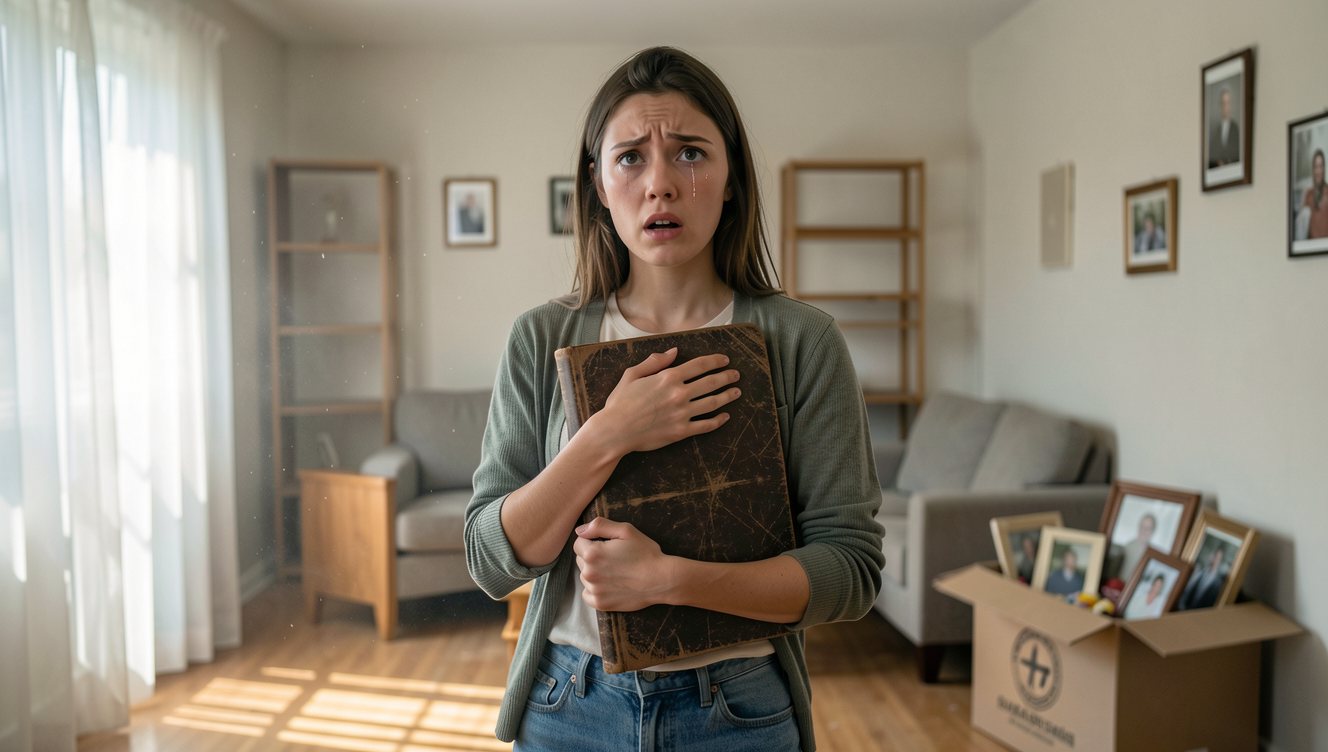
Inside was my grandmother’s leather-bound Bible with the loose spine. My great-aunt’s sapphire brooch in a Ziploc bag. My mother’s handwritten recipe cards — the ones she used to read to me over the phone — crumpled and stained with something sticky from where a jar had leaked. The high school yearbook with my mother’s senior photo and the inscription that said “see you at the top.”
Clementine had planned to take these to a donation center. She had packed them in a bag marked Goodwill and left them by the door.
I walked back into the living room with the bag in my hand. “Clementine. These were in a Goodwill bag.”
She looked up from the magazine she was paging through. “Oh, I was going to drop those off but I got distracted. I will take them this week.”
“This is my grandmother’s Bible.”
“I know, honey. But it was collecting dust. Your father agrees the house needed a fresh start.”
I knew then that my father had been in his study the whole time. He had heard every word and said nothing. I walked to the study. He was in his armchair with a book open, not reading it.
“Dad.”
He looked up. The same face he had given me for three years. The one that said “please do not make this harder.”
“She did not mean it, sweetheart.”
“She put Grandma’s Bible and my things in a donation bag.”
“It was a mistake. She told you it was a mistake.”
I turned to look at my stepmother. She was standing in the doorway of the kitchen. Her arms were folded. She was not saying anything. There was nothing she needed to say. She had won this argument the day she moved in.
I went back to the garage. I carried the three boxes and the Goodwill bag to my room — the gray room that did not feel like mine anymore. I sat on the unfamiliar bed frame and opened my grandmother’s Bible to the first pages where she had written the dates of births and deaths and marriages in careful cursive.
My father never came to check on me that night.
Maybe that is the part that matters most. Not the paint, not the missing quilt, not the rearranged furniture. It is the part where the person who is supposed to stand beside you chooses not to.
I found an apartment near campus three days after Christmas. I picked up extra shifts at a bookstore. I did not go back to the house on Pine Street for eight months.
I still talk to my father on the phone. But I stopped calling it home. I call it Clementine’s house. I call it the blue house on Pine Street.
It was my home once. But you cannot call a place home when someone has filled a bag with every trace of your mother and set it by the front door waiting for someone to drive it away.
Would you have packed your things and left? Or would you have stayed and tried to make them understand why it hurt?