🎧 Listen to this story
Full narration — “My Ex-Wife Called Me an Unfit Father at the Custody Hearing — Then th
Narrated by Dramateller
The morning of the custody hearing, I stood in front of the bathroom mirror and didn’t recognize the man staring back. I’d lost twelve pounds in six weeks. My suit hung loose on my shoulders. I looked exactly the way my ex-wife had been telling everyone I looked: broken.
Maybe that was the point.
Eighteen months earlier, Rachel had sat me down at our kitchen table and said she needed space. “I don’t feel like myself anymore,” she’d told me, her voice flat and rehearsed. “I need time to figure out what I want.”
I’d believed her. I’d packed a bag and moved into a furnished apartment three miles away, certain she just needed time. I told the kids Daddy would be back soon.
Two weeks later, her attorney filed for divorce. Sole custody. Supervised visitation only.
The grounds? “Emotional instability rendering the father unfit for unsupervised parenting.”
I’d never raised my voice at Rachel. I’d never missed a parent-teacher conference, a soccer game, or a sick day. I was the one who woke up at 3 AM when Lily had nightmares and the one who taught Connor how to ride a bike without training wheels. But none of that mattered now. What mattered was that Rachel had spent a year and a half building a case, and I had spent a year and a half hoping she’d come to her senses.
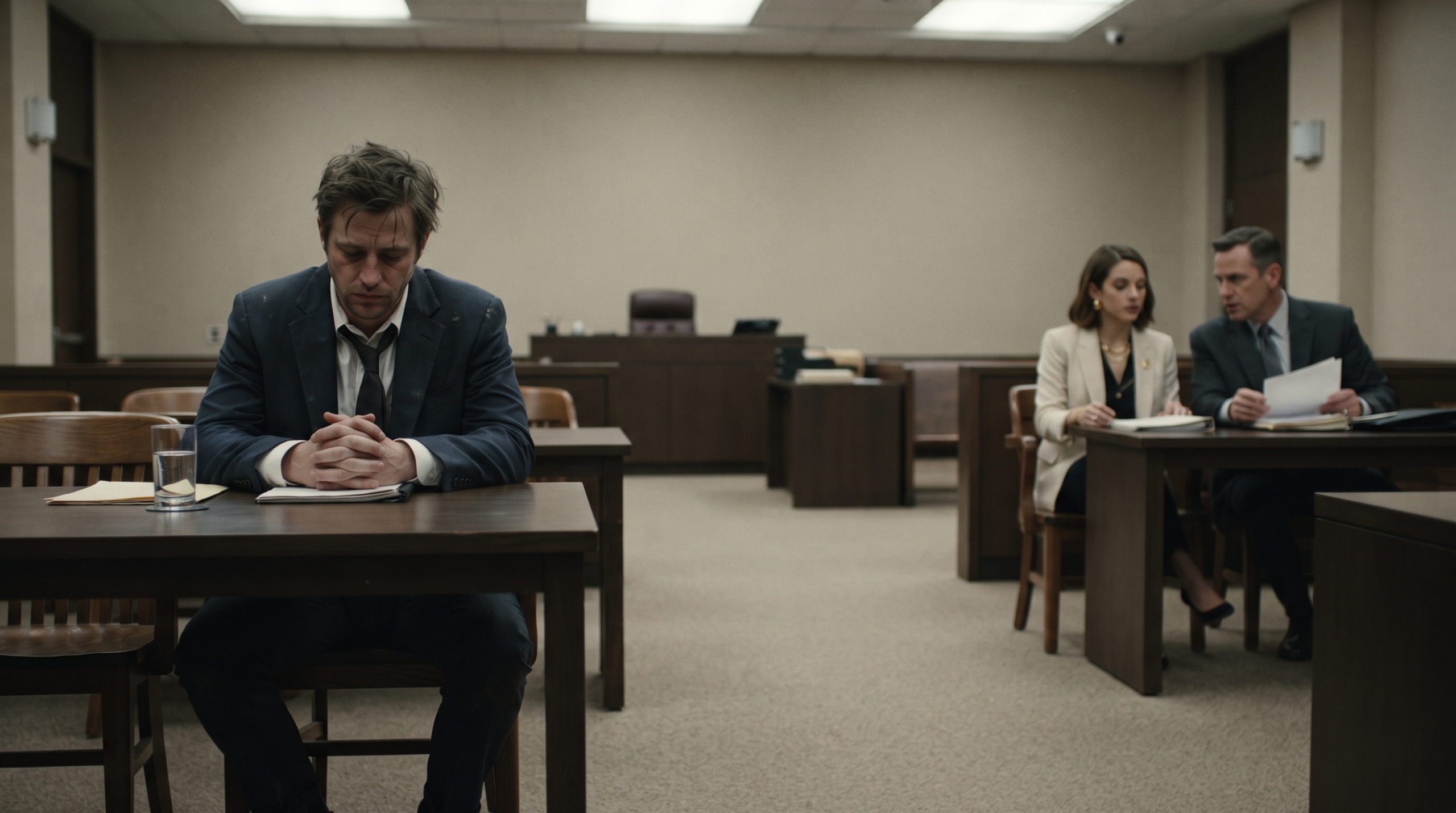
The courtroom was beige and cold. Fluorescent lights hummed overhead. Rachel sat at the petitioner’s table in a cream blazer, her attorney beside her, a woman named Margaret Crain who had a reputation for winning custody battles by any means necessary. Rachel didn’t look at me. She kept her hands folded on the table, her posture perfect, her face arranged into an expression of calm concern.
She looked like a mother who had sacrificed everything for her children.
I looked like a man who hadn’t slept in a week.
Margaret Crain began her opening statement with a pointed look in my direction. “Your Honor, over the past eighteen months, my client has documented a pattern of increasingly erratic behavior that has left her no choice but to seek sole custody for the safety of their minor children.”
“Documented” was a strong word. What she had was a binder of Rachel’s journal entries, screenshots of text messages taken out of context, and a statement from Rachel’s sister that I’d been “moody and withdrawn” during the separation.
Moody and withdrawn. My wife had left me. I’d lost half my time with my children. I was supposed to be cheerful?
When it was my turn, I kept my testimony simple. I told the truth: that I had never hurt my children, that I had never threatened Rachel, that I only wanted to be a regular father to Lily and Connor. My voice shook once, near the end. I saw Margaret Crain write something down.
The worst moment came when Rachel took the stand.
She described me as unpredictable. She said the children had come home from my visits “anxious and withdrawn.” She said Connor had stopped talking about his weekend with me, and that Lily had started wetting the bed again after spending time at my apartment.
I felt the room tilt.
“And did you raise these concerns with your ex-husband directly?” the judge asked.
Rachel’s eyes went wide and earnest. “I tried. Multiple times. He would either become defensive or shut down completely. I stopped bringing it up because I was afraid of how he’d react.”
I opened my mouth to speak, but my attorney put a hand on my arm. Not yet.
Then the judge looked at a woman seated in the second row. “Dr. Vasquez, if you’d approach.”
Dr. Elena Vasquez was the court-appointed child psychologist. She’d met with me three times, with Rachel twice, and with Lily and Connor individually over the course of six weeks. She was in her late forties, with silver-streaked hair and glasses that hung on a chain around her neck. She carried a brown leather file that was thicker than Rachel’s entire binder.
Rachel shifted in her seat. I saw her hands grip the edge of the table.
Dr. Vasquez was sworn in. She spoke calmly, professionally, with the quiet authority of someone whose job was to look past the performance and see what was actually happening.
“I conducted individual assessments of both parents and each child over a six-week period,” she said. “I also observed three separate visitation exchanges and reviewed school reports, medical records, and the children’s separate statements.”
She paused and opened the file.
“Connor, age nine, described his mother’s home as ‘strict’ and his father’s home as ‘where I can breathe.’ He reported that his mother asks him questions about his father after every visit and that he has learned to say ‘fine’ because saying anything else makes her upset. He was able to articulate, in age-appropriate language, that he feels caught in the middle and wishes his mother would stop being angry.”
Rachel’s face went pale.
“Lily, age seven, drew a picture during one of our sessions. It showed two houses. One was labeled ‘Mommy’s rules’ and had a small frowning figure at the door. The other was labeled ‘Daddy’s hugs’ and showed a larger figure holding a smaller one. She told me, unprompted, that she pretends to be sad after visits because she heard her mother say that happy children meant she wasn’t being careful.”
There was a sound in the courtroom. A sharp intake of breath. It came from my side of the room, and I think it came from me.
Dr. Vasquez continued for another ten minutes. She described the patterns she’d observed: Rachel’s coaching behavior, her attempts to alienate the children from me, the documented instances where she’d grilled the children after visits. She explained that my so-called “emotional instability” was a normal grief response to sudden family dissolution and that I had actually sought therapy voluntarily, which Rachel had not.
Then she delivered the line that I will carry with me for the rest of my life.
“In my professional opinion, the children are not at risk with their father. They are at risk of losing him.”
The judge was quiet for a long moment. Then she looked at Rachel.
“Mrs. Barnett, the court takes accusations of parental unfitness extremely seriously. And the court takes parental alienation even more seriously. You will not be getting sole custody. You will not be getting supervised visitation for your ex-husband.”
She looked at me.
“Mr. Barnett, you are granted joint legal and physical custody. The children will alternate weeks between both homes, effective immediately. Parental alienation therapy is ordered for the mother, to begin within thirty days.”
I didn’t hear the rest. Lily and Connor were waiting in the hallway with my mother, and I needed to tell them that I was coming home.
That was eight months ago. My kids are with me every other week. Connor joined a swim team. Lily started piano lessons. We have a garden in the backyard now — tomatoes, basil, and mint — and every Sunday we cook together and talk about the week ahead.
Rachel still tries sometimes. She sends long emails about scheduling conflicts and requests for “adjustments.” But the therapist has been helping her see what the rest of us already knew: that tearing me down was never going to build her up.
Some people say I should hate her for what she tried to do. Maybe they’re right. But when I look at my kids, I don’t see a war I won. I see two small people who almost lost their father because their mother couldn’t bear to share them fairly.
And I think: they shouldn’t have to pay for what she couldn’t let go of.
Maybe that makes me the fool. Or maybe it just means I learned, finally, what it means to put them first.
Would you be able to forgive an ex who tried to take your children away, or would that be a line you couldn’t cross?