The notary stopped reading on page seven.
He didn’t look at my husband first. He looked at me.
“Mrs. Bell,” he said, “before I continue, I need to ask you a question.”
David shifted in the chair beside me.
The conference room had smelled like coffee and new carpet when we walked in. Ten minutes later, it smelled like something had been buried under the floorboards.
“What question?” I asked.
The notary placed one finger on the document.
“Why did you sign this transfer?”
I stared at the page.
“I didn’t.”
David gave a short laugh. Not a nervous laugh. An irritated one.
“Claire, we’ve been over this. You signed the papers last month.”
“No, I didn’t.”
The notary’s expression changed.
Not shock. Recognition.
He turned the document toward me.
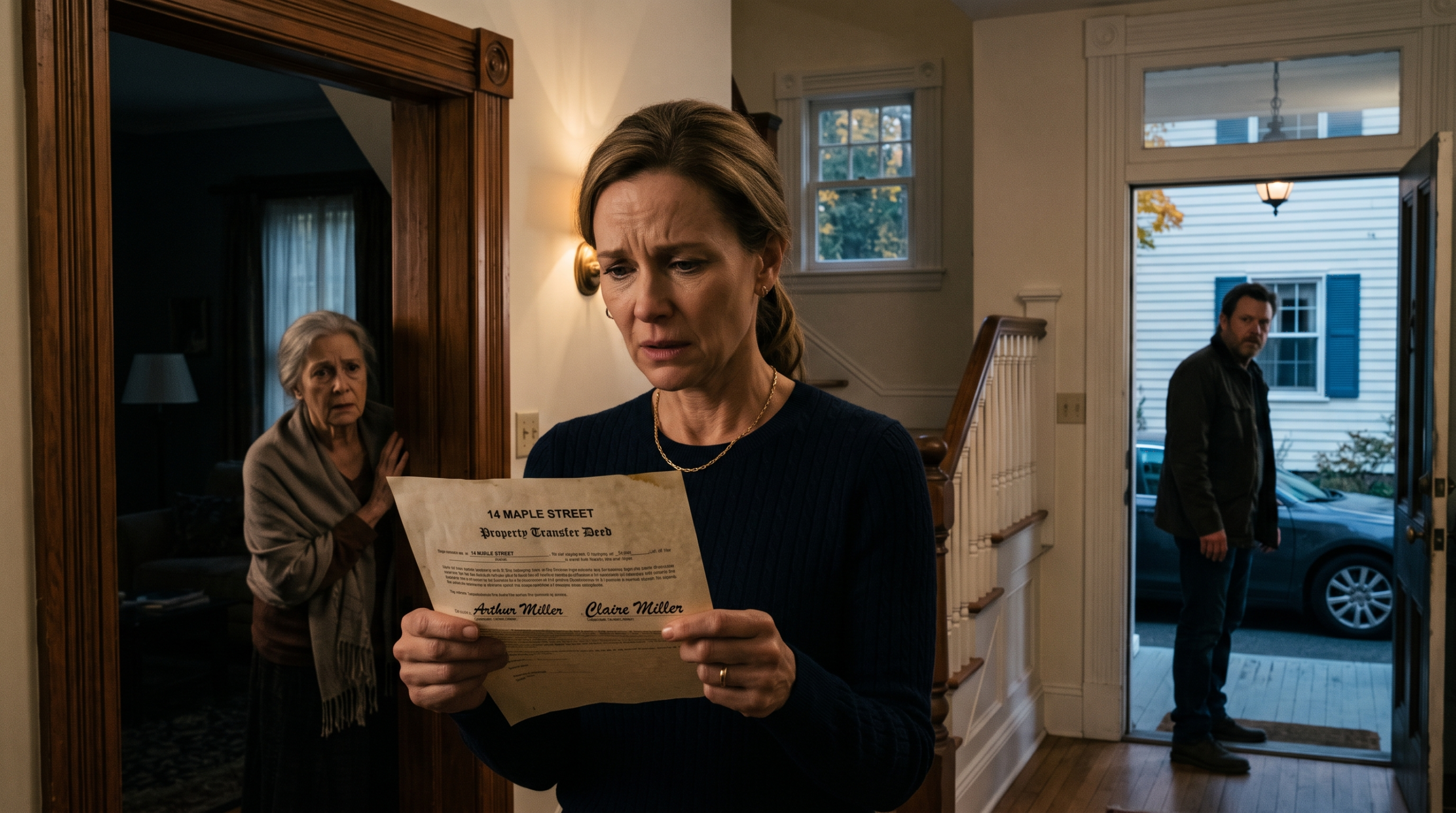
The signature looked like mine from a distance. The same long first stroke. The same loop in the C. But the final letter leaned too far to the right, as if someone had copied it from memory instead of from my hand.
David reached for the paper.
The notary pulled it away.
“Mr. Bell, please don’t touch the documents.”
David’s face tightened.
I looked at him.
“What exactly did I sign?”
He leaned toward me and lowered his voice.
“Not here.”
That answer was the first thing that frightened me.
Not because it explained anything.
Because it didn’t.
The house had been David’s birthday surprise for me. That was what he had said when he handed me the keys three months earlier.
He had blindfolded me in the car and driven for almost an hour. When he finally took the blindfold off, we were parked in front of a white two-story house with blue shutters and a dead rosebush beside the front steps.
I had stood there, speechless.
David had smiled as if he had just performed a magic trick.
“For us,” he’d said.
I had asked how he could afford it.
He had kissed my forehead.
“Trust me.”
I did.
That was the part I kept returning to later. Not the forged signature. Not the second mortgage. Not the woman whose name appeared on page seven.
Trust me.
He had said it so gently that I mistook the softness for honesty.
The first strange thing happened two weeks after we moved in.
I found a brass key in the kitchen drawer. It was attached to a red plastic tag with no label.
I held it up while David was making coffee.
“What’s this for?”
He didn’t turn around.
“Probably the old shed.”
“There’s no shed.”
“There used to be one.”
I looked out through the kitchen window. The yard was empty except for a broken birdbath and three bags of mulch.
“Where did it go?”
David poured coffee into his mug.
“Claire, it’s a key. Throw it away.”
He said it too quickly.
I placed the key on the counter instead.
He picked it up and put it in his pocket.
The next morning, it was gone.
I told myself I was being suspicious because the move had been stressful. We had been married for eleven years. David had always handled the complicated things: taxes, insurance, bank accounts, contracts.
He liked being the person who knew where everything was.
I liked not having to ask.
Still, the house never felt entirely ours.
The upstairs hallway had a door at the end that stayed locked. David said it was a storage room. When I asked what he kept inside, he said old work files.
“Why lock it?” I asked.
“Because the doorknob sticks.”
“Then why not fix it?”
He looked up from his phone.
“Why are you making this into a thing?”
I wasn’t.
Not yet.
But three days later, someone knocked on that door from the other side.
I was standing in the hallway with a basket of laundry when I heard it.
Two soft taps.
Then silence.
I stood very still.
A moment later, I heard a woman’s voice.
“David?”
The laundry slipped from my hands.
I walked downstairs and found David in the office.
He was sitting behind his desk, staring at his computer.
“Is someone upstairs?” I asked.
His fingers stopped moving.
“What?”
“Someone knocked on the storage-room door.”
He leaned back.
“You heard a knock?”
“And a woman called your name.”
David smiled, but the smile arrived late.
“Claire, this house is old. Pipes make sounds.”
“Pipes don’t say your name.”
For a few seconds, neither of us spoke.
Then David stood up.
“You’re tired.”
“I’m asking you a question.”
“No, you’re turning a noise into a conspiracy.”
He walked past me and went upstairs.
I followed.
The locked door was closed. The hallway was empty.
David placed his hand on the doorknob.
“See?” he said. “Nothing.”
“Open it.”
His eyes hardened.
“Why?”
“Because you said there was nothing.”
“That doesn’t mean you get to invade every private space in this house.”
The words landed harder than they should have.
Private space.
In our house.
David walked back downstairs. I remained in the hallway, looking at the door.
There was a thin line of light underneath it.
I noticed it only after he had gone.
That night, I asked him about the light.
He denied seeing it.
Then he said the hallway lamp must have been on.
Then he said I was remembering the conversation incorrectly.
It was a small argument. No shouting. No slammed doors.
But it left something behind.
A question with nowhere to go.
A week later, my sister Emily came to visit.
She arrived with soup, bread, and the kind of concern that made me regret answering the door.
“You look exhausted,” she said.
“I’m fine.”
“You said that last time.”
“Last time I was fine too.”
She looked over my shoulder into the hallway.
“Is this the house David bought?”
“Surprised me with it.”
Emily stepped inside. She studied the walls, the staircase, the framed photographs David had hung before we moved in.
At the end of the hall, she stopped.
“Who’s that?”
I followed her gaze.
There was a photograph beside the locked door. It showed David standing beside an older woman I didn’t recognize.
The woman had gray hair and a thin, serious face. Her hand rested on David’s shoulder.
“His mother?” Emily asked.
“His mother died before we met.”
“That’s not what I asked.”
I walked closer to the photograph.
The frame had been turned slightly toward the locked door. I had never noticed it before.
On the back, written in black marker, were two words:
For David.
I turned around.
David was standing at the bottom of the stairs.
He wasn’t looking at the photograph.
He was looking at Emily.
“Who is she?” I asked.
David’s answer came instantly.
“No one.”
Emily gave a quiet, humorless laugh.
“People in photographs usually are someone.”
David’s mouth tightened.
“She was a client’s mother.”
“Why is the photograph in our hallway?” I asked.
“I found it here.”
“Why does it say ‘For David’?”
He walked up the stairs and took the frame off the wall.
“I don’t know.”
“You just said she was a client’s mother.”
“Because I remember her. I don’t remember the photograph.”
That was his first contradiction.
It was small enough to dismiss.
Emily didn’t dismiss it.
After David went into the office, she leaned close to me.
“Ask him again when he can’t prepare an answer.”
“You think he’s lying?”
“I think he answered three different questions without answering yours.”
That night, I waited until he was asleep.
Then I went downstairs.
The photograph was no longer on the wall. I found it in the kitchen trash, face down beneath a napkin.
I pulled it out.
On the back, below the words For David, someone had written a date.
March 14, 2018.
The year before David and I got married.
I took a picture of the photograph and sent it to Emily.
She replied almost immediately.
Find out who lived here before you.
The next morning, I searched the county property records online.
The house had belonged to a woman named Nora Bell, David’s mother and Olivia’s grandmother.
Bell was David’s last name.
I read the record twice.
The property had been transferred six years earlier to a company called Bell Family Holdings.
Then, three months before David surprised me with the keys, the company transferred it to him.
There was one detail I could not understand.
The transfer listed a second beneficiary.
Olivia Bell.
I sat at the kitchen table with my laptop open and waited for the panic to pass.
It didn’t.
When David came home, I was still there.
He placed his briefcase beside the door.
“Why are you sitting in the dark?”
I turned the laptop toward him.
“Who is Olivia Bell?”
He stopped removing his coat.
For half a second, his face became completely blank.
Then he laughed.
“That’s what this is about?”
“Answer me.”
“Olivia is a name on an old property document.”
“Why?”
“I don’t know.”
“You don’t know?”
“I didn’t prepare every document personally.”
“You told me this house was ours.”
“It is ours.”
“The record says there’s another beneficiary.”
David walked toward the kitchen.
“You’re reading a public record you don’t understand.”
“Then explain it.”
“I just did.”
“No. You told me I was too stupid to understand.”
His expression changed.
“I didn’t say that.”
“You said I was reading something I didn’t understand.”
“Because you are.”
He reached for the laptop.
I closed it first.
“Who is Olivia?”
David stared at me.
The refrigerator hummed behind him.
Finally, he said, “She’s my daughter.”
The room went quiet.
I waited for the rest.
There had to be more. A story. An explanation. A woman from before me. A child he had never mentioned.
But David said nothing else.
I looked at him.
“Your daughter?”
“She was born before we met.”
“How old is she?”
“Twenty-four.”
“Where is she?”
“I don’t know.”
The answer was too fast.
I stood up.
“You just said she was your daughter.”
“She is.”
“Then how do you not know where she is?”
David rubbed his forehead.
“Claire, this is complicated.”
“No. It’s not complicated. You had a daughter, you hid her from me, and her name is on the deed to our house.”
“She has no claim to the house.”
“Then why is she listed?”
“Because my mother put her there years ago.”
“Your mother is dead.”
“Yes.”
“Then why did the property transfer happen through Bell Family Holdings?”
David looked toward the stairs.
I followed his gaze.
The locked door waited above us.
“What is in that room?” I asked.
“Nothing.”
“Is Olivia in there?”
He flinched.
It lasted less than a second.
It was enough.
I walked toward the stairs.
David caught my wrist.
“Don’t.”
His grip was not painful.
It was worse than painful.
It was desperate.
I looked down at his hand.
He released me.
“Claire, please. Not tonight.”
“You have had eleven years to tell me.”
“I was protecting you.”
“From what?”
He didn’t answer.
That silence became an answer of its own.
I went upstairs.
David followed me but did not try to stop me again.
At the locked door, I turned around.
“Where is the key?”
He said nothing.
“David.”
“You don’t want to know.”
“That is not your decision anymore.”
His eyes were wet now.
“You think I’m the villain.”
“I think you’ve spent eleven years deciding what I’m allowed to know.”
He reached into his pocket.
For a moment, I thought he was going to give me the key.
Instead, he pulled out his phone.
A message had appeared on the screen.
The sender was listed as O.
The preview contained five words:
She found the property records.
David turned the phone face down.
I looked at him.
“Call her.”
“No.”
“Call her.”
“Claire, listen to me—”
“Call the woman whose name is on our deed.”
He backed away from the door.
“She doesn’t want to speak to you.”
“Then why did she message you?”
He had no answer.
I held out my hand.
“Give me your phone.”
“No.”
That was the first honest word he had given me all evening.
I went downstairs, took my coat, and walked out of the house.
David followed me to the porch.
“Where are you going?”
“To find Olivia.”
“You don’t know where she is.”
I turned toward him.
“You just told me she doesn’t want to speak to me. That means you do know where she is.”
He said nothing.
I got into my car.
Before I closed the door, David spoke.
“She lives in the blue house at the end of the lane.”
I looked at him through the open door.
“The house beside ours?”
He nodded.
My hands went cold.
I had seen that house every morning for three months. Curtains closed. Porch light on. No car in the driveway.
“Why didn’t you tell me?”
David looked toward the neighboring house.
“Because she hates me.”
That answer made me stay.
I walked to the blue house alone.
The door opened before I knocked.
The woman standing there was young. Maybe twenty-four. She had David’s eyes, but not his expression.
She looked at me for a long time.
Then she said, “You’re Claire.”
I nodded.
“Are you Olivia?”
She stepped aside.
“Come in.”
The house was nearly empty. One table. Two chairs. Boxes along the wall.
On the table lay a folder with my name on it.
I didn’t touch it.
“Why is my name there?”
Olivia closed the door.
“Because I needed to know whether you would believe him.”
“Believe him about what?”
She sat down but did not invite me to do the same.
“My father told me you were helping him steal the house.”
I stared at her.
“What?”
“He said you knew the property belonged to my grandmother. He said you pressured him to transfer it to you.”
“That’s a lie.”
“I know.”
“Then why did you believe him?”
“I didn’t. That’s why I stayed next door.”
The folder sat between us.
I opened it.
Inside were copies of bank statements, property records, and emails from David.
One email was dated two months before our wedding.
Once Claire moves in, the house will be protected. She has better credit and no idea how the family trust works.
I read it twice.
Olivia watched my face.
“He didn’t buy the house as a surprise for you,” she said.
I kept reading.
“He used your income and credit to refinance the property. The house belonged to my grandmother. My father was supposed to manage it for me until I finished school.”
I looked up.
“Why did he put my name on anything?”
“He didn’t. That’s the part you need to understand.”
She pulled out the transfer document.
The signature on page seven was mine.
But beneath it, in smaller print, was a clause I had never seen.
If the transfer was challenged, the debt would become the responsibility of the signing party.
Me.
I pushed the document away.
“Your father forged my signature.”
Olivia nodded.
“And he used the house as collateral for a loan.”
“How much?”
“Four hundred and eighty thousand dollars.”
I stood up too quickly. The room tilted.
“Where did the money go?”
Olivia’s face tightened.
“That’s the other reason I asked you to come.”
She opened a second folder.
Inside was a photograph of David outside a fertility clinic.
Beside him stood a woman I had never seen before.
I recognized her anyway.
She was the woman from the hallway photograph.
David’s mother.
Alive.
Olivia placed another document on the table.
“This is a medical power of attorney,” she said. “My grandmother, Nora, signed it six years ago. It gave her son, David, control of the trust after her stroke.”
I looked at the signature.
The same strange right-leaning final letter.
The same hand that had copied mine.
“Nora wasn’t dead,” I said.
“No. She was in a care facility. My father told everyone she had died because he wanted access to the trust.”
“And Nora?”
Olivia looked down at the document.
“David told me she died last month.”
I stared at her.
“He told you?”
She nodded slowly.
“I believed him. I hadn’t seen her since the stroke. He said the funeral had been private.”
The room became silent.
Olivia reached into the folder and removed one final page.
A handwritten note.
The paper was yellowed and folded twice.
I read it aloud.
“Claire Bell is not responsible for any debts created without her knowledge. If David brings her into the house, warn her before the next transfer.”
The note was signed by Nora Bell.
David’s mother.
There was a date at the bottom.
Three days before I met David.
I looked at Olivia.
“Why did she warn me?”
“Because she knew what he was planning.”
“Then why didn’t she stop him?”
“She tried.”
Olivia’s voice dropped.
“My father locked her in that upstairs room.”
I stopped breathing.
The woman’s voice I had heard behind the door.
The light beneath it.
The photograph.
The key in the kitchen drawer.
All of it rearranged itself at once.
“Is your grandmother the woman I heard?”
Olivia nodded.
“She was alive when you moved in.”
I closed my eyes.
“How long?”
“Eight months.”
The date on the property transfer was three months before David gave me the keys.
The date on Nora’s note was three days before I met him.
And the final message on the page was written in blue ink beneath the signature.
He will tell you it was a gift. It was never a gift.
I took the note with me when I left Olivia’s house.
David was waiting on our porch.
He had changed out of his work clothes. He looked older than he had that morning.
“Where did you go?” he asked.
I held up the note.
His face collapsed.
Not guilt.
Recognition.
“You found her papers.”
“No,” I said. “Olivia gave them to me.”
He looked toward the blue house.
“She had no right.”
“You forged my signature.”
“I was going to fix it.”
“You locked your mother in an upstairs room.”
“She was sick.”
“She warned me about you.”
“She hated me.”
“She knew you were stealing from your daughter.”
David stepped toward me.
“Claire, you don’t understand what happened.”
I held out the note.
“Then explain it.”
He looked at the paper but didn’t take it.
For once, he didn’t rush to deny anything.
That frightened me more than his anger.
“I needed the house,” he said.
“For what?”
“To pay back the loan.”
“What loan?”
He looked past me at the road.
“The first one.”
“There was another?”
Silence.
A car passed at the end of the lane.
David lowered his voice.
“I thought I could make it right before you found out.”
“How much?”
“Eight hundred thousand.”
I felt the porch beneath my feet.
“And the money?”
He rubbed both hands over his face.
“Some of it went to Olivia’s medical bills.”
“Some?”
He said nothing.
“Where did the rest go?”
His phone buzzed.
He looked at the screen.
I saw the message before he turned it away.
The bank is sending someone tomorrow. If Claire files the challenge, we’re finished.
The sender was his mother.
I looked at the upstairs window.
A curtain moved behind the glass.
David noticed.
His face went white.
I stepped back from him.
“Your mother is alive.”
He didn’t answer.
“Your mother is alive, and she has been messaging you.”
He reached for my arm.
I moved away.
“You brought me into this house so my credit could cover your debt.”
“Claire—”
“You told me it was a gift.”
“I loved you.”
“No. You needed me.”
The porch light flickered above us.
Behind the upstairs window, the curtain moved again.
This time, a hand appeared against the glass.
Thin fingers.
A wedding ring.
I looked at David.
He whispered, “Please don’t call the police.”
I took out my phone.
“I’m not calling the police.”
His shoulders lowered.
I opened the camera.
“I’m calling the notary.”
David stared at me.
“What are you going to tell him?”
I looked at the forged signature in my hand.
“That page seven was never signed by me.”
Then I turned toward the upstairs window and raised my phone.
“Send me the photograph,” I said to the woman behind the glass.
A moment later, my phone buzzed.
The message contained one attachment.
A scan of the original trust agreement.
At the bottom was the clause David had tried to hide.
If any beneficiary used fraud to obtain the property, ownership would pass to the person who exposed the fraud.
I read the clause once.
Then I looked at the white house, the blue shutters, and the dead rosebush beside the steps.
David had handed me the keys and called it a surprise.
I put the phone in my pocket.
“Pack your things,” I said.
He stared at me.
“Where am I supposed to go?”
I opened the front door.
“Ask the woman you locked upstairs.”
I left him on the porch and walked into the house.
The locked door at the end of the hallway was still closed.
This time, I had the brass key.
I slid it into the lock.
From the other side, Nora Bell whispered my name.
I opened the door and found her sitting beside a small table covered with documents. She looked frail, but her eyes were clear. The light I had seen beneath the door had come from a reading lamp. The woman I had heard was not a ghost, a stranger, or a secret visitor. She was David’s mother, alive and frightened, and she had been kept there because David was afraid she would tell me the truth.
“Start with the bank,” she said.
This time, there was no mystery left in the sentence.
The next morning, Nora, Olivia, Emily, and I met with the notary and an attorney. Nora gave a recorded statement explaining that she had never authorized David to borrow against the property. Olivia provided the original trust agreement. The notary confirmed that my signature on the transfer was a forgery, and the bank froze the loan before any foreclosure process could begin.
The investigation took six weeks.
It established what David had done. He had taken money from the family trust after Nora’s stroke, used the house as collateral, and then married me without telling me that my income would be used to strengthen the application for the refinancing. He had called the house a gift because he needed me to move in, improve my credit profile, and trust him enough not to examine the paperwork.
The eight hundred thousand dollars had not disappeared into one dramatic scheme. It had gone into years of bad decisions: failed investments, private debts, expensive hotel rooms, and payments to cover earlier loans. He kept borrowing to hide the fact that the previous money was gone.
The first loan had been taken against the trust.
The second had been taken against the house.
The third would have been taken against my name.
That was why David had rushed the final transfer. He wasn’t protecting our future. He was trying to place the collapse on me before anyone noticed what he had done.
The house remained in Olivia’s name under the original trust agreement. The forged transfer was canceled. The bank pursued David for the fraudulent loan, and the district attorney charged him with forgery, financial fraud, and unlawful use of the trust.
He pleaded guilty six months later.
He received a prison sentence and was ordered to repay what he could. The money would never be fully recovered, but the debt was not mine. The house was not mine either, and I was relieved to learn that. I had thought losing it would feel like losing the life David promised me. Instead, leaving it felt like returning something stolen.
David and I divorced before his trial.
He sent me three letters. In the first, he called everything a misunderstanding. In the second, he blamed his mother for turning Olivia against him. In the third, he admitted that he had believed I would forgive him if the house looked beautiful enough.
I returned all three unopened.
Olivia moved into the white house temporarily while the trust was settled. She and I did not become friends in the way people sometimes expect after surviving the same person. We became something quieter and more practical. We exchanged documents, warned each other when David contacted us, and sat together during the court hearings when one of us could not face the room alone.
Nora moved into a care facility chosen by Olivia. She had not been locked away because she was dangerous. She had been locked away because she remembered everything.
Before I left the white house for the last time, Nora gave me the brass key.
“Keep it,” she said.
“I don’t want anything from that house.”
“It isn’t for the house.”
She closed my fingers around it.
“It’s proof that you opened the door.”
I kept the key in a drawer for almost a year. Then I took it to the courthouse and placed it in an envelope with the final judgment, the canceled transfer, and the letter David had written about forgiveness.
I did not need the key anymore.
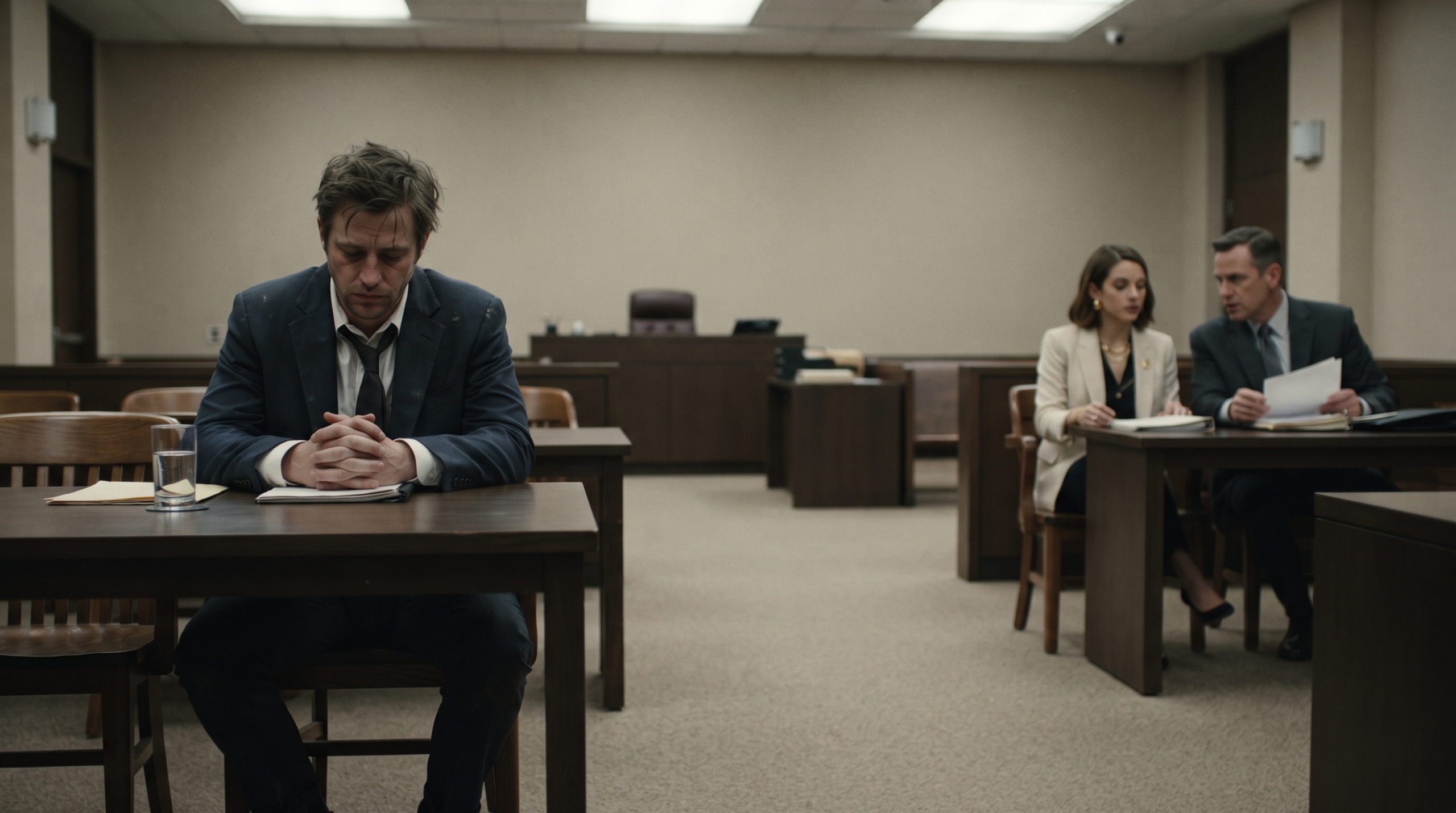
The last time I saw David was outside the courthouse. He was being led toward a waiting vehicle. He stopped when he saw me.
“Claire,” he called.
I kept walking.
“You were supposed to have the house,” he said.
I turned around then.
“No,” I told him. “I was supposed to trust you. You confused those two things.”
He looked down at the pavement.
For a moment, I thought he might apologize.
Instead, he asked, “Do you hate me?”
I considered the question.
“No,” I said. “Hating you would still make you part of my life.”
Then I walked away.
A year after the divorce, I rented a small apartment near Emily. I opened my own bank accounts, learned how to read every document before signing it, and stopped treating questions as accusations. On the wall above my desk, I kept a plain white card with one sentence written on it:
Trust is not the same as surrender.
Olivia eventually took full control of the family trust. She sold the blue house and used part of the money to pay for Nora’s care. She never moved into the white house. She said too many lies had been attached to its walls.
Nora died peacefully the following winter. Her attorney sent me a copy of her final statement. In it, she apologized for not protecting me sooner. I wrote back that she had protected me when she finally had a way to do it.
That was the truth I chose to keep.
David had not given me a house. He had used a house to hide a debt, a forged signature, and a life built on postponing consequences.
I lost eleven years of marriage. I lost the home I thought was ours. I lost the version of myself who believed love meant letting someone else handle every important decision.
But I did not lose my name, my credit, or my future.
On the anniversary of the day David handed me the keys, I went to the bank and closed the last account we had shared. The clerk printed two copies of the receipt. I signed one and placed it in my file.
That afternoon, I put the old brass key into an addressed envelope for Olivia’s attorney, along with a copy of the final case documents. The key belonged with the trust records, not in my desk drawer and not in my new home.
I sealed the envelope, wrote the attorney’s address across the front, and placed it in the outgoing mail slot at my apartment building.
It was the only thing from that house I had kept.
It was also the last thing I needed to return.