🎧 Listen to this story
Full narration — My Father Walked Out When I Was Twelve. Twenty Years Later, He Showed
Narrated by Dramateller
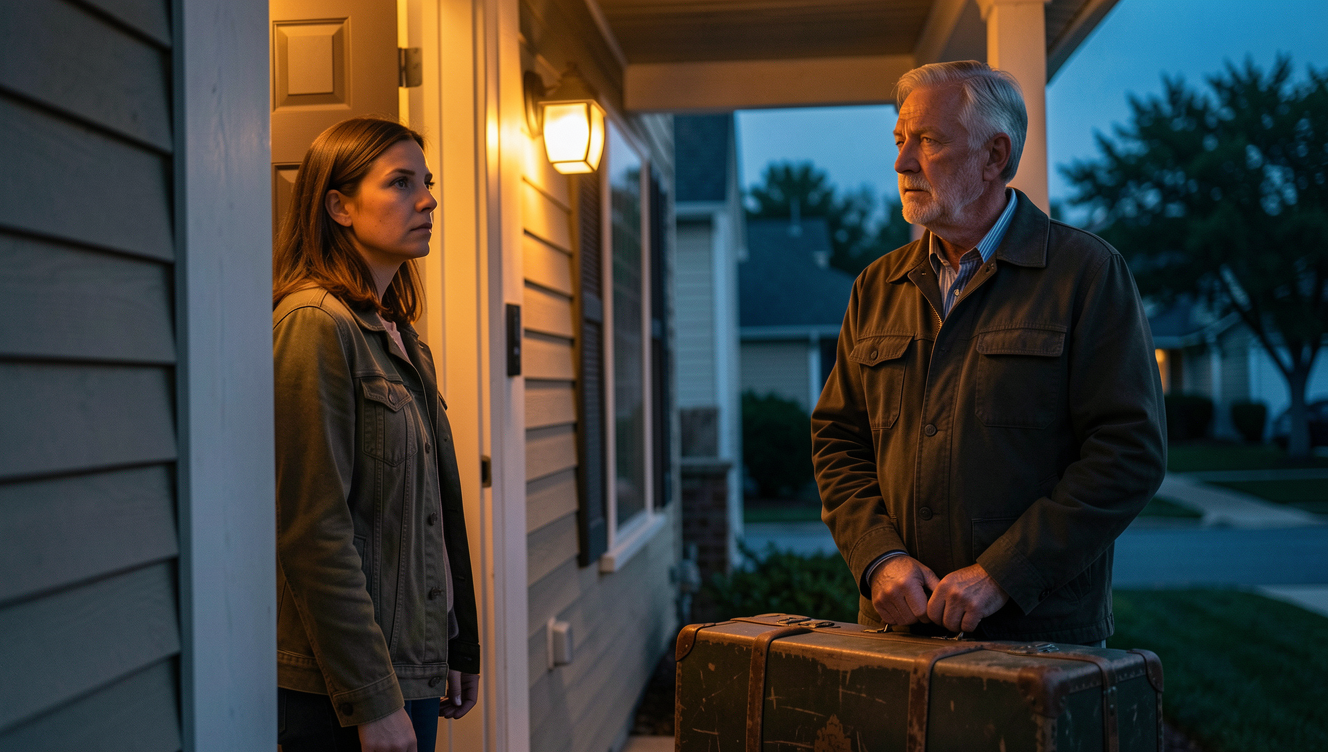
The knock came at 9:47 on a Tuesday night.
I almost didn’t answer it. I was in my pajamas, half-watching a documentary I’d already seen, half-scrolling through work emails I’d already answered. The only people who show up at my door unannounced are neighbors with packages, and this was too late for that.
But I looked through the peephole anyway.
And my blood went cold.
It was my father.
I hadn’t seen his face in twenty years. Twenty years, and he looked exactly like a heavier, grayer version of the man I remembered — same jaw, same tired eyes, same way of standing with his weight on one foot like the world owed him a chair. He was holding a suitcase. The same beat-up brown leather suitcase he’d taken with him when he left.
I opened the door a crack.
“Hi, sweetheart,” he said. Like it was nothing. Like he’d just come back from the grocery store instead of two decades of silence.
“What are you doing here?”
He shifted his weight. “Can I come in? It’s cold out here.”
It was September. It was not cold.
But I let him in anyway.
I was twelve when my father left. He didn’t say goodbye. He didn’t leave a note. My mother woke me up for school and found a drawer half-empty in their bedroom and a note on the kitchen counter that said, “I can’t do this anymore.”
No forwarding address. No phone number. No child support.
My mother worked double shifts at a nursing home to keep the lights on. I learned to make my own lunches, do my own laundry, sign my own permission slips. By the time I was sixteen, I was working weekends at a diner. By the time I was eighteen, I had a full ride to a state school and a plan to never depend on anyone again.
I built my life from scratch. I graduated. I got a good job. I bought a house. I made peace with the fact that I didn’t have a father. It hurt less than hoping he would come back.
And now he was sitting on my couch, drinking water from my tap, telling me he’d been thinking about me for years and wanted to “make things right.”
I sat across from him in the armchair. I didn’t offer him food.
“Why now?” I asked.
He sighed and looked at his hands. “I’m not getting any younger, sweetheart. I’ve made a lot of mistakes. I want to fix them while I still have time.”
It was a good answer. It was the answer I would have written for him if I’d scripted this moment in my head a hundred times. But something about the way he said it felt practiced.
“How long are you in town?”
He looked at the suitcase beside his feet. “I was hoping I could stay here. Just for a few days. Until I figure things out.”
I should have said no. Every instinct I had told me to say no. But I looked at his gray hair and his tired eyes and his worn-out suitcase, and I thought about that twelve-year-old girl who used to cry herself to sleep wishing her dad would come home. And I said yes.
It was the worst decision I’ve made in my adult life.
The first three days were tense but manageable. He was polite. He kept to himself. He made coffee in the morning and washed his own mug. We talked about safe things — the weather, the neighborhood, how much the city had changed since he’d last been here.
I didn’t ask about where he’d been. He didn’t offer. We orbited the real conversation like planets around a dead star.
On the fourth night, I came home from work early and heard him on the phone in the guest room. I wasn’t trying to eavesdrop. But the walls in my house are thin, and his voice was raised.
“I told you, I’m working on it,” he said. “She just needs a little more time.”
Pause.
“No, she doesn’t know about the money. And she’s not going to find out unless you open your mouth.”
My stomach dropped.
He laughed — a short, hollow sound. “Relax. I’ve got it under control. Give me two weeks and I’ll have enough to get my own place. She’s my daughter. She’s not going to throw me out.”
I stood in the hallway with my work bag still on my shoulder, and I felt something inside me go very, very quiet. The kind of quiet that comes before a storm, not after one.
I didn’t confront him that night. I went to my room, closed the door, and sat on the edge of my bed trying to piece together what I’d heard. He needed money. He was working on someone — and that someone was me. The whole reconciliation was a plan.
The next morning, I waited until he was in the shower and I picked up his phone from the nightstand. It was unlocked.
The texts were all there.
His girlfriend — a woman named Denise who’d apparently kicked him out after he’d drained her savings account — had been sending him angry messages for weeks. “Did you tell her yet?” “I need that money by Friday.” “If you don’t get it from your daughter, I’m calling the police about the checks you stole from me.”
I read every single message. Then I put the phone back exactly where I found it.
When he came out of the shower, I was sitting at the kitchen table with a cup of coffee. I asked him to sit down.
“I heard you on the phone last night,” I said.
The color drained from his face.
“I also saw the texts from Denise.”
He opened his mouth, closed it, opened it again. “Sweetheart, let me explain —”
“Don’t call me that.” My voice was steady. I’d been preparing for this conversation for twenty years, even if I didn’t know it. “You didn’t come here for me. You came here because your girlfriend kicked you out and you needed a place to stay until you could drain my accounts too.”
He started crying. It was ugly and loud and it made me feel nothing.
“I’m your father,” he said. “I know I made mistakes. But I love you. I’ve always loved you.”
I looked at him — this stranger wearing my father’s face — and I realized something I should have known the moment I opened the door.
He wasn’t here because he wanted to be my dad. He was here because he had nowhere else to go. I was the last option on a very long list of people who had stopped answering his calls.
I gave him one hour to pack his suitcase.
He begged. He pleaded. He tried guilt, then anger, then guilt again. I stood by the front door with my arms crossed and watched him load that beat-up brown suitcase with the few things he’d brought — clothes, a toiletry bag, a phone charger. Nothing that suggested he’d planned to stay in my life. No photo albums. No old mementos. No apology written on paper.
At the door, he turned to me one last time. “You’re going to regret this.”
“No,” I said. “I regret letting you in. But I don’t regret this.”
I closed the door behind him and locked it.
That was six months ago. I haven’t heard from him since. I don’t know where he went or whether he’s okay, and I’ve stopped asking myself if I should care.
Part of me still feels guilty. Part of me wonders if I was too harsh, if I should have given him a real chance instead of one week before I went through his phone. But most of me knows the truth:
He had twenty years to come back. He chose to come back only when he had nothing left to lose. That’s not reconciliation. That’s a con.
And I’m not that twelve-year-old girl anymore, waiting by the window for a father who was never coming home.
Would you have given him more time, or was I right to draw the line?