
I spent weeks believing my husband was only protecting his irresponsible younger brother from another stupid mistake. Then two detectives knocked on our door and asked for the footage from the night my husband swore he never left the house.
The first time the police came to my house, I thought they were there for my brother-in-law.
That sounds bad, but if you had known Caleb you would have assumed the same thing. He was my husband’s younger brother, thirty years old going on sixteen, always borrowing money, always driving cars that somehow belonged to other people for just a little too long, always promising that whatever disaster he had caused this time was really a misunderstanding. My husband, Owen, had spent most of our marriage acting like Caleb’s emergency contact, legal advisor, part-time parent, and occasional accomplice in the softer sense of the word. Not criminal, I told myself. Just loyal to a fault.
By the time the detectives showed up, we had been married eight years. We had one daughter, Nora, a ring camera over the porch, two outdoor cameras aimed at the driveway and side gate, and the sort of respectable split-level house that makes neighbors assume nothing interesting ever happens behind the curtains. I liked that life. I liked knowing what time the dishwasher ran and which floorboards creaked and how Owen took his coffee. Predictable homes make betrayal feel almost supernatural, because your body keeps insisting something impossible is happening in familiar rooms.
Three weeks before the detectives arrived, Caleb had come over after midnight with a split lip and blood on the sleeve of his hoodie. Owen met him outside before I could even put on shoes. Through the front window I watched them stand under the porch light, shoulders tight, talking fast. When Owen finally came inside, he told me Caleb had gotten into a fight outside a bar and needed somewhere to calm down for an hour. I asked whether the police were involved. Owen said no. I asked whether Caleb had hurt someone. Owen snapped that not every stupid thing his brother did needed to become a courtroom in our kitchen.
That was unusual enough to stick with me. Owen was normally calm, even when he was lying. I just did not know that about him yet.
The next morning, Caleb was gone before Nora woke up. Owen deleted the porch camera notification from the family app before breakfast, which I noticed only because he had once lectured me about digital clutter like it was a moral failing. When I asked why, he said there was no reason to keep footage of his brother bleeding on our steps. I let it go because marriage is partly choosing which odd behavior to investigate and which to file under stress.
Then little things started piling up. Owen began taking his phone onto the back patio whenever Caleb called. He transferred money from our joint account twice in one week and called it helping family. He told me Caleb’s landlord was threatening eviction, then later claimed it was actually a car issue, then later still said I should stop interrogating him because not every problem was mine to carry. That last sentence would have been more convincing if the money had not very much been mine to carry.
I tried to be reasonable. I told myself my husband was embarrassed, not deceitful. Caleb had always been a chaos magnet, and maybe Owen was covering for the usual things: missed rent, unpaid tabs, some drunk argument that sounded uglier once sober people described it. I even apologized one night for sounding suspicious. Owen kissed my forehead and said, ‘I’m just trying to stop one mistake from ruining his life.’ At the time, I heard compassion. Later, I heard confession.
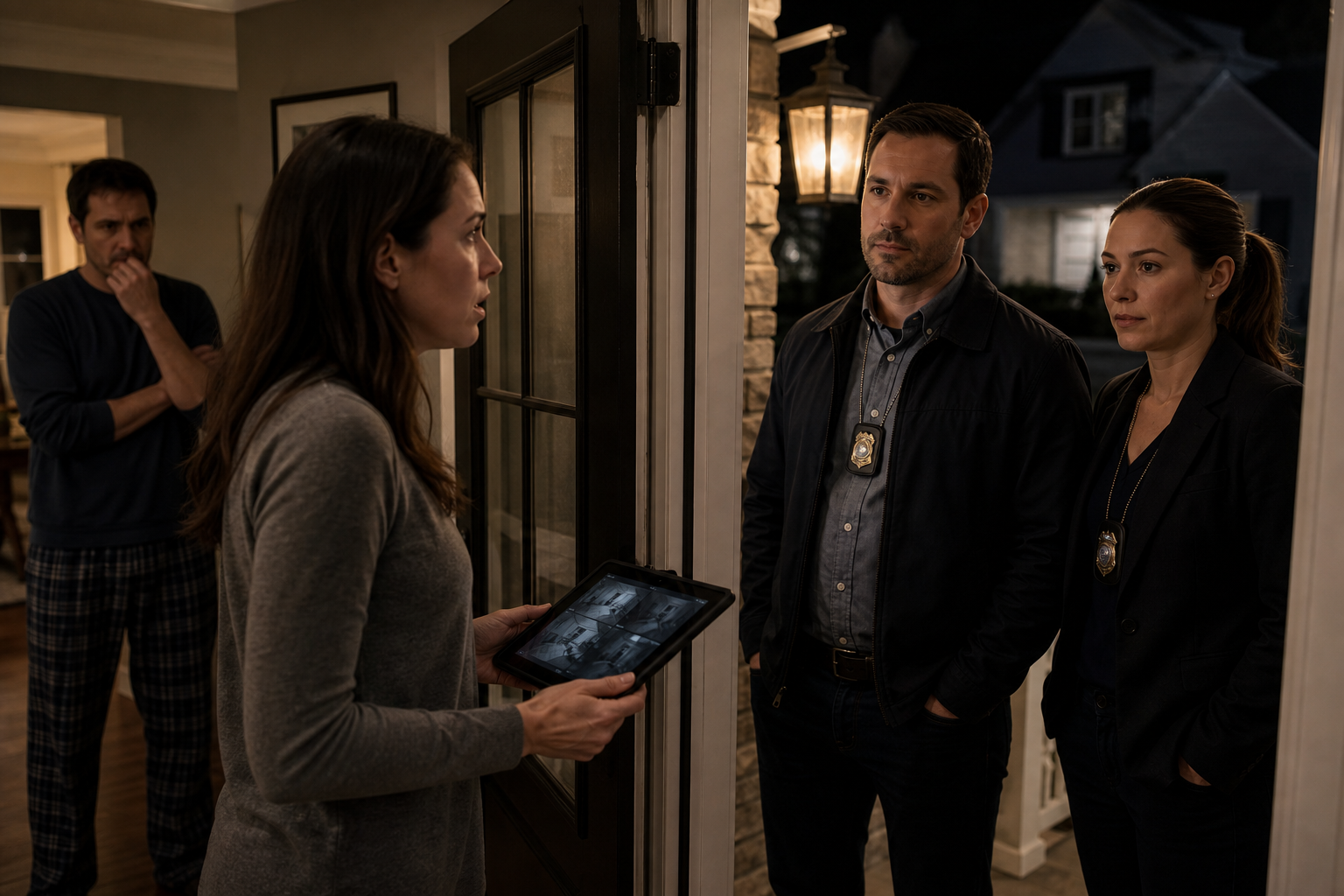
The detectives came on a Tuesday at 6:40 p.m., just as I was draining pasta. Nora was upstairs doing spelling homework. Owen had not come home from work yet. When I opened the door, a man and a woman in plain clothes introduced themselves and asked whether we had external security cameras covering the driveway and front entrance. I said yes. The woman asked if we would be willing to provide footage from the night of May 17th between 11:30 p.m. and 2:00 a.m. She said they were following up on an assault investigation involving a man named Marcus Bell.
I said, automatically, ‘This is about my brother-in-law, isn’t it?’
The detective looked down at her notes. ‘We are interested in anyone who arrived at or left this address during that window.’ Then she said a sentence that made my mouth go dry. ‘Our information is that your husband may have relevant footage or relevant knowledge.’
Relevant knowledge. Such a careful phrase. Such a brutal one.
I let them in because there was no elegant way not to. I logged into the camera app on the tablet, but the footage from that window was gone. Not unavailable. Deleted. I knew it instantly because the storage timeline showed a neat blank span between clips from 11:12 and 2:09. The male detective noticed my face and asked whether that was normal. I said no. He asked who else had access to the account. I heard myself answer, ‘My husband.’
Owen walked in ten minutes later and stopped dead in the hallway when he saw them. I have replayed that expression more times than I care to admit. Not confusion. Not annoyance. Recognition. The kind a person wears when the fear they have been rehearsing finally uses the front door.
He said he wanted a lawyer before answering questions. The room became instantly colder.
After they left, I asked him the only thing that mattered. ‘What did you do?’ He insisted he had not done anything. He said Caleb had panicked after a bar fight, come over asking for help, and that Owen had driven him home to keep him from doing something stupid. I asked why that required deleting our footage. He said he was trying to protect Caleb from being blamed for something he did not start. I asked why the detectives seemed more interested in him than in Caleb. Owen sat at the kitchen table and pressed his hands together so tightly his knuckles blanched. Then he said, ‘Because I was there before Caleb called.’
That was the crack the truth came through.
He admitted he had met Caleb at the bar earlier that night after work. He admitted Caleb got into an argument with Marcus. He admitted he stepped in. But what he called stepping in turned out to be punching a man hard enough to fracture his eye socket after the fight had already started breaking up. Owen said Marcus had shoved Caleb first. He said everything happened fast. He said he had not meant for it to get that bad. He said deleting the footage was just panic because he had driven Caleb back to our house to wash blood off his shirt before taking him home.
I stared at him and thought about the sentence he had used to soothe me: one mistake. Men love singular nouns when they are describing the disasters they built step by step. The fight was one mistake. The lie was another. Deleting evidence was another. Taking money from our account to pay Caleb’s lawyer before telling me was another. Suddenly I could see the whole staircase, not just the top step.
Nora came downstairs halfway through our argument because children always appear when adults are trying hardest to sound controlled. She stood in the doorway in unicorn pajamas, clutching her spelling sheet, and asked whether Daddy was in trouble. Owen looked at me like he wanted me to fix the room for him. That was when something inside me finally stopped volunteering.
I told Nora to go back upstairs and put headphones on. Then I turned to my husband and asked whether he had used our daughter’s college savings to help Caleb. He did not answer fast enough. That silence felt worse than the detectives at the door.
The next morning, I called the bank before I called my sister. I moved what money I could. I called a lawyer before Owen had finished texting me that I was overreacting. He kept insisting he was not the kind of man who would really destroy his family over his brother. But families are not only destroyed by affairs and abandonments and dramatic exits. Sometimes they are destroyed by a pattern of smaller loyalties, each one chosen in secret, until your own house is no longer the place someone tells the truth first.
Owen was eventually charged with obstruction and assault. Caleb got dragged in too, though not nearly as deeply as he deserved. Owen took a plea months later. Every relative who wanted me to stand by him used the same phrase: he was just protecting family. I never found a polite way to explain that I was family too, and he had chosen against me repeatedly before the police ever knocked.
What stayed with me most was not the legal mess, or even the money. It was the blank line in the camera timeline. That clean, deliberate absence. A little erased window where my husband decided his version of events mattered more than reality. Maybe marriages do not end when trust is broken. Maybe they end when one person starts editing the evidence and expects love to fill in the missing hour.
I used to think loyalty meant standing beside the person you married when things got ugly. Now I think it means being someone they do not need to hide the footage from in the first place.