
My mother left when I was fourteen.
Not in the dramatic movie way, with a slammed suitcase and everyone screaming in the driveway. It was quieter than that, which somehow made it worse. She told me she “needed space,” kissed the top of my head like she was going to the grocery store, and moved three counties away with a man named Victor who sold office furniture and wore too much cologne.
For the next twenty years, she drifted in and out of my life like weather. A birthday text one year. Silence the next three. A voicemail after my wedding saying she was “thinking of me,” even though she hadn’t come. A card after my first daughter was born with no return address and fifty dollars tucked inside, as if motherhood could be outsourced like guilt.
My father never said much about her. He just got on with things. He packed school lunches badly, burned grilled cheese with astonishing consistency, and once sewed the hem of my choir dress with blue fishing line because that was all he had in the garage. It held.
Maybe that was him in one sentence. It held.
By the time I was thirty-eight, I had a husband named Mark, two daughters, a mortgage, and a Thanksgiving routine that made me feel safe. My father came early. My younger sister, Beth, brought the sweet potatoes. Mark handled the turkey like it was military strategy. The girls set folded name cards at each plate and argued about whose pumpkin pie drawing looked more realistic.
I liked the predictability of it. After a childhood built around vanishing, predictability feels holy.
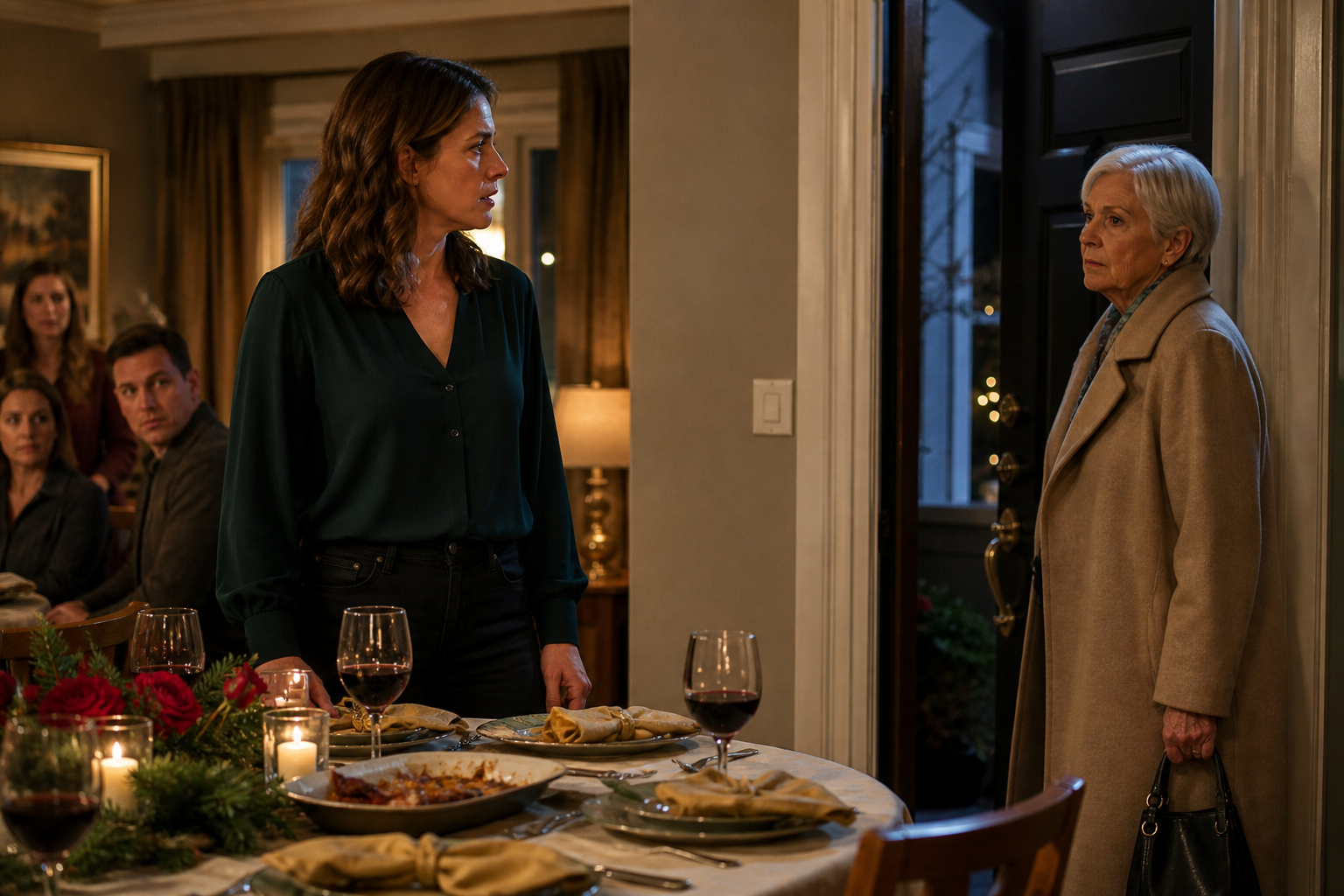
That Thanksgiving, the house smelled like butter and rosemary. The dining table was set. My father was opening wine. Beth was in the kitchen asking where I kept the hand mixer for the third year in a row.
Then the doorbell rang.
Mark went to answer it, since my hands were covered in flour.
I heard his voice first. Polite. Confused.
Then I heard hers.
“Hello, sweetheart.”
Every muscle in my body locked.
I stepped into the hallway and there she was: my mother, Diane, standing in a camel-colored coat, silver hair perfectly arranged, holding a small black handbag like she’d arrived for a luncheon instead of an ambush.
For one stupid second, all I could think was that she looked older. For the next second, all I could think was that I hated myself for noticing.
Beth appeared behind me and actually gasped. “Mom?”
Our mother smiled as if surprise were proof of affection. “I was in town and thought… maybe it was time.”
Time for what? A holiday cameo?
My father had come into the hallway by then. His face didn’t change, but the room did. The air got tight.
“Who invited her?” I asked.
Beth looked instantly guilty.
Of course.
She stepped forward. “I did. Just hear me out—”
I laughed, sharp and joyless. “You invited Mom to Thanksgiving without telling me?”
“She said she wanted to make things right.”
My mother put a hand lightly over her chest, performing humility. “I know I’ve made mistakes.”
Mistakes.
Like forgetting to call your daughters for Christmas. Like missing graduations. Like mailing apologies instead of showing up.
I looked at Beth. “In my house?”
Beth’s eyes filled immediately. She had always been the peacekeeper, the one who mistook reunion for repair. “I just thought maybe we could finally be a family again.”
That sentence landed on me like an insult dressed as hope.
I looked at my daughters peeking from the dining room, confused by the sudden silence. I looked at my father standing near the staircase, one hand wrapped around the neck of the wine bottle like he needed something solid to hold. I looked at the woman who had walked out of my life and back into my doorway as if nostalgia were the same thing as accountability.
And I knew, with a clarity so sharp it felt clean, that if I let her in without naming the truth, I would spend the rest of the day performing comfort for everyone except myself.
So I said, very calmly, “If she sits at my table, I won’t.”
The room erupted.
Beth burst into tears. “How can you say that?”
My mother’s mouth tightened. “I’m trying here.”
Mark moved closer to me but didn’t speak. He knew that look on my face. It meant I had gone past hurt and reached decision.
My father finally set the wine bottle down on the side table. “Maybe this isn’t the day,” he said quietly.
But my mother wasn’t interested in maybe.
She straightened her coat and turned to me. “You’re punishing me because I was unhappy.”
I stared at her. “No. I’m refusing to lie because you’re uncomfortable.”
She went pale, then defensive. “I sent money. I kept in touch.”
“A card every few years isn’t parenting,” I said. “And fifty dollars doesn’t buy your way back into our traditions.”
Beth whispered, “Please don’t do this.”
I turned to my sister. “I’m not the one who did this. You brought a stranger to my front door and expected me to call it healing.”
That was the moment my mother’s expression changed. The polished sorrow dropped away, and what was underneath was irritation.
“Stranger?” she repeated.
“Yes,” I said. “A mother doesn’t get to disappear for twenty years and then arrive for turkey.”
My daughters were still watching. That mattered more than everyone else’s outrage combined.
I walked to the dining room, took the little handwritten name card that said **Grandma**, and folded it in half.
Then I came back to the hallway and opened the front door wider.
“You can come back another day,” I told her, “if you want to have an honest conversation about what you did. But you are not walking into my home on a holiday and pretending we skipped straight to forgiveness.”
My mother looked at Beth, maybe waiting for backup. Beth just cried harder.
My father said nothing. But when my mother looked at him, he didn’t move toward her.
That seemed to answer something for everyone.
She left with her chin high, the way people leave when dignity is the only luggage they still control.
Beth locked herself in the bathroom for ten minutes. Mark basted the turkey in total silence. My father stood at the sink, looking out the window like there might be instructions written in the dark.
Dinner happened anyway.
It was awkward. The girls sensed the fracture but not its history. Beth barely ate. My father finally reached across the table and squeezed my hand once, hard.
Later that night, after everyone went home, Beth texted me that I had humiliated our mother.
I wrote back: **No. I just stopped protecting her from the truth.**
We didn’t speak for six weeks.
My mother sent me a long email after that. It was full of explanations: she had been young, lost, overwhelmed, in love, ashamed, afraid to return once too much time had passed. Some of it may even have been true. But truth without responsibility is just autobiography.
I answered with one sentence: **If you want a place in my life, start by describing what you took from it.**
She never replied.
Beth says I’m too hard. Maybe I am. But my daughters will never learn from me that peace means pretending abandonment was only a misunderstanding. They will never watch me set a plate for someone who only remembers she belongs when the table is already warm.
Maybe forgiveness will come one day. Maybe it won’t.
But that Thanksgiving, I finally understood something I should have learned years earlier: a closed door is not always cruelty. Sometimes it is the first honest thing in the room.