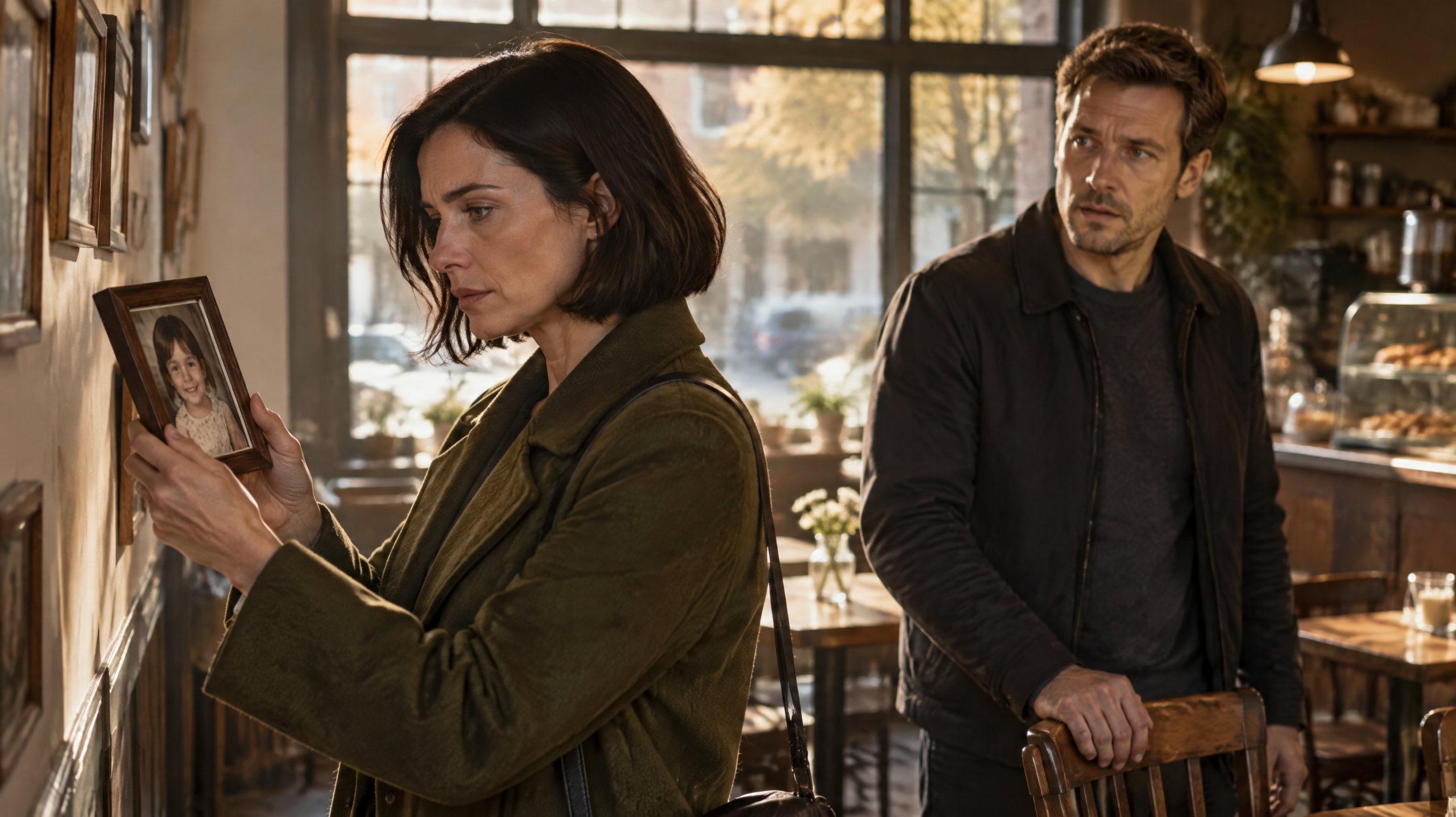
I had a chair balanced against my hip when the woman lifted Ruth’s photograph off the café wall.
“Careful,” I said. “That’s mine.”
She turned the frame over, worked the little metal tabs with her thumbnail, and looked at me.
“The photograph might be yours. The missing girl isn’t.”
I put the chair down too hard. One leg struck the tiles with a crack that made us both look at it.
We were due to open the doors for the annual appeal in forty minutes. I had moved the café tables against the windows and set out five rows of chairs. Beside the empty hook, a stack of flyers sat under a sugar bowl to keep the corners flat.
The woman pulled the backing away from the frame.
“Stop telling people to look for me.”
I reached toward the photograph, then stopped before touching her hand. She was about my age, thirty-nine, with rain darkening the shoulders of her coat. There was nothing about her that gave me the instant certainty I had imagined so often. I kept looking for a thirteen-year-old.
“What’s your name?” I asked.
“Ruth. You know that.”
“No. I don’t know that.”
Her mouth tightened. I hated having said it, but I had spent twenty years answering messages from people who were certain they had seen her. A woman at a bus stop. Someone in a wedding photograph. Once, a stranger had asked me for money before giving me an address that didn’t exist.
I had been nineteen when I started searching properly. Ruth had been gone for six years by then. At thirteen, I had waited for her to come back to school. At nineteen, I thought being an adult meant I could finally do something about it.
Now an adult woman stood in front of me holding the face I had used to ask for help.
“You made me a birthday cake,” she said.
“That’s something anybody could guess.”
“You put it on the kitchen chair because there wasn’t room on the counter. Then you sat on it.”
I looked at the chair between us.
“You said we could scrape off the top,” she continued. “But there was a button mark from your shorts right through the icing. We ate the middle out of the tin with teaspoons. You wouldn’t let me tell your mum because she’d said not to use all the eggs.”
I remembered trying to wash icing off the back of those shorts in cold water. Ruth had stood in the doorway laughing so hard she couldn’t explain what had happened.
“The teaspoons bent,” I said.
“Only yours. You tried to cut the burnt edge.”
I sat down. She stayed standing.
For years I had pictured myself knowing what to say. Her name first, probably, then something about how much I had missed her. Instead I asked whether she wanted a coffee, in the same voice I used when someone came in out of the rain.
“No, thank you.”
“You’re really here.”
“Yes. And this needs to come down.” She nodded toward the flyers.
I took out my phone. I wanted one thing that would make the moment solid, something I could look at after she left and know I hadn’t misunderstood.
“Could we get a picture? Just us, by the counter?”
“No.”
“I wouldn’t have to put it anywhere.”
“I said no, Owen.”
Hearing my name from her made me smile before I could stop myself. She didn’t smile back. I put the phone facedown on the table.
“Who said you could hold this tonight?” she asked.
“It’s my café.”
“That isn’t what I asked.”
I glanced at the rows of chairs. My older brother, Derek, organized the appeal every year. He contacted people, printed the notices, reminded me which local groups to invite. I provided the room and told the same story about the last time I had seen Ruth.