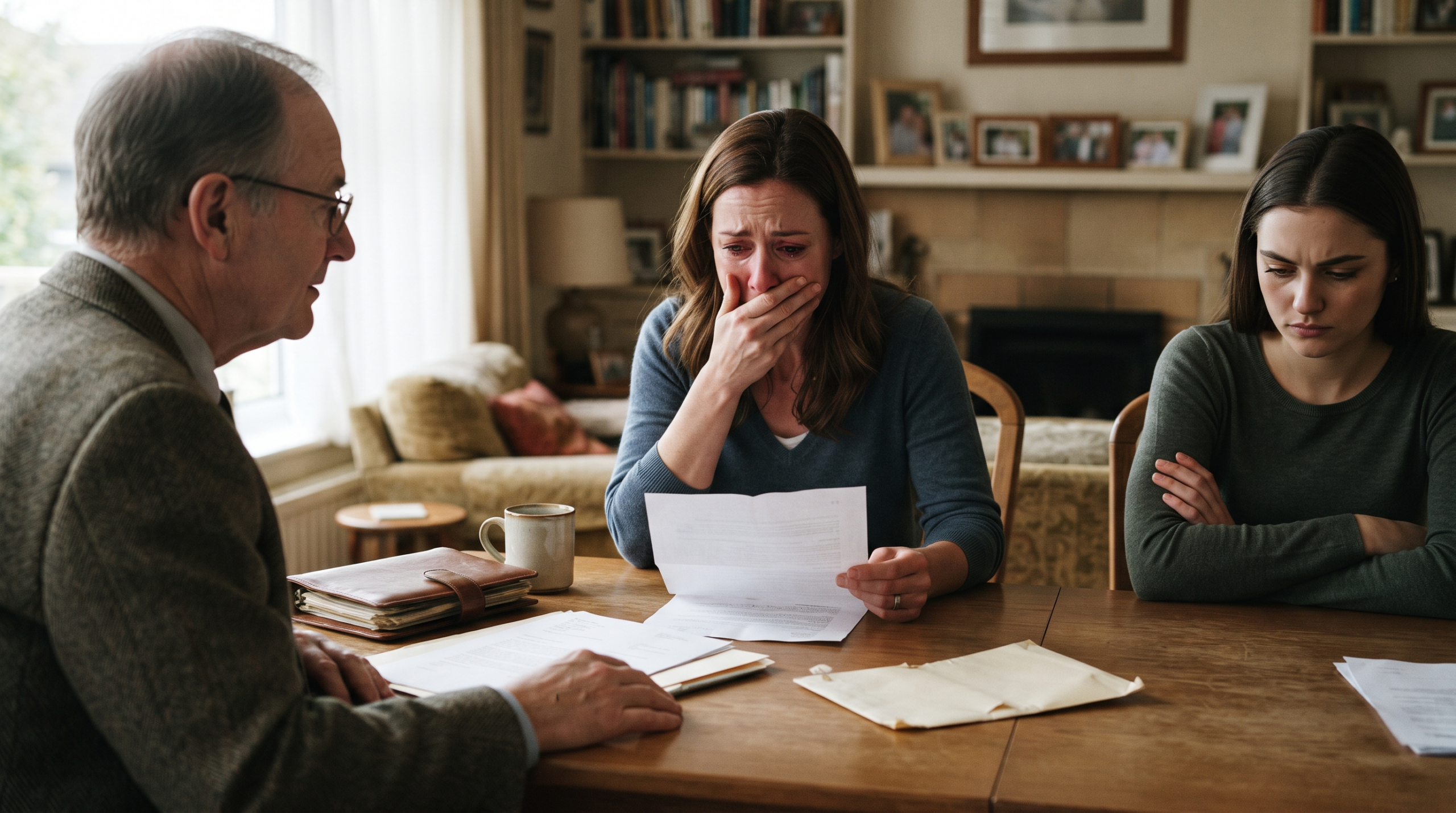
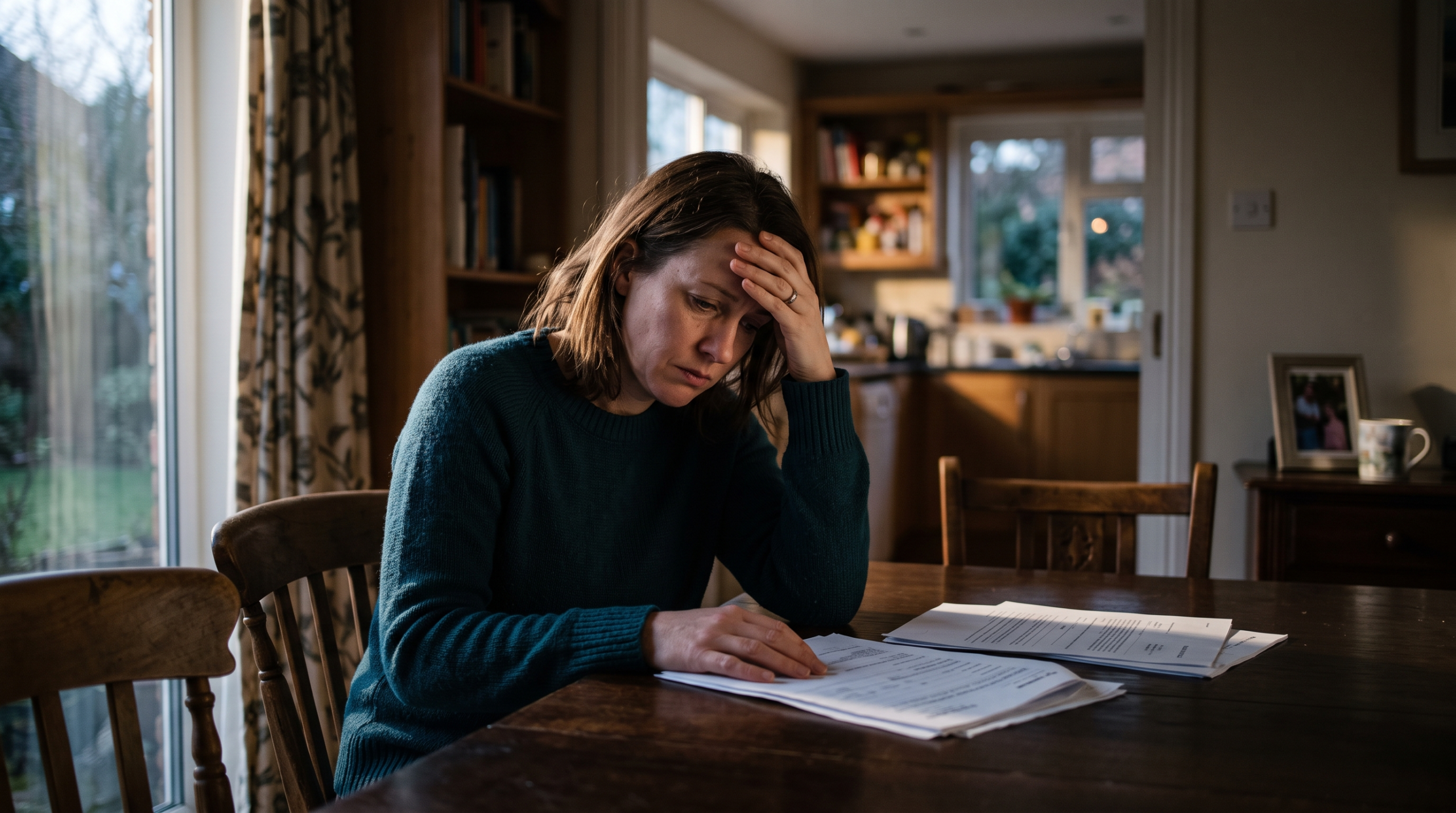
Three days after Dad died, I sat at the dining table beneath the brass light he had installed himself, watching Sylvia arrange a stack of estate documents into neat, merciless piles.
The house still smelled like him. Coffee grounds in the kitchen bin. Cedar from the hall closet. The faint medicinal scent of the bedroom where he had spent his last days. Every room seemed to hold its breath, as if grief had become another person living among us.
Derek sat across from me with his arms folded. He had not cried at the funeral. Not in front of me, anyway. He had stood beside the grave with his jaw clenched and one hand in his coat pocket, looking less like a son saying goodbye than a man waiting for a meeting to end.
I kept my hands in my lap so he would not see them shaking.
Dad had promised us the same thing for years. He would tap the side of his coffee mug, look from me to Derek, and say that the estate would be divided equally.
“Half for you, half for your brother,” he had told me the last time I visited. “That way, when I’m gone, neither of you has a reason to fight.”
I had believed him because Dad had always treated promises like contracts. He wrote appointments on calendars. He kept receipts from twenty years earlier. He never borrowed a tool without returning it to the exact place where he found it.
The estate documents on Sylvia’s side of the table represented one million dollars, not counting the memories packed into the walls around us. Dad had built that money slowly—through the hardware business, careful investments, and the kind of frugality he sometimes disguised as stubbornness.
I looked at the papers and thought of the number he had repeated whenever Derek and I argued about money.
“One million isn’t enough to ruin a family,” Dad used to say.
He had been wrong about that.
Sylvia removed her glasses, polished them with a square of cloth, and placed them back on her nose. She was an older woman with silver hair cut close to her jaw and a voice that never rose, even when the words themselves carried weight.
“I’ll begin with the accounts and beneficiary designations,” she said.
Derek shifted in his chair. “Do we need to go through every account?”
“Yes,” Sylvia answered. “That is what we are here to do.”
He glanced at me as though I had arranged the meeting to inconvenience him. I stared at the grain in the table instead.
Sylvia opened a folder marked with Dad’s full name. The paper made a dry whisper as she turned the first page.
“Your father maintained several accounts,” she said. “Checking, savings, investment, and retirement accounts. There is also the brokerage account and the proceeds from the sale of the northern property.”
I tried to listen, but each category blurred into the next. The words sounded clinical, detached from the man who had kept coins in a ceramic bowl by the back door and saved birthday cards because he disliked throwing away handwriting.
Then Sylvia stopped turning pages.
Her pause pulled my attention upward.
“The beneficiary designation on these accounts lists Derek as the sole beneficiary.”
For a moment, I thought I had misunderstood her.
The brass light buzzed overhead. Somewhere in the kitchen, the refrigerator clicked off.
I looked at Derek. He did not look surprised.
“What does sole mean?” I asked.
Sylvia’s expression softened, though her voice remained precise. “It means the accounts pass directly to Derek. They do not enter the general estate for division between the heirs.”
My throat tightened. “All of them?”
“The accounts covered by this designation,” she said. “Yes.”
Derek leaned back. The leather of his chair creaked beneath him.
I turned toward him. “You knew?”
“I knew Dad had made arrangements,” he said.
“That wasn’t what I asked.”
His mouth tightened into a thin line. “I knew I was listed.”
The room seemed to tilt. I pressed my palm against the table to steady myself.
Dad had promised a 50/50 split. Not vaguely. Not once, years ago, in passing. He had told me after his surgery, when his hands were still bruised from the hospital needles. He had told me in the driveway last winter while scraping ice from my windshield. He had told me the morning I left for home.
Half for you. Half for your brother.
I looked at the folder again, expecting the ink to rearrange itself.
“Maybe this is an error,” I said.
Sylvia folded her hands over the documents. “That is possible. It will need to be examined carefully.”
Derek gave a short, humorless laugh. “It’s not an error.”
The sound struck harder than his words.
I turned to him. “Then why didn’t you tell me?”
“You were grieving.”
“We were both grieving.”
“You were three states away until the funeral.”
“I came as soon as I knew.”
“You came after he was already gone.”
His words landed with the force of an accusation, though I could not understand what crime I had committed by arriving too late to say goodbye.
Sylvia lifted one hand. “This meeting is not the place for personal arguments.”
Derek looked away, but the corner of his mouth remained hard.
I reached toward the papers. “May I see the designation?”
Sylvia hesitated before sliding the folder across the table.
The top page was a bank form printed in black ink. Dad’s name appeared near the top. Below it were boxes, account categories, and a beneficiary section.
My eyes moved over the lines without taking them in.
Then I saw Derek’s name.
It sat alone beneath the word “beneficiary.”
No Clara.
No equal division.
Just Derek.
I gripped the edge of the page. The paper trembled against my fingers.
“Could Dad have changed this without telling me?” I asked.
Sylvia did not answer immediately. “People can revise beneficiary designations when they choose, provided the institution accepts the change.”
“But he told me—”
I stopped.
Dad’s promise suddenly felt embarrassingly fragile. It had lived in conversations, in memory, in the trust between a father and daughter. Derek’s name lived on paper.
I looked at the date printed in the corner.
The form was not old.
I leaned closer, certain I had read it wrong.
The date was the day before Dad died.
My breath caught.
I traced the printed numbers with my eyes, refusing to let the meaning settle. Dad had been alive that day. He had been in the house. I remembered calling and hearing his voice answer, weaker than usual but unmistakably his.
The form had been updated one day before his death.
I lifted the page. “Sylvia.”
She watched me carefully. “Yes?”
“This date.”
Derek’s chair scraped against the floor.
I kept my finger beside the printed date. “It says this was changed the day before Dad died.”
No one spoke.
The silence stretched long enough for me to hear the clock in the hallway count off another minute.
Sylvia reached for the paper, but I held on to it.
“Who submitted this?” I asked.
“I don’t have that information in this folder,” she said. “The bank’s records would show how and when it was processed.”
“Was Dad even able to do this?”
Derek exhaled sharply. “Of course he was.”
I turned toward him. “He was dying.”
“He was still competent.”
“I didn’t say he wasn’t.”
“You’re implying it.”
“I’m asking how a form changed the day before he died when he had already made his wishes clear.”
Derek’s eyes hardened. “Maybe his wishes changed.”
The words seemed too smooth, too ready. He had not needed time to consider them.
I lowered the page. “You knew about this.”
“I told you, I knew I was listed.”
“You knew Dad had changed everything.”
“I knew he trusted me.”
The room went cold despite the warm afternoon outside.
Sylvia drew the form gently from my hand and placed it back on the table. “We need to avoid assumptions until the documentation is reviewed.”
Derek leaned forward, bracing both hands against the table. “There’s nothing mysterious here. Dad made a decision. Clara just doesn’t like it.”
“I don’t like being told that my father reversed years of promises without saying a word to me.”
His gaze did not soften. “Maybe he didn’t say anything because you lived so far away.”
I stared at him.
Derek’s voice remained flat, almost bored. “You built your life out of state. You visit when you can, call when you remember, and then you expect Dad’s money to be divided like you were here every day.”
“That is not what happened.”
“Isn’t it?”
“I spoke to him every week.”
“And I was the one who drove him to appointments. I was the one who handled his bills. I was the one in this house.”
“I never denied that.”
“Then stop acting shocked that he changed his mind.”
My fingers curled beneath the table.
Sylvia gathered the documents into a single stack. “For clarity, Derek is claiming that your father intentionally changed the beneficiary designation because Clara lived out of state.”
Derek’s jaw moved. “I’m not claiming it. I’m telling her what happened.”
“No,” I said. “You’re telling me what you want me to believe.”
His eyes flashed. “Be careful.”
The warning was quiet, but it filled the space between us.
I looked past him toward the hallway. Dad’s study door stood half open. The room beyond it was dim, the curtains still drawn from the day we brought him home after the hospital.
For years, Dad had kept a small journal in the top drawer of his desk. He wrote in it almost every evening. I knew because, when I was a child, I had once asked what he was recording, and he had closed the cover over his hand.
“Things I don’t want to forget,” he’d said.
The thought came to me suddenly, so sharply that I almost stood before deciding whether to.
If Dad had changed his mind, maybe he had written it down.
I pushed my chair back.
Derek watched me. “Where are you going?”
“To Dad’s study.”
“You can’t start taking things.”
“I’m not taking anything.”
Sylvia looked from him to me. “Clara, if you find personal records, leave them where they are until we can inventory the contents.”
“I just want to look at his journal.”
Derek’s expression shifted for the first time. It was small—only a tightening around his eyes—but I saw it.
“Why?” he asked.
“Because I want to know what Dad wanted.”
“You already know what he wanted. He wanted me to have the accounts.”
“That isn’t what he told me.”
“Then maybe he was telling you what you wanted to hear.”
I walked away before he could say anything else.
Dad’s study smelled of dust, wool, and the cedar oil he used on the desk. His chair was pushed back at an angle, as though he had just stood up and intended to return. A magnifying glass lay beside a stack of unopened mail. His reading glasses rested on top of a newspaper folded to the crossword puzzle.
I stood in the doorway and fought the urge to apologize for entering.
Then I crossed to the desk.
The top drawer held pens, old receipts, a tape measure, and three rolls of peppermints. The second held tax papers and warranty cards. The third stuck halfway, just as it had when I was a girl.
I pulled harder.
The drawer opened with a wooden groan.
At the back, beneath a bundle of envelopes, I found the journal.
Its brown cover was worn smooth along the spine. I held it against my chest for several seconds, feeling the weight of it.
Behind me, the floor creaked.
I turned.
Derek stood in the doorway.
“What are you doing?” he asked.
I kept one hand on the journal. “Looking for Dad’s records.”
“You heard Sylvia. You’re supposed to leave everything alone.”
“She said to leave personal records for the inventory. She didn’t say I couldn’t read them.”
Derek stepped into the room. “Give me that.”
“No.”
His face darkened. “Clara.”
I opened the journal.
Most of the pages contained ordinary entries—appointments, repairs, reminders to call the insurance company. Dad’s handwriting slanted sharply to the right, growing less steady near the final pages.
I turned forward, scanning dates.
Derek came closer. “You’re making this worse.”
“For whom?”
He did not answer.
Near the end, I found an entry dated less than a week before Dad died.
The ink was uneven, but the words were clear.
I read the first line silently. Then I read it again.
Clara and Derek will receive equal shares. I have told them both this, and I want it settled fairly so there is no bitterness after I am gone.
My breath stopped.
Below that, Dad had written more.
No matter where Clara lives, she is my daughter. Distance does not change that.
The journal shook in my hands.
Derek reached for it.
I pulled it against my chest and stepped backward.
He stared at me. “What does it say?”
I looked at my brother, at the man who had just told me Dad changed his mind because I lived far away.
Then I looked down at Dad’s final words.
For the first time since the funeral, my grief made room for something else.
Suspicion.
Derek reached for the journal.
I pulled it against my chest and stepped backward.
He stared at me. “What does it say?”
I looked at my brother, at the man who had just told me Dad changed his mind because I lived far away.
Then I looked down at Dad’s final words.
For the first time since the funeral, my grief made room for something else.
Suspicion.
Derek’s hand fell to his side.
“You went through his desk,” he said.
“I found something in his desk.”
“You had no right.”
“I’m his daughter.”
“And I’m his son.”
The words came out sharp, almost triumphant, as though being Dad’s son gave him authority over every drawer, every account, and every memory left in the house.
I closed the journal. “That never made you his only child.”
His jaw tightened.
For a moment, I thought he might try to take it from me. Instead, he turned and walked out of the room.
The front door slammed hard enough to shake the glass in the picture frames.
I stayed in the doorway with Dad’s journal pressed to my ribs. In the quiet that followed, I heard a car start outside. Tires scraped over the gravel, then faded down the road.
I read the entry again.
Clara and Derek will receive equal shares.
Dad had written it less than a week before he died. The promise I had carried across two states was no longer only a memory in my head. It existed in his handwriting.
I tucked the journal beneath my sweater and carried it to the kitchen.
Before I could decide where to hide it, a vehicle pulled into the driveway.
This time, the engine did not fade away.
The back doors opened. Cardboard struck the pavement. Then another box landed beside it.
Derek came through the front door carrying a plastic storage bin against his hip.
I stood beside the kitchen table. “What are you doing?”
He set the bin down and went back outside.
When he returned, he had two flattened boxes under one arm. “Moving my things.”
“Your things are already in the house.”
“Not all of them.”
He walked past me toward the staircase.
I followed him into the hall. “Sylvia said the estate inventory wasn’t finished.”
“Sylvia said a lot of things.”
“She said neither of us should remove property until everything was documented.”
He stopped on the first stair and looked back. “This isn’t property. These are my belongings.”
“You brought empty boxes.”
“I’m taking what belongs to me.”
His voice had a calmness that made it worse. He sounded as if he had already settled the matter and was waiting for me to catch up.
I saw him glance toward the living room, where Dad’s grandfather clock stood beside the fireplace.
“You’re not taking that,” I said.
Derek followed my gaze. “Dad gave it to me.”
“He told me it would stay in the house.”
“Then you can put that in your list of things he supposedly promised you.”
He climbed the stairs.
I moved in front of him. “You’re not removing anything until Sylvia tells us what’s allowed.”
Derek’s expression hardened. “You’re confused about the situation.”
“I’m confused about why you’re acting as though the funeral is over and you’ve already won.”
His eyes went flat.
Then he reached into his jacket and pulled out a folded sheet of paper. He held it up between us without offering it to me.
“You should read this.”
I took it.
The page was not from Sylvia. It was a typed notice with Derek’s name at the bottom.
You are required to vacate the premises immediately. Personal belongings left after departure may be removed or discarded.
I looked at the words, then at him. “What is this?”
“A notice.”
“You can’t evict me.”
“I can tell you to leave.”
“You don’t own this house.”
“Neither do you.”
His answer struck harder than I expected.
I folded the paper once. “I’m staying.”
“Then I’ll have you removed.”
“Go ahead.”
His face changed—not with anger exactly, but with surprise that I had not stepped aside.
He came down one stair. “You think the journal changes anything?”
“It proves Dad meant to split everything equally.”
“It proves he wrote something in a notebook.”
“It proves you lied about what he wanted.”
Derek snatched the notice from my hand.
“You have until tonight,” he said. “Pack your clothes and leave the rest. I’m not coming back to find you sleeping in this house.”
“You just said you were taking your things.”
“I’ll be taking the house too.”
He walked into the living room and picked up a framed photograph from the mantel. It showed Dad standing between us at a lake, his arm around each of our shoulders. Derek turned it facedown inside one of his boxes.
I crossed the room. “Put that back.”
He did not look at me. “You’re making this difficult.”
“No. I’m refusing to disappear.”
He placed the photograph into the box and folded the flaps closed.
The cardboard scraped against the floor as he dragged it toward the front door.
I watched the box pass over the threshold.
For years, I had thought the worst thing about losing Dad would be the silence he left behind.
I had been wrong.
The worst thing was hearing my brother fill that silence with orders.
When Derek finally left, he took three boxes and the framed photograph. He did not take the clock. Not yet.
I locked the door behind him, though the lock felt meaningless.
Then I carried Sylvia’s paperwork from the dining room to the kitchen table.
The beneficiary form lay beneath the estate summary. I had looked at it earlier without truly seeing it. Now I placed Dad’s journal beside the page and studied every line.
The form named Derek as the sole beneficiary.
The date sat near the top.
It had been signed the day before Dad died.
I ran my finger along the photocopied signature.
Dad’s name was familiar to me in hundreds of forms and birthday cards, on the backs of envelopes and the labels of tools he had loaned me. His handwriting usually leaned forward with confidence. Even when his hands had begun to tremble, the first stroke of his name remained firm.
This signature did not.
The letters seemed pressed too carefully into place. The first name began with a dark, hesitant curve. The final letter wavered, then lifted abruptly.
I brought the page closer to the window.
The line around the signature looked darker in some places and unnaturally pale in others, as if a pen had followed an existing mark instead of making one clean stroke.
I turned the page sideways.
A cold feeling moved through me.
The signature looked traced.
I set the form down, then picked it up again. Perhaps I wanted to be wrong so badly that my eyes had started inventing patterns.
I found one of Dad’s old checks in the desk drawer. His signature stretched across the bottom in a single decisive motion. The final letter curled beneath the rest like a hook.
I placed the check beside the beneficiary form.
The difference was not subtle anymore.
The signature on the new form had the same basic shape, but none of Dad’s movement. It looked like someone had copied what his hand did without understanding how his hand did it.
I took a photograph of both pages with my phone.
My thumb hovered over Sylvia’s number.
Calling her felt like admitting the situation had become something larger than a family argument. It meant putting Dad’s final days under a harsh light, where every conversation and every signature could be examined.
I pressed the call button.
Sylvia answered on the fourth ring. “Clara?”
“I need you to look at something.”
“Are you at the house?”
“Yes.”
“Is Derek there?”
“No. He came by with boxes.”
There was a pause. I heard papers moving on her end.
“What did he take?” she asked.
“A photograph. Some of his belongings. He also left a notice telling me to leave tonight.”
Sylvia’s voice sharpened. “Did he threaten you physically?”
“No. He threatened to have me removed.”
“That is different, but it is not acceptable. Keep the notice.”
“I will.”
I looked down at the beneficiary form. “I found Dad’s journal.”
“Tell me what it says.”
I read Dad’s entry aloud. My voice caught once, but I kept going.
When I finished, Sylvia was silent for several seconds.
“Clara,” she said carefully, “that is important evidence of his intent. It may not, by itself, override a beneficiary designation, but it matters.”
“I know.”
“No, listen to me. Do not confront Derek alone about the form.”
“I already confronted him.”
“About the form?”
“About the journal.”
“That is not the same thing.”
I stared at the photocopied signature. “The signature looks wrong.”
“How wrong?”
“Shaky. Like it was traced.”
“Send me the photograph.”
I did.
While she opened it, I heard my own breathing through the phone.
Then Sylvia said, “I’m looking at it.”
“What do you see?”
“I see a photocopy, so I cannot tell you whether the original ink was altered. But the signature is irregular.”
“I’m not imagining it.”
“No. You are not.”
Relief came first.
Then Sylvia continued.
“The problem is that the bank accepted this form.”
I gripped the phone harder. “So?”
“So the designation is currently treated as valid.”
“But it was dated the day before Dad died.”
“That raises questions. It does not automatically invalidate the document.”
“What happens to the money?”
“Unless we can prove forgery or incapacity or some other legal defect, the bank will follow the accepted form.”
I looked toward the locked front door. “Derek gets everything.”
“Right now, Derek is listed as the sole beneficiary of the accounts.”
The sentence seemed to drain the warmth from the kitchen.
I pressed my free hand against the table. “Even with Dad’s journal?”
“Even with the journal, until we establish that the form is not genuine.”
I closed my eyes.
Dad’s voice returned to me from months earlier, over a video call when I had apologized for missing one of his doctor’s appointments.
We’ll make it fair, Clara. You and Derek. Fifty-fifty. No arguments.
I had trusted the promise because it sounded like him.
Now the bank trusted a page that looked as though someone had imitated him.
“What should I do?” I asked.
“Get every document you can. Keep the original paperwork in one place. Photograph the form, the journal entry, and Derek’s notice. Do not give him anything.”
“I need proof of who submitted it.”
Sylvia exhaled softly. “The bank may have records.”
“Security footage.”
“That could help.”
“I’m going to the branch.”
“Clara, be calm when you go.”
“I am calm.”
“You sound like you’re about to break down a door.”
“I’m going to ask for the footage.”
“And if they refuse?”
“Then I’ll ask again.”
Sylvia did not argue. “Take your identification. Take the estate documents. Write down the names of everyone you speak with.”
I gathered the papers into a folder.
“And Clara?”
“Yes?”
“Do not tell the bank what you suspect before you know who can help you.”
I looked once more at the copied signature.
“I think I’m already too late for that.”
The local branch sat beside a pharmacy on Main Street, in the same low brick building where Dad had opened his first account. I drove there with the folder on the passenger seat and the journal tucked beneath my coat.
I kept expecting Derek to call.
He did not.
At the bank, an electronic chime sounded when I opened the glass door. Two customers sat in the waiting area. A woman at the nearest desk looked up, then returned to her computer.
I walked to the counter.
“I need to speak with the manager,” I said.
The clerk behind the counter glanced at my folder. “Can I ask what this concerns?”
“My father’s account. A beneficiary form was submitted here the day before he died.”
The clerk’s fingers paused above the keyboard.
“I need to see the security footage from that day.”
“Are you the account holder?”
“No. I’m his daughter and the executor is handling the estate.”
The clerk looked toward a closed office at the rear of the branch.
“I need the manager,” I repeated.
A man in a dark suit emerged from the office. He was carrying a tablet and wearing a name badge I could not read from where I stood.
“I’m the branch manager,” he said. “How can I help you?”
I placed the folder on the counter but kept my hand over it.
“My father died three days ago. A beneficiary form was submitted here the day before he died, naming my brother as the sole beneficiary. I believe the signature may have been forged.”
The manager’s expression did not change.
“I’m requesting the security footage from that day,” I continued. “I want to see who came in and submitted it.”
The manager looked at the folder, then at me.
“I need you to review the footage,” I said. “Today.”
The manager folded his hands over the tablet.
“I understand this is upsetting,” he said, “but we cannot release security footage to a family member based on a verbal request.”
“I’m not asking for someone else’s account information. I’m asking to see who walked into this branch and handed over a form.”
“The footage is bank property.”
“Then preserve it.”
His eyes narrowed slightly. “Preservation requests must come through the proper channel.”
“What is the proper channel?”
“A court order.”
The answer landed with such finality that for a moment I could hear everything around us—the soft printer behind the counter, the electronic chime at the door, the low murmur of the two customers waiting near the windows.
“My father is dead,” I said. “The form was submitted one day before he died. The bank accepted it, and now my brother is claiming a million-dollar estate. If there is footage showing him submitting that form, why would you let it disappear?”
“The footage will not disappear.”
“How do you know?”
“Because our retention policy is monitored.”
“Then let me see it.”
“I can’t do that without a court order.”
I pressed my palm against the folder. Beneath it, Sylvia’s copies shifted against one another. I had brought the estate documents, my identification, the journal, and the suspicious form. I had followed every instruction Sylvia gave me.
The manager had answered none of my questions. He had only placed a locked door between me and the truth.
“I’m the executor’s daughter,” I said.
“You are not the executor.”
“Then contact the executor.”
“If Ms. Hale submits a formal request, we will respond through the appropriate legal process.”
“Sylvia Hale is the estate lawyer. You know that.”
“I’m sure she can advise you.”
His polite tone made my throat tighten. He was not angry. He was not confused. He was dismissing me with the calm confidence of someone who knew I had no power inside his branch.
I opened the folder and pulled out the beneficiary form.
“This is the document your bank accepted.”
The manager looked down at it without touching it. “I can’t discuss account records at the counter.”
“You already told me you can’t show me footage. Now you can’t discuss the form either?”
“I’m asking you to leave the documents with the estate attorney.”
“My attorney has the documents.”
“Then she can contact our legal department.”
“I am contacting you.”
“You have contacted the branch.”
I stared at him. “And?”
“And I’ve explained that we cannot release security footage without a court order.”
Behind me, the door chimed again. A man entered carrying a paper bag, and the nearest waiting customer glanced toward us before looking away. I lowered my voice, though the manager had not lowered his.
“Please preserve the footage,” I said. “I want that request documented.”
“You may submit it in writing.”
“Give me the form.”
“Our legal department can provide instructions.”
“Give me the form.”
The manager’s jaw moved once. He tapped something on his tablet.
“I have to ask you to leave if you continue disrupting the branch.”
The threat was quiet, almost gentle. That made it worse.
I looked past him toward the closed office where he had appeared from. Somewhere in that building, a recording might show the exact moment my father’s wishes had been replaced. Somewhere, the person who brought in that form might already be protected by the bank’s procedures.
“Who was working here that day?” I asked.
“I can’t discuss employee schedules.”
“Who accepted the form?”
“I can’t discuss internal transactions.”
“Was my brother here?”
“I can’t confirm or deny customer activity.”
“He is not the account holder. He is the beneficiary.”
“I’ve answered your questions.”
“No,” I said. “You have avoided them.”
The manager’s expression hardened.
“Please leave the branch.”
I gathered the folder. My fingers had begun to shake, and I hated that he could see it. I slid the beneficiary form back between the other papers, then tucked the journal beneath my coat.
At the door, I turned around.
“If the footage is erased while I’m trying to get a court order, will you tell the court that?”
The manager did not respond.
That silence followed me outside.
The afternoon air was colder than it had been when I arrived. I stood on the sidewalk beside the pharmacy, holding the folder against my chest while cars moved along Main Street. Through the bank’s glass front, I could see the manager return to his office.
He did not look back.
I had come there expecting a locked file, a formal process, maybe even suspicion. I had not expected to feel as though I had been the one accused of doing something wrong.
My phone vibrated.
For one wild second, I thought Derek had finally called. I pulled it from my pocket, but it was only a message from Sylvia asking how the visit had gone.
I typed, They refused. They said I need a court order.
I watched the message send.
Then another vibration came.
This time, it was not my phone.
A man stood a few feet away near the edge of the parking lot. I recognized him vaguely from inside the branch. He had been behind the counter at a side station, quiet enough that I had barely noticed him. He wore a pale blue shirt and a name badge.
Marcus.
He looked toward the bank entrance, then back at me.
“Are you Clara?” he asked.
My hand closed around my phone. “Who are you?”
“Marcus. I work inside.”
“I know.”
He glanced through the glass doors. The manager’s office remained closed.
“You should go,” Marcus said.
“I was just told to leave.”
“That’s not what I mean.”
A tightness formed beneath my ribs. “What do you mean?”
Marcus reached into his jacket pocket. His fingers hesitated around something small and folded.
“I can’t talk here.”
“If you have something to say, say it.”
His eyes moved toward the bank again.
“I’m sorry,” he said. “I shouldn’t have stopped you.”
He began to turn away.
“Wait.”
He stopped but did not face me.
“If you know something about my father’s form, you need to tell me.”
“I don’t know enough.”
“Then tell me what you do know.”
A woman came out of the pharmacy, pushing a child in a stroller. Marcus stepped farther from the entrance, as though the ordinary movement around us made him nervous.
“I can’t give you anything official,” he said.
“I’m not asking for official.”
He pulled a folded piece of paper from his pocket and held it low between us.
“Call me tonight,” he whispered.
I reached for it.
Before the paper touched my hand, Marcus looked over my shoulder toward the bank. His face changed—not dramatically, but enough for me to understand that someone inside might be watching.
“Don’t mention my name in the branch,” he said.
Then he placed the note in my palm.
His fingers withdrew immediately.
I unfolded it only after he had crossed the parking lot and gone around the side of the building. A name was written across the paper in careful block letters.
Marcus
Beneath it was a phone number.
I read it twice.
At the bottom, he had added one sentence.
After seven. Not from inside the bank.
I folded the note and pushed it into the inside pocket of my coat. The paper seemed to burn against my ribs.
I looked through the glass doors again. The manager was still nowhere in sight. The clerk who had first spoken to me was entering something into a computer, his head bent low. Nothing appeared unusual.
That was what frightened me.
I drove home without calling Sylvia. I did not tell her about Marcus because I could already hear the questions she would ask. Who was he? What authority did he have? Had he made a copy? Had I seen the original?
I had no answers.
At home, I placed the bank note beside Dad’s journal on the kitchen table. The two objects looked absurdly harmless beside each other. One was a worn notebook filled with my father’s handwriting. The other was a scrap of paper from a bank employee who had asked me to wait until dark.
Derek called at six forty-three.
I watched his name appear on my screen until the call stopped.
A minute later, a message arrived.
You need to stop making accusations about the bank. Sylvia told me you went there.
I read it once, then again.
I had not told Derek I was going to the bank. Sylvia had known, but she had not mentioned that she would tell him.
My thumb hovered over the screen. I wanted to ask how he knew what I had requested. I wanted to ask whether he had been inside that branch the day before Dad died.
Instead, I placed the phone face down.
At seven minutes past seven, I carried it into the hallway, away from the kitchen windows, and dialed Marcus’s number.
He answered before the second ring finished.
“Marcus?”
“Yes.”
“It’s Clara.”
“I know.”
The quickness of his answer made me grip the phone harder. “How did you know?”
“I was expecting you.”
“Then talk to me.”
There was a pause on the line. I could hear faint traffic behind him and what sounded like a door closing.
“Are you somewhere private?” he asked.
“I’m home.”
“Is anyone with you?”
“No.”
“Your brother?”
“No.”
Marcus breathed out slowly.
“Tell me what happened,” I said.
“The manager refused to release the footage.”
“He said I need a court order.”
“That’s the policy.”
“Did you know he would refuse?”
“Yes.”
“Then why did you tell me to come?”
“I didn’t tell you to come.”
“No. Sylvia did. But you gave me your number.”
“I needed to know whether you would actually ask.”
The irritation rising in me pushed past my fear. “Ask what?”
“If you were willing to challenge the form.”
“I’ve been challenging it since I saw the signature.”
“I don’t mean privately.”
The line went quiet.
I walked to the kitchen table and looked at the journal. Dad’s final entry was still open where I had left it, his words pressed into the paper with the same stubborn certainty he had used when he promised Derek and me an equal share.
“What do you know?” I asked.
Marcus lowered his voice. “Your brother came in right at closing time.”
The room seemed to contract around me.
“When?”
“The day before your father died.”
I closed my eyes. The date on the submitted form had already felt like a deliberate wound. Now it had a place, an hour, a door opening after most of the day had ended.
“What time?”
“Just before we locked the doors.”
“Did he have the form with him?”
“He had paperwork.”
“That is not an answer.”
“I saw him carrying a folder.”
“Was Dad with him?”
“No.”
“Did Derek say my father had sent him?”
“Not at first.”
“What did he say?”
Marcus hesitated. “He said he needed to update a beneficiary document.”
I pressed my free hand to the table. “And the bank accepted it?”
“I processed the intake.”
“Was my brother nervous?”
“Yes.”
The word came too quickly to be polite.
“How nervous?”
“He kept looking toward the lobby. He asked how long the review would take. He asked whether anyone else would see the paperwork.”
My stomach turned.
“Why would he ask that?”
“I don’t know.”
“You do know something. You slipped me your number.”
Marcus was silent long enough that I could hear my own breathing.
“Derek’s behavior made me suspicious,” he said at last. “That’s why I acted.”
“What did you do?”
“I need you to understand that I could lose my job.”
“You may be the only person who can help me keep my father’s wishes from being stolen.”
“I know.”
“Then tell me.”
Another pause.
“After Derek left,” Marcus said, “I made a photocopy of the original form before it was replaced.”
My fingers went numb around the phone.
“Replaced by what?”
“I can’t explain everything over the phone.”
“You just told me you copied it.”
“I said I made a photocopy.”
“Where is it?”
Marcus’s voice dropped to almost a whisper. “Safe.”
“Safe where?”
“I’ll show you.”
“When?”
“Tomorrow.”
“No.”
“Clara—”
“No. You asked me to wait until tonight, and I did. You told me you had something, and now you want me to wait until tomorrow?”
“I’m trying to keep this from becoming worse.”
“It became worse when my brother took a million dollars from our father.”
“I don’t know what he took.”
“You know enough to copy the form.”
He stopped speaking.
I stared down at Dad’s journal, at the sentence I had read until the ink blurred: equal shares, no exceptions.
“Did the original form name me?” I asked.
Marcus did not answer.
“Marcus.”
“Yes,” he said.
The word struck harder than I expected.
“How?”
“It was a fifty-fifty split.”
I gripped the edge of the table.
“Dated when?”
“Years ago.”
My breath caught. The photocopy was not merely proof that I had once been included. It was proof that Dad had arranged the estate long before the final days of his illness.
“Why was it replaced?” I asked.
“I don’t know who replaced it.”
“But you know Derek submitted something at closing.”
“Yes.”
“And you know the form I was shown was not the one you copied.”
“I know the one I copied was different.”
“Different how?”
Marcus went quiet again.
I could feel the answer waiting between us, close enough to touch and still beyond my reach.
“Tell me,” I said.
“I’ll tell you when I show you the copy.”
“Tomorrow morning.”
“Not at the branch.”
“Where?”
“I’ll call you.”
“No. You’ll text me the address tonight.”
“I can’t.”
“Then I’ll come back to the bank tomorrow and say your name to the manager.”
His breathing changed.
“You wouldn’t.”
“I will.”
“Please don’t.”
“Then send me the address.”
For several seconds, neither of us spoke.
Finally, Marcus said, “I’ll text you.”
The call ended.
I remained at the kitchen table with the phone in my hand. The bank had denied me footage, but Marcus had given me something the manager could not take away: a time, a witness, and the promise of a photocopy.
Then my phone lit up again.
A new message appeared from Derek.
I know you’re talking to someone at the bank. Be careful who you trust.
I did not answer Derek’s message.
I took a screenshot of it instead, then placed my phone facedown beside Dad’s journal. The warning was meant to make Marcus look dangerous. It did the opposite. If Derek knew I had spoken to someone at the bank, then Marcus had been right to be afraid.
At six the next morning, my phone vibrated.
Meet me at the coffee shop on Linden Street at eight. Come alone.
There was no name attached, but I knew who had sent it.
I arrived early and sat with my back to the wall. Every time the door opened, my shoulders tightened. I hated that Derek had made suspicion feel like a permanent condition, something I carried into every room.
Marcus came in at eight minutes past the hour. He wore the same dark bank uniform, though his tie was loosened and his face looked drawn. He scanned the tables before spotting me.
I stood.
“You shouldn’t have come here in your uniform,” I said.
“I came straight from work.”
“Did anyone follow you?”
His eyes moved toward the window. “Not that I saw.”
That answer made my stomach turn.
Marcus sat across from me and placed a thin brown envelope on the table. He kept one hand over it.
“This is the original photocopy,” he said.
“Why is your hand on it?”
“Because once I give it to you, I can’t take it back.”
“You already took a risk making it.”
“I know.”
“Then don’t make me beg.”
He looked at me for a long moment. “I made the copy before Derek replaced the form in the bank’s file. I shouldn’t have done it without authorization, but I knew something was wrong. He came in right before closing, agitated, insisting the paperwork be processed that night. He kept checking the clock. He asked who would see the form afterward.”
“Because he wanted to avoid scrutiny.”
“Yes.”
“And the shaky signature?”
Marcus slid the envelope toward me. “Look.”
I opened it carefully.
The photocopy was gray and slightly blurred around the edges, but the words were clear. Dad’s name appeared beside mine and Derek’s, each assigned an equal share. The date was from years earlier, long before Dad’s final illness, long before the form Derek had presented to Sylvia.
For a few seconds, I could not breathe.
Dad had not changed his mind at the end.
He had made his decision when he was well enough to think about it, signed it when neither of us was standing over him, and left it in place for years.
My name was there.
My brother’s name was there.
Nothing had been taken from me until Derek tried to take it.
I pressed my fingertips against the photocopy without touching the ink.
“He kept this on file all these years?”
Marcus nodded. “That’s what I saw.”
“Why was it replaced?”
“I don’t know who physically removed it. I only know Derek submitted a new form, and afterward the older one was no longer in the active file.”
“Did you see him remove it?”
“No.”
“Then say exactly what you know.”
His jaw tightened. “I saw Derek hand the new form to the teller supervisor. I saw the supervisor place it in the file. I had already made the photocopy of the older form because Derek had asked several questions that didn’t make sense. The next day, when the file was reviewed, the older form was gone.”
I looked at the copy again.
“What questions?”
“He wanted to know whether the bank compared signatures. He wanted to know whether the notary was contacted. He asked if a beneficiary change could be processed before the account holder’s death certificate was filed.”
The coffee shop suddenly seemed too warm.
“He knew exactly what he was doing.”
Marcus lowered his voice. “I think he knew enough to be afraid of being caught.”
I placed the photocopy back in the envelope, but my hands had stopped shaking.
“Will you give a statement?”
His expression changed. Fear moved across it, followed by resignation.
“Yes,” he said. “If you need me to.”
“I do.”
He nodded once. “Then take it to your lawyer before you show it to anyone else.”
I called Sylvia from the parking lot.
She answered on the second ring.
“Clara?”
“I have the original beneficiary form.”
There was a pause. “What do you mean, the original?”
“Marcus made a photocopy before Derek submitted the new one. It shows Dad’s fifty-fifty split, dated years ago.”
“Where are you?”
I told her.
“Bring it to my office. Do not give Derek a copy. Do not leave it in your car. And do not confront him until I have reviewed it.”
“I already know what he did.”
“You suspect what he did,” Sylvia said. “There is a difference between suspicion and evidence. Bring me the evidence.”
I drove to her office with the envelope on the passenger seat. At every red light, I looked at it. The paper seemed impossibly thin for the weight it carried.
Sylvia examined the photocopy beneath a bright desk lamp. She read every line twice, then compared it with the beneficiary form Derek had given her.
Her face became still.
“This changes everything,” she said.
“It proves Dad intended an equal split.”
“It proves more than that. This form was executed years before the document Derek submitted. Unless there is a valid revocation, this is the controlling instruction.”
“Can you use a photocopy?”
“Not by itself to distribute the funds. But I can use it to stop distribution while we establish what happened. I’m filing an emergency notice with the bank and the court today.”
“To freeze the estate?”
“To freeze the estate assets,” she said. “No one will withdraw, transfer, or distribute anything until the dispute is resolved.”
Relief came first. Then anger.
“Derek will say I’m trying to steal from him.”
“Let him say it.”
“He threatened to put me out of Dad’s house.”
Sylvia looked up. “Did he threaten you in writing?”
I showed her the message.
I know you’re talking to someone at the bank. Be careful who you trust.
She read it without touching the screen.
“That is useful,” she said.
“Useful?”
“It shows consciousness of the bank inquiry. It may also show an attempt to intimidate you. Save the original message and do not answer it.”
I locked my phone.
“What happens now?”
“Now I submit the photocopy, Marcus’s statement, and the disputed form. Then we notify Derek that the estate is frozen and require him to explain the change.”
“And if he refuses?”
“Then the court will require him to explain it.”
Sylvia prepared the filings while I sat across from her, watching the photocopy disappear into a clear evidence sleeve. She called the bank. I heard her identify herself, state the account number, and direct the manager to place an immediate hold on the estate accounts.
When she ended the call, she said, “The freeze is in effect.”
The words did not feel real until she handed me the confirmation.
Estate assets restricted pending investigation.
For the first time since Dad died, Derek could not move faster than the truth.
Sylvia asked me to meet her at the house that afternoon. Derek was already there when we arrived.
His car sat crooked in the driveway. The trunk was open, and two cardboard boxes rested beside it. The sight of them carried me back to the day he had threatened to evict me, speaking about our childhood home as if Dad’s body had barely cooled and the house had already become a prize.
He stood in the entryway when I unlocked the door.
“You brought her,” he said.
Sylvia stepped inside behind me. “I am acting as Clara’s estate counsel.”
Derek looked at the envelope in my hand. His face changed before anyone said a word.
That was the first honest thing he had shown us.
“What is that?” he asked.
I placed the evidence sleeve on the dining table.
“The beneficiary form Dad signed years ago.”
Derek did not look at it.
Sylvia set a second folder beside it. “The estate assets have been frozen pending investigation. The bank has been notified that the later form is disputed.”
His eyes moved between us. “You can’t do that.”
“We already did,” Sylvia said.
“He changed it.”
“Then you can explain why the older form gives Clara and you equal shares.”
“He changed his mind after that.”
“Where is the revocation?” Sylvia asked.
Derek opened his mouth, then closed it.
“Where is the appointment record showing Dad signed a new form with a licensed notary?” she continued.
“He was sick,” Derek said. “He didn’t keep track of everything.”
“Where is the notary?”
“He came to the house.”
“What was his name?”
Derek rubbed both hands over his face. “I don’t remember.”
Sylvia removed the later form from her folder and laid it beside the photocopy.
“Then perhaps you can explain the signature.”
Derek glanced down.
The signature on the later form was thin and unsteady, with the same letters dragged through twice. It had seemed suspicious when I first saw it, but beside Dad’s older signature, the truth was unmistakable. The newer one did not look like a tired hand. It looked like someone had tried to imitate the shape of a signature and lost control of the pen.
“You traced it,” I said.
Derek flinched.
I had imagined this moment for days. I had imagined him shouting, denying everything, blaming Sylvia, blaming the bank, blaming me for living too far away.
I had not imagined him becoming small.
“I didn’t have a choice,” he said.
“There is always a choice not to forge our father’s name.”
“You don’t understand.”
“Then make me understand.”
He looked at the boxes by the door. “I owed money.”
“How much?”
He gave a hollow laugh. “More than I could pay.”
“From what?”
He did not answer.
Sylvia’s voice hardened. “Mr. Hale.”
Derek sat down.
“It started with sports betting,” he said. “I thought I could fix it before anyone knew. Then I borrowed to cover the losses. Then I borrowed again to pay the first loan. By the time Dad got sick, I was buried.”
I felt the room tilt.
“You used Dad’s illness to plan this?”
“I thought I could pay everything back once the accounts transferred.”
“You knew he intended to split the estate.”
“He kept saying that.”
“And you knew the old form would give me half.”
“I needed the whole amount.”
“So you forged his signature.”
Derek stared at the table.
“Yes.”
The word landed quietly. There was no dramatic crack in the room, no sudden release. Only the sound of the clock in the hallway and my own breathing.
Sylvia pointed to the notary stamp on the later form.
“What about this?”
Derek swallowed. “I bought the stamp online.”
I looked at the circular mark beside Dad’s signature.
The stamp had bothered me from the beginning. Its edges were too sharp, its ink too dark, and the notary number looked wrong. Sylvia had checked it against the state registry that morning. The commission number did not belong to the notary named on the form. When I searched the image, I found the same customizable seal advertised online as a rubber stamp for novelty documents. It had never belonged to a licensed notary.
“That stamp was fake,” I said.
“Yes.”
“The signature was traced.”
“Yes.”
“You rushed to the bank at closing because you knew the form wouldn’t survive questions.”
Derek closed his eyes.
“Yes.”
Each answer removed another piece of the fog. The strange date, the shaky signature, his urgency, his warning, his boxes by the door—none of it had been accidental. He had built a lie quickly because he believed grief would make me too slow to challenge it.
Sylvia gathered the documents.
“I am submitting the photocopy, Marcus’s statement, the disputed form, the false notary information, and Derek’s admission to the authorities.”
Derek stood abruptly. “Wait.”
“No,” I said.
His eyes found mine.
“Clara, I can fix this.”
“You already said that about your debts.”
“I’ll repay everything.”
“With what?”
“I can sell the house.”
“You don’t own the house.”
His face twisted. “You’re going to put me out?”
“No,” I said. “The law will decide what happens to you. But you will not touch Dad’s estate again.”
He took one step toward me.
Sylvia moved between us. “Do not approach her.”
Derek stopped.
I looked at my brother and saw the boy who had once stolen the best piece of pie from my plate, the man who had called me whenever Dad needed a ride, the stranger who had stood in this same house and threatened to erase me from our father’s life.
I wanted him to apologize. I wanted him to become someone I could forgive.
Instead, he said, “You’re destroying me.”
“No,” I told him. “You did that when you forged his name.”
The police report was filed that evening.
Derek was charged with fraud and forgery. The evidence included the fraudulent beneficiary form, the fake notary stamp, the bank records showing his rushed submission, Marcus’s account of what he had seen, and Derek’s own confession. His gambling debts remained his responsibility. The estate would not be used to rescue him.
I gave my statement without looking at him.
When the investigator asked whether I wanted to press charges, I answered clearly.
“Yes.”
The word hurt, but it did not feel cruel. It felt like a boundary finally spoken aloud.
The estate remained frozen while the court reviewed the evidence. Sylvia handled the paperwork. Marcus provided his statement and testified about the photocopy. The bank corrected its records and acknowledged that the later form should never have replaced the older one.
Months passed before the restriction was lifted.
By then, the house felt less like home than a room where an injury had occurred. Every doorway held a memory of Dad. His coat still hung in the hall. His reading glasses remained beside the chair. The dining table carried the faint circular mark from the coffee mug he had used every morning.
Sylvia came to the house with the final distribution documents.
“The accounts have been divided according to the original beneficiary form,” she said. “Your share is secured. Derek’s share is being held according to the court’s orders while his criminal case proceeds.”
I signed where she indicated.
My hand did not shake.
“You can keep the house,” Sylvia said. “Or sell it. That decision is yours.”
I walked through the rooms alone after she left.
In the kitchen, I opened Dad’s journal to the page I had read so often. The sentence was still there.
Equal shares, no exceptions.
I ran my finger beneath the words.
Dad had kept his promise. Derek had tried to make me believe that the promise had never existed, but the truth had survived in a bank file, in Marcus’s careful photocopy, and in Dad’s own handwriting.
I decided to sell the house.
Not because Derek had threatened to take it from me, and not because the rooms were poisoned beyond repair. I sold it because I wanted the next place to belong to the life I chose, not to the argument my brother had created over our father’s death.
On the final afternoon, I stood in the empty living room with the keys in my palm. The buyers would arrive the next morning. Sylvia had already confirmed the sale. The estate was settled, my inheritance was secure, and Derek was awaiting trial for fraud.
I had cut off all contact with him. I did not answer his letters through Sylvia, and I did not accept the calls that came from numbers I did not recognize. Protecting Dad’s final wishes meant accepting that I could not protect my brother from the consequences of his own choices.
Before I left, I went to the kitchen and placed Dad’s journal in a box beside the photocopy of the original beneficiary form. I kept both.
Then I turned off the lights one room at a time.
At the front door, I looked back at the house where my father had raised us, where Derek had lied, and where the truth had finally stood its ground.
I locked the door, put the key in the mailbox for the new owners, and walked toward my car without looking back.