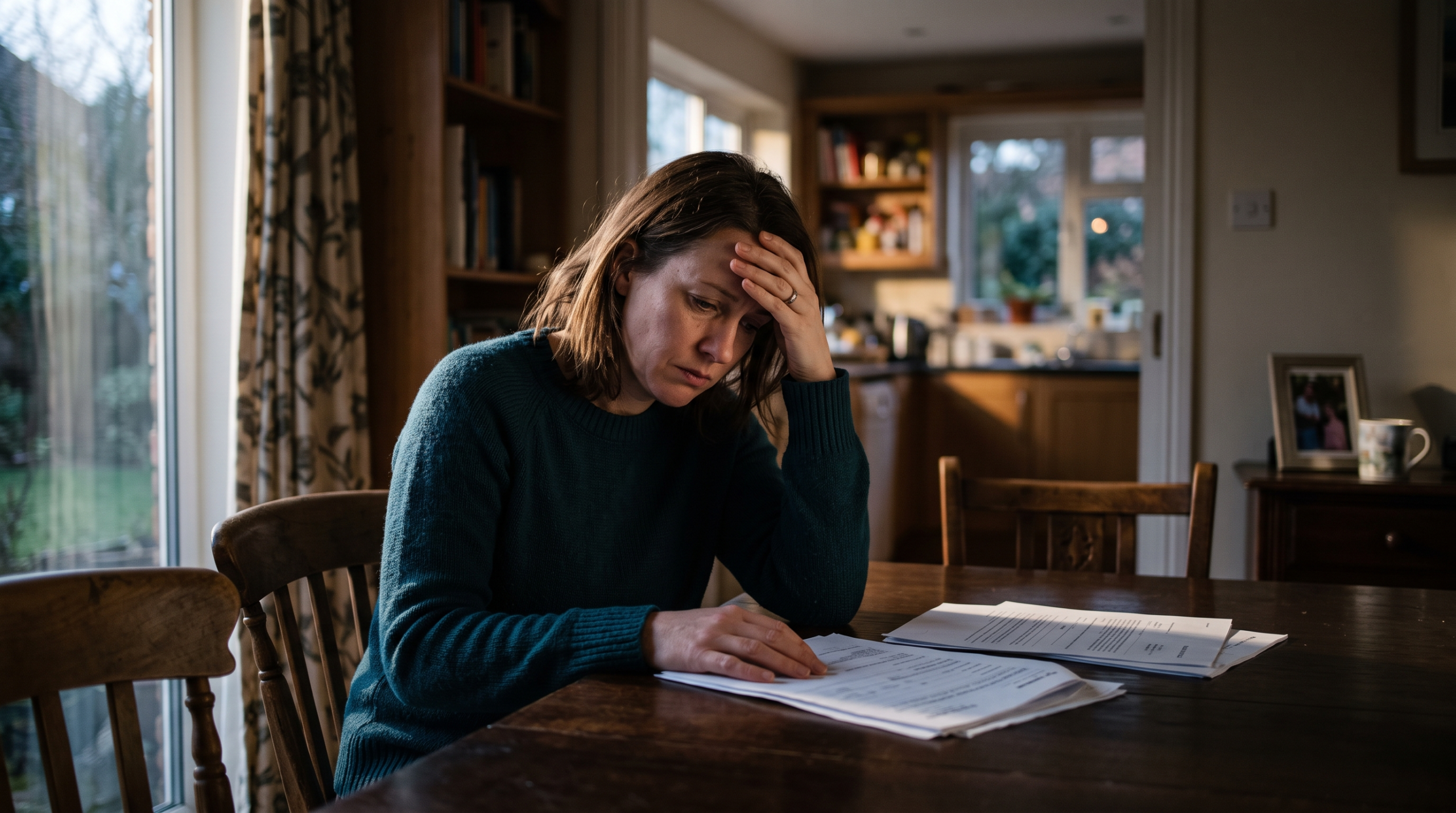
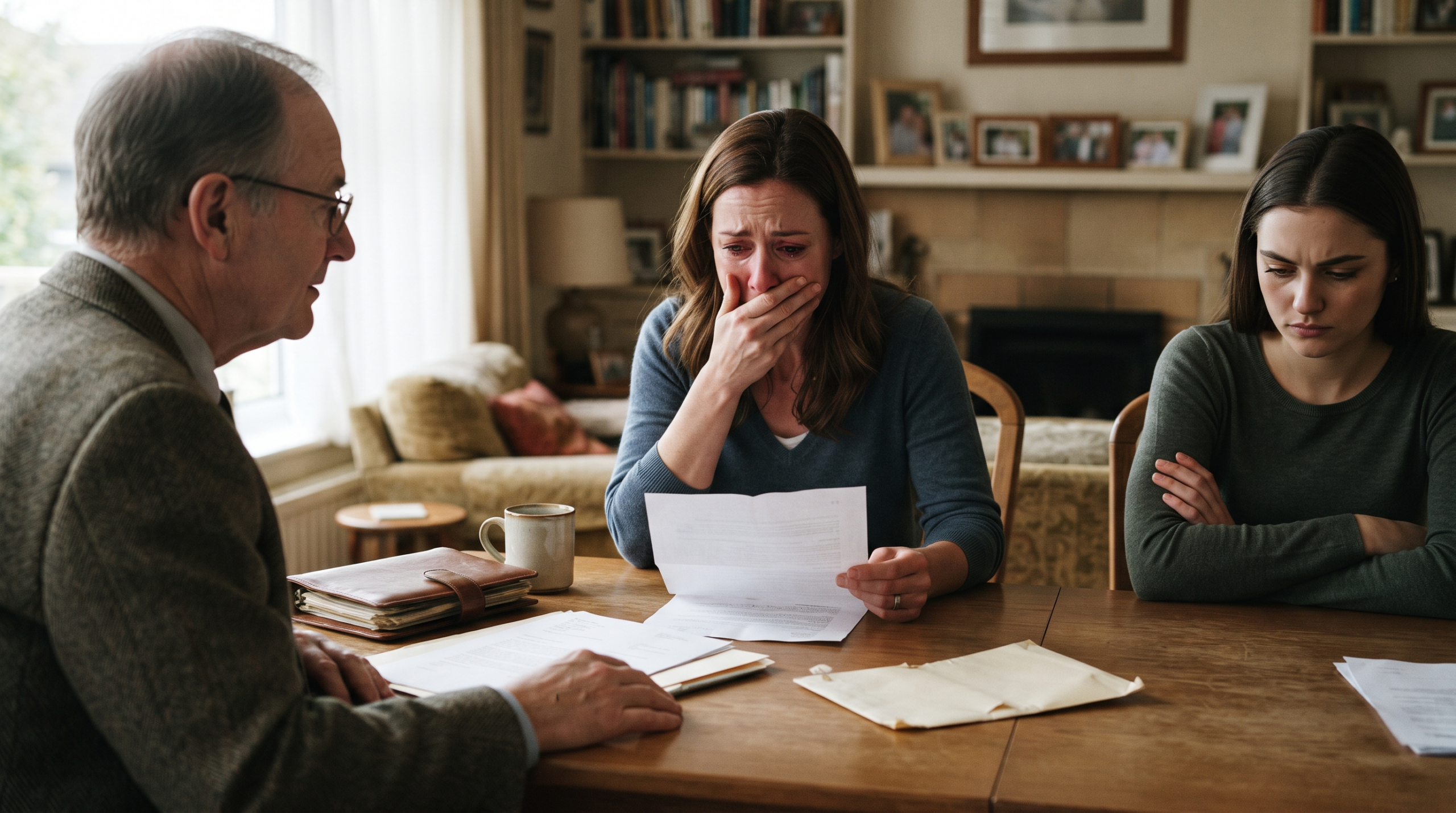
The house had gone quiet in the wrong way.
For three days, people had filled it with lowered voices, casserole dishes, and the soft scrape of shoes across the hallway floor. Now the last of them were gone. The sympathy flowers had begun to sag in their vases, and the clock above the kitchen doorway sounded louder than it ever had while Mom was alive.
I stood at the dining-room table with both hands wrapped around a mug I had forgotten to drink from. Across from me, Vanessa was sorting papers into three neat stacks.
One stack was labeled taxes. Another was labeled household. The third had no label at all.
She had always been better at making grief look organized.
Vanessa sat with her back straight and her dark hair pinned neatly at her neck. She was our mother’s older daughter, the one who had stayed nearby, handled appointments, and eventually become executor of Mom’s original will. Everyone had treated that role as proof that Vanessa was the responsible one.
I had believed it too, once.
The family home belonged to the estate now. It was fully paid off, a fact Mom had mentioned with quiet pride whenever the subject of money came up. She had spent her whole life making sure no bank could take the roof over our heads. Even after her illness worsened, she had insisted that the house remain untouched until both her daughters had been heard.
That was what I remembered her saying.
Vanessa lifted a small cream-colored envelope from the unmarked stack.
“Mom left this for you,” she said.
My fingers tightened around the mug. “For me?”
“She told me to give it to you after the funeral.”
The envelope looked ordinary except for the heavy cream paper and the flap pressed flat beneath a strip of clear tape. My name was written across the front in Mom’s handwriting.
Clara.
The letters leaned slightly upward, as if even at the end she had been trying to climb toward something.
I set down the mug. “You didn’t mention a letter.”
“I didn’t think it mattered before now.”
“Why would it matter now?”
Vanessa pushed it across the table. “Because you’re here. Because the family is finished pretending this is going to be a normal week.”
The words struck harder than they should have. I looked toward the empty doorway leading to the hall. Mom’s coat still hung on its hook there. One sleeve had been turned inside out, and I had kept telling myself I would fix it.
“What do you mean, pretending?” I asked.
Vanessa’s mouth tightened. “Don’t start, Clara.”
“I’m not starting anything.”
“You’ve been looking at me like I stole something since you arrived.”
I looked down at the envelope instead of answering.
She tapped one finger against it. “Take it.”
I picked it up. The paper felt strangely soft, as if it had been held too many times. I turned it over, searching for the seam.
“Was it sealed when you found it?” I asked.
Vanessa leaned back in her chair. “What kind of question is that?”
“A simple one.”
“Yes,” she said. “It was sealed.”
Her answer came too quickly. I noticed that before I noticed the faint redness around her right thumb.
I slid one fingernail beneath the taped edge and peeled it away. The seal gave with almost no resistance. Inside was a single folded sheet.
For a moment, I couldn’t unfold it.
Mom’s final letter to me. The phrase had already begun to take shape in my mind, carrying the weight of every unsaid thing between us. I imagined her sitting at the desk in her bedroom, her reading glasses low on her nose, writing about my childhood, or the years I had spent away, or the argument we had never properly repaired.
I unfolded the paper.
It was blank.
Not nearly blank. Not faded. Completely blank.
I turned it over. The other side was blank too.
The room seemed to contract around me.
Vanessa watched my face. “There.”
I looked up. “There what?”
“That’s all it is.”
“This is a blank sheet.”
“I know.”
“You said Mom left me a letter.”
“She left you that.”
I held it by the corners, afraid my fingers would leave marks on the empty page. “Maybe the writing is on another page.”
“There isn’t another page.”
“Maybe it was erased.”
Vanessa gave a short, humorless laugh. “You think I erased it?”
“I didn’t say that.”
“You didn’t have to.”
I lowered the paper onto the table. The blankness felt deliberate, almost aggressive. Mom had never wasted stationery. She reused envelopes, wrote grocery lists on the backs of old medical forms, and once scolded me for throwing away a perfectly good receipt because there was room on it for a phone number.
She would not have written nothing.
Vanessa gathered the papers in front of her. “Her mind was slipping near the end.”
I stared at her. “Mom knew what she was saying.”
“Some days she did.”
“She recognized me.”
“I’m not saying she didn’t recognize you.”
“You’re saying she sat down to write me a letter and produced an empty page.”
Vanessa’s eyes hardened. “I’m saying she wasn’t well.”
The paper lay between us like an accusation neither of us wanted to touch.
I lifted it again and held it toward the window. Gray afternoon light passed through it without revealing even the faintest impression of ink. No hidden writing appeared. No indentation showed along the margins.
Vanessa stood and reached for the sheet.
I pulled it back.
Her hand stopped in midair.
“Give it to me,” she said.
“Why?”
“Because it’s private.”
“It’s addressed to me.”
“And I’m the executor.”
“That doesn’t make it yours.”
For a second, neither of us moved. Then Vanessa sat down again, slowly.
“You always did make everything difficult,” she said.
The sentence was so familiar that it almost sounded like Mom speaking. Vanessa had been saying it since we were girls, whenever I asked why she had locked the bathroom door or hidden the better half of a birthday cake.
I folded the blank page along its original crease and placed it back inside the envelope.
Vanessa’s gaze followed my hands. “There’s nothing to investigate, Clara.”
“I didn’t say I was investigating.”
“You’re already doing it.”
I put the envelope in my purse. “I’m taking it home.”
“This is your home.”
“Then I’m taking it upstairs.”
Her expression flickered at that, so quickly I might have missed it if I hadn’t been watching.
Mom’s bedroom was at the end of the hall. The door stood open, and beyond it I could see the edge of the quilt folded across the bed. I had promised myself I would not go in until I was ready.
Apparently, Vanessa had just decided that I was ready for something else.
I carried the envelope upstairs.
At the top of the staircase, I paused beside the framed photograph of Mom and Dad on their wedding day. Dad had been gone for years, but Mom had kept that photograph polished and centered. Vanessa had moved it slightly to the left.
I touched the frame.
“Why did you give me a blank page?” I whispered.
No answer came from the quiet house.
In Mom’s room, I placed the envelope on the dresser and opened the top drawer. Her scarves were folded into a careful row. Beneath them sat a box of old birthday cards, a bundle of yellowed recipes, and the small silver brush she had used every morning.
The envelope remained in the center of the dresser, impossible to ignore.
I picked it up again.
The flap was not merely taped. Along its edge, a thin, glossy line caught the light. I ran my thumb over it. The paper there was stiff and ridged, with a tacky residue that clung faintly to my skin.
I brought it closer to my nose.
There was a sharp, chemical smell beneath the familiar scent of paper.
Glue.
I turned the envelope sideways. A portion of the flap had been torn and pressed down again, leaving a pale wrinkle across the fold. The adhesive was uneven, gathered in tiny beads along the edge.
My pulse began to beat faster.
Vanessa had said it was sealed when she found it.
I pictured her at the dining-room table, taking the envelope from somewhere, holding it up to the light. I pictured her opening it, reading whatever Mom had written, and then searching for a way to make the contents disappear.
The image was unfair. It was also the first one that made sense.
I wiped my thumb against the side of my jeans and carried the envelope downstairs.
Vanessa was no longer at the table. I found her in the kitchen, standing beside the sink with her arms crossed.
“What did you do to this?” I asked.
Her eyes dropped to the envelope.
“To what?”
I held it out, keeping my hand steady. “The flap has fresh glue on it.”
For the first time that afternoon, Vanessa looked genuinely startled.
Then she recovered.
“You’re accusing me of opening it?”
“I’m asking why it was resealed.”
“It wasn’t.”
“The adhesive is still tacky.”
“It’s an old envelope.”
“Old paper doesn’t smell like fresh glue.”
Vanessa stepped closer. “You’ve been upstairs for less than five minutes.”
“Long enough to notice.”
She snatched the envelope from my hand. “You’re imagining things.”
“Am I?”
“You’re grieving.”
“That doesn’t make me blind.”
Her jaw tightened. She pressed her lips together, and I watched her thumb move over the flap in the same place where I had noticed the redness earlier.
A small smear of glue shone on her skin.
Vanessa saw me looking at it. She closed her hand.
“Mom gave this to me months ago,” she said. “I didn’t open it.”
“You just said it was sealed when you found it.”
“I meant sealed when she gave it to me.”
“That isn’t what you said.”
“You know what I meant.”
I reached for the envelope. “Give it back.”
She held it against her chest. “You’re acting insane over a blank piece of paper.”
“Then why are you afraid to let me keep it?”
“I’m not afraid.”
“Give it back.”
The kitchen clock ticked once. Twice.
Vanessa tossed the envelope onto the counter. “Take it. Take the whole useless thing.”
I picked it up.
The words useless thing followed me as I carried it back upstairs. Mom’s final message, useless. Her handwriting, if there had been handwriting, useless. Everything she had intended to say to me reduced to an inconvenience Vanessa wanted removed from the room.
I shut Mom’s bedroom door and sat on the edge of the bed.
The mattress dipped beneath me. Her lavender sachet still rested beneath the pillow, and the air held the faint medicinal scent of the cream she used on her hands. I pressed my palm to the quilt, remembering how those hands had once buttoned my school coat, braided my hair, and pushed a warm bowl of soup toward me when I was too stubborn to admit I was sick.
The blank page trembled between my fingers.
I wanted to believe there was an innocent explanation. I wanted to believe Mom’s mind had failed her, that she had placed an empty sheet in an envelope and forgotten what she meant to write. I wanted to believe Vanessa was cruel only because grief had stripped away whatever patience she had left.
But the glue was fresh.
The flap had been opened and sealed again.
Someone had decided I should receive nothing.
A knock sounded against the door.
I slid the envelope beneath the quilt before answering. “What?”
Vanessa opened the door without waiting. “The movers are coming tomorrow.”
I stared at her. “What movers?”
“The ones clearing Mom’s room.”
“You said we would pack her things together.”
“I changed the schedule.”
“Why?”
“Because the house needs to be emptied.”
I stood. “It’s been three days.”
“And it’s already costing money to keep everything here.”
“The house is paid off.”
“That doesn’t mean maintaining it is free.”
She glanced around the bedroom, taking in the dresser, the bed, and the framed photograph of Mom by the window. Her gaze paused on the quilt.
I moved slightly, blocking her view of the mattress.
“We’re not clearing this room tomorrow,” I said.
Vanessa’s eyes narrowed. “You don’t get to decide that.”
“Neither do you.”
“I’m the executor.”
“You keep saying that.”
“Because you keep forgetting.”
She left before I could answer, pulling the door shut with a hard click.
I waited until her footsteps faded down the stairs. Then I took the envelope from beneath the quilt and placed it inside my suitcase.
The next morning, I began packing Mom’s room myself.
I told Vanessa I was doing it because I didn’t trust the movers with sentimental things. She told me I was being dramatic. I let her think that was the reason.
The truth was that I needed to search the room without her watching me.
Sunlight pressed through the curtains in pale stripes. Dust drifted over the dresser. Every drawer contained some small remnant of Mom’s life: a handkerchief folded into a square, a bottle of rosewater, a stack of appointment cards, a photograph of Vanessa and me at the beach when we were children.
I placed the things I wanted to keep into labeled boxes. I worked slowly, listening for Vanessa’s movements below.
For a while, I heard her speaking on the phone in the hallway.
“No, next week is too late,” she said. “I need it handled before then.”
Her voice dropped before I could hear the response.
I stopped folding a cardigan.
A few seconds later, she said, “Because I said so. Just prepare the documents.”
I moved toward the bedroom door, but the floorboard creaked beneath my foot. Vanessa’s voice went silent.
I waited.
When I heard her descend the stairs, I returned to the dresser.
The bottom drawer stuck halfway open. I pulled harder, and a thin notepad slid forward from behind a stack of old receipts. It was the kind Mom kept by her bed, with a cardboard cover and pages attached by a narrow strip of glue.
I recognized it immediately. Mom had used it for medication times, phone numbers, and thoughts she wanted to remember after waking.
Most of the pages were filled with her small, rounded handwriting.
The top sheet was blank.
I almost set it aside.
Then I noticed the shallow grooves crossing the paper.
I tilted the notepad toward the window.
The grooves were deep enough to catch the light. Several lines overlapped near the center, pressing through from whatever had been written on the page above. The indentation was strongest where a pen had paused and pushed down.
I ran my fingertip over the marks.
Words had been written here.
Not lightly. Not absentmindedly. Someone had pressed hard enough to carve them into the paper.
I turned the notepad over and examined the sheet beneath it. That page contained only the beginning of a grocery list. Milk. Oatmeal. Oranges.
The top sheet had been torn away, leaving its message behind.
My heart began to pound.
I carried the notepad to the desk beside the window. A pencil lay in the drawer, sharpened to a fine point. I took it out and held it above the blank page.
For one breath, I considered putting it back.
If I found nothing, I could tell myself the grooves were meaningless. If I found something, I would have to decide what to do with it.
Downstairs, a cabinet slammed.
I placed the pencil on its side and began shading across the paper.
The graphite dust settled into the indentations. At first, the marks looked like nothing more than scratches. Then a dark curve emerged near the top.
I leaned closer.
The first word appeared in fragments, broken by the crossing lines.
Sterling.
My hand stopped.
Mr. Sterling had been Mom’s long-time estate notary and trusted lawyer. His office was where the original will had been signed, and he was the person Vanessa had said would handle everything after the funeral.
I shaded again, more lightly this time.
Beneath the first word, another fragment surfaced.
Copy.
I stared at it until my eyes watered.
Then, lower on the page, a final word took shape.
Safe.
Sterling.
Copy.
Safe.
I whispered each word aloud, hearing how little they explained and how much they threatened.
The pencil slipped from my fingers.
Behind me, the bedroom door began to open.
The bedroom door began to open.
I folded the notepad against my chest.
Vanessa appeared in the gap, one hand still on the brass knob. Her eyes went first to my face, then to the pencil on the desk, and finally to the page I had covered in gray dust.
For a moment, neither of us spoke.
Then she stepped inside and shut the door behind her.
“What are you doing?” she asked.
“Packing.”
Her gaze stayed fixed on the notepad. “That doesn’t look like packing.”
I slid the pencil into my pocket. “I found it on Mom’s nightstand.”
“You were told to box the room, not go through every piece of paper.”
“You said we needed to clear the house.”
“I said we needed to be practical.” She crossed the room and held out her hand. “Give me that.”
The command landed harder than it should have. Vanessa had always spoken to me that way when we were children, as if being older made her the owner of every decision. But her attention was no longer on the furniture or the boxes. She wanted the notepad.
I closed my fingers around it.
“Why?” I asked.
Her expression tightened. “Because it’s personal.”
“So was the letter.”
A faint color rose along her cheekbones.
The sealed envelope was still in my coat pocket. I could feel its stiff edge against my ribs. The blank page inside had stopped feeling like an insult and started feeling like evidence.
Vanessa reached for the notepad again. “Clara, don’t turn this into something it isn’t.”
“Then tell me what it is.”
She gave a short, humorless laugh. “It’s Mom’s old grocery pad. She wrote nonsense on everything near the end.”
I glanced at the shaded words. “Sterling. Copy. Safe.”
Her hand dropped.
The silence that followed was so sudden that I could hear the furnace clicking somewhere below us.
Vanessa recovered first. “Those aren’t complete sentences.”
“They don’t have to be.”
“They’re random words.”
“Maybe.”
She moved toward the desk. I moved with her, keeping the notepad between us.
Her eyes narrowed. “You’re making accusations again.”
“I haven’t accused you of anything.”
“You don’t have to. You’ve been looking at me like I stole something since the funeral.”
I thought of the envelope flap. The fresh glue. The way she had avoided touching the blank page.
“Did you?” I asked.
Her mouth opened, then closed.
Before she could answer, her phone buzzed in the pocket of her sweater. She pulled it out, glanced at the screen, and turned away from me to read the message.
That small movement told me more than an answer might have.
“What is it?” I asked.
“Nothing.”
She put the phone away.
“Vanessa.”
“I said it’s nothing.” She turned back, her voice suddenly clipped. “Come downstairs. We need to discuss the house.”
The shift was so abrupt that I followed her, though I kept the notepad tucked beneath my arm. She walked ahead of me without checking whether I was behind her. At the bottom of the stairs, she entered the dining room, where the late afternoon light lay across the table in long, pale rectangles.
A manila folder waited beside two coffee cups.
The sight of it stopped me.
Vanessa pulled out a chair. “Sit.”
“What’s in the folder?”
“Documents.”
“That’s not an answer.”
She opened it and removed several pages. The first was printed on thick white paper, with a notary’s seal block at the bottom and a signature line marked with my name.
I recognized the words across the top.
Quitclaim Deed
My stomach tightened.
“What is this?”
“It transfers your interest in the house to the estate so we can sell it cleanly.”
“The estate already owns the house.”
“Mom owned the house.”
“Mom is dead.”
“And now the estate has to be settled.” Vanessa placed the deed in front of me. “The buyer wants everything finalized next week.”
I stared at the signature line. My name had been typed beneath it, neat and black, waiting for my hand.
“Next week?”
“Yes.”
“You already have a buyer?”
“We have an interested party.”
“That isn’t the same thing.”
“It’s close enough.”
I looked at the other pages. There was a proposed closing date, a property description, and a paragraph releasing me from any claim to the home or its proceeds. The language blurred when I tried to read it too quickly.
Vanessa pushed a pen across the table.
“Sign it,” she said.
I kept my hands in my lap. “I’m not signing this.”
Her eyebrows lifted. “Why not?”
“Because I haven’t read it.”
“You can read it after you sign.”
“No.”
“Clara, don’t be difficult.”
“I said no.”
She leaned over the table and tapped the signature line with one fingernail. “You’re not losing anything. The house is part of the estate. We divide the proceeds according to Mom’s will, and everyone moves on.”
“Then there’s no reason to rush me.”
“The market changes.”
“Not in a week.”
“Are you an expert now?”
“I’m an adult. I know not to sign away property because my sister put a pen in front of me.”
Her face hardened. “You always do this.”
“Do what?”
“Assume the worst of me.”
“You handed me a blank letter and told me Mom wrote nothing.”
“That has nothing to do with this.”
“It has everything to do with this.”
Vanessa stood so quickly that her chair struck the wall. “You’re obsessed with that piece of paper.”
“It was supposed to be Mom’s final letter to me.”
“She wasn’t herself.”
“You said that after you gave it to me.”
“Because it was true.”
“Then why did you seal it?”
Her lips thinned.
I felt the notepad beneath my arm, its shaded fragments pressing against me through the cover. Sterling. Copy. Safe.
Vanessa came around the table. “Give me the deed.”
“I’m not signing it.”
“You don’t understand what happens if this sale falls through.”
“Then it falls through.”
Her hand closed around the edge of the folder. “You will regret making this harder.”
“Is that a threat?”
“It’s a warning.”
“No. It’s pressure.”
She snatched the deed from the table and shoved it back into the folder. “Fine. Don’t sign today.”
I let out a breath I hadn’t realized I was holding.
“But you’re coming to Sterling’s office tomorrow,” she continued. “You can sign there.”
“I’m attending the estate reading.”
Her eyes flicked toward me.
“The official one,” I said. “With Mr. Sterling present.”
“There’s no reason for you to attend.”
“I’m one of Mom’s daughters.”
“You’re not named in the original will.”
The words struck with a strange, hollow force.
I looked at her. “What did you just say?”
Vanessa tucked the papers into the folder. “You heard me.”
“You said I’m not named in the will.”
“I said you’re not named in the original will. There may be amendments. I don’t know. Sterling handles that.”
“And you were planning to have me sign away the house before the reading?”
“I was trying to make the process easier.”
“For whom?”
She looked toward the windows. Outside, the yard was darkening beneath the bare branches. Mom had planted those trees when Vanessa and I were children. One of them leaned toward the kitchen, held up by a wooden brace.
“For everyone,” Vanessa said.
I stood. “I’m not signing anything without independent legal advice.”
Her jaw flexed. “You don’t need a lawyer for a simple quitclaim.”
“I do now.”
“You’re being paranoid.”
“Maybe.”
I picked up my coat from the back of the chair.
Vanessa stepped between me and the doorway. “Where are you going?”
“To call Mr. Sterling.”
“You don’t have his number.”
“I’ll find it.”
“You’re not contacting him without me.”
“Why not?”
“Because I’m the executor.”
“That doesn’t give you the right to keep me away from the lawyer handling Mom’s estate.”
She stared at me as if I had crossed a line neither of us could uncross.
Then she smiled.
It wasn’t a warm smile. It was the expression she wore when she had already decided how a conversation would end.
“Fine,” she said. “Come to the office tomorrow.”
I expected an argument. I expected her to threaten me again.
Instead, she picked up the folder and walked toward the stairs.
At the first step, she paused without turning around.
“Just remember,” she said, “if you embarrass yourself in front of Sterling, that won’t be my fault.”
The next morning, I arrived at Mr. Sterling’s office twenty minutes early.
His name was engraved on a brass plate beside the entrance, the same name I had shaded onto Mom’s notepad. The building stood on a narrow street lined with old brick storefronts, and his office occupied the second floor above a closed tailor shop.
I sat in my car for several minutes with the engine off.
The notepad rested on the passenger seat. I had placed a sheet of clear plastic over the shaded page to keep the graphite from smearing. I had also written the three fragments on an index card.
Sterling. Copy. Safe.
I kept looking at them, trying to force them into a sentence.
My phone buzzed.
A message from Vanessa appeared on the screen.
I’m inside. Don’t make a scene.
I looked up at the office windows.
She had told me to meet her there, yet she had gone in without me.
I took the notepad and stepped out of the car.
The stairs creaked beneath my shoes. At the top, a receptionist’s desk stood empty behind a glass door. I tried the handle.
It was locked.
Through the glass, I saw Vanessa near the reception area. She was speaking with someone I couldn’t see. When she noticed me, her shoulders lifted sharply.
I knocked.
She walked toward the door, but instead of opening it, she stood on the other side of the glass.
“You’re early,” she said.
“You told me to come.”
“I told you to wait until I called.”
“You didn’t say that.”
“I’m in the middle of something.”
“Open the door.”
She folded her arms. “The reading is private.”
“I’m family.”
“You’re not part of the will.”
The receptionist’s desk remained empty. Behind Vanessa, a hallway led deeper into the office. A framed photograph of Mom hung on the wall near the entrance, taken years ago at a garden party. She was laughing at something outside the frame, her hand lifted to shield her eyes from the sun.
I pointed toward the hallway. “Where’s Mr. Sterling?”
“He’s busy.”
“Then let him tell me I can’t come in.”
Vanessa’s gaze dropped to the notepad in my hand. Her mouth tightened.
“Go home, Clara.”
“No.”
She placed her palm flat against the door, as if preparing to hold it shut.
“I’m not asking permission to attend the reading,” I said. “I’m telling you I’m attending.”
“You don’t understand the legal situation.”
“Then explain it.”
“I already did. Mom left an original will, and you were written out of it.”
The words echoed down the empty stairwell.
I stared through the glass. “Written out?”
“She made her wishes clear.”
“When?”
“Before she got sick.”
“Then why did you bring me here?”
“Because I wanted to avoid this.”
“Avoid what?”
“Your hysterics.”
My fingers tightened around the notepad.
Vanessa unlocked the door only far enough to step into the gap. She kept one hand on the edge, blocking my way with her body.
“You are not going inside,” she said.
“I’m going inside.”
“No.”
“Move.”
Her face changed. The controlled irritation vanished, replaced by something more desperate.
“I am the executor,” she said. “I decide who attends.”
“You don’t decide whether I hear Mom’s final wishes.”
“I do when you’re not included in them.”
I looked past her again.
A voice came from the hall.
“Vanessa?”
She glanced over her shoulder.
An older man appeared from the corridor, wearing a dark suit and carrying a leather file. His silver hair was combed neatly back, and he stopped when he saw me standing outside the locked door.
Mr. Sterling looked from my face to Vanessa’s hand on the door.
Then he said, “Clara, why are you waiting in the hall?”
Vanessa’s fingers slipped from the handle.
“I told her the reading was private,” she said.
Mr. Sterling came closer. “That is not what I instructed you.”
Her expression flickered. “She isn’t named in the original will.”
“I’m aware of the original will.”
“She has no right to—”
“Clara,” he interrupted, opening the door fully, “please come inside.”
I stepped past Vanessa.
She moved aside with obvious reluctance, her shoulder brushing mine as I entered. The office smelled of paper, furniture polish, and the faint bitter scent of coffee. Mr. Sterling gestured toward a conference room at the end of the hall.
Vanessa followed us.
“Before we begin,” Mr. Sterling said, “there is something you need to know.”
I stopped beside the conference table.
He placed his leather file on the polished wood but didn’t open it yet.
“Your mother came to see me one week before she died,” he said.
Vanessa went still behind me.
Mr. Sterling looked directly at me.
“She came alone,” he continued. “She told me she wanted to update her estate plans.”
“She came alone,” he continued. “She told me she wanted to update her estate plans.”
Vanessa shifted behind me.
I heard the soft scrape of her shoe against the floor, a tiny movement that carried more alarm than any protest could have.
“What did she update?” I asked.
Mr. Sterling’s gaze moved briefly to Vanessa, then returned to me. “We will address the estate documents in due course. First, I need to clarify one matter concerning a letter.”
Vanessa folded her arms. “There is no matter to clarify.”
Mr. Sterling ignored her.
“Clara,” he said, “your mother told me she had written something for you. Did Vanessa give you that letter?”
My throat tightened.
I reached into my bag and pulled out the envelope. The paper had softened at the corners from the number of times I had turned it over in my hands. The flap still carried the faint tacky ridge I had noticed in Mom’s bedroom—the glue Vanessa had used after steaming it open and closing it again.
“She gave me this,” I said.
Vanessa let out a small, humorless laugh. “That is what I’ve been trying to explain.”
Mr. Sterling held out his hand. “May I see it?”
I started toward him, but Vanessa moved first. She stepped between us and took the envelope from my fingers.
“Vanessa,” I said.
“She should see it properly,” Vanessa replied. “There’s nothing hidden.”
She turned the envelope over and slid one finger beneath the flap. It opened too easily. The seal had already been broken once, and the fresh glue had begun to peel away from the paper.
Vanessa drew out the sheet inside.
The blank page looked almost luminous under the conference room lights.
She placed it on the table with exaggerated care, smoothing it flat with her palm.
Mr. Sterling stared at it.
I watched his face, waiting for recognition, anger, anything that might confirm the unease that had followed me from Mom’s bedroom. Instead, his eyebrows drew together.
Vanessa leaned against the table.
“Mom was very confused at the end,” she said. “She insisted she had written Clara a letter, but she couldn’t remember what it said. When I found this in her things, it was completely blank.”
I looked at her. “You told me Mom’s mind had slipped.”
“I told you the truth.”
“You told me this was her final letter.”
“It was the page she left.”
“Those are not the same thing.”
Vanessa’s mouth tightened. “You want to make everything into a conspiracy.”
Mr. Sterling reached toward the page but stopped before touching it. “This is the document your mother gave you?”
Vanessa answered for me. “This is what she intended to give Clara.”
“Intended?”
“She couldn’t finish it.”
“You just said she left it blank.”
Vanessa’s eyes flashed. “Because she was no longer capable of writing coherently.”
The words landed harder than I expected. For one instant, I saw Mom in the hospital bed, her thin hands resting on the blanket, her eyes following me whenever I entered the room. I remembered how she had squeezed my fingers when speaking became difficult. I remembered the way Vanessa had begun answering questions for her.
“She knew exactly who I was,” I said.
Vanessa looked at me with practiced pity. “Knowing your name is not the same as knowing what you’re doing.”
My hands curled at my sides.
Mr. Sterling picked up the blank page by one corner. He held it toward the light, then turned it over. His expression grew more troubled.
“Where did you find this?” he asked Vanessa.
“In Mom’s desk.”
“Which desk?”
“The writing desk in her bedroom.”
“Was it inside an envelope?”
“Yes.”
“Sealed?”
Vanessa hesitated. It lasted less than a second, but I saw it.
“It had been sealed,” she said.
Mr. Sterling lowered the page. “And you opened it?”
“I had to identify what it was.”
“You opened a sealed letter addressed to Clara?”
“I was the executor.”
“That does not give you authority to read a private communication before delivering it.”
Vanessa’s composure cracked. “There was nothing to read.”
“Then why did you open it?”
“Because I was trying to protect Clara from being upset.”
I gave a short, disbelieving breath. “You protected me by handing me an empty page?”
“You would have been more upset if I let you believe Mom had written something meaningful and then discovered she hadn’t.”
“I never got the chance to discover anything. You decided what I was allowed to see.”
Vanessa turned toward Mr. Sterling. “This is exactly what I mean. She has been grieving irrationally. She keeps searching for messages in scraps of paper and old household items.”
The notepad was still in my bag. I felt its weight against my hip.
Mr. Sterling looked at Vanessa for a long moment. “Your mother was not irrational when she came to my office.”
“You saw her once.”
“I saw her repeatedly over the years.”
“Not near the end.”
“She came here one week before her death,” he said. “She was lucid.”
Vanessa’s face drained of color, then hardened again.
“She had good days,” she said.
“She knew what she wanted changed.”
“She was frightened.”
“She was specific.”
“She was being manipulated.”
Mr. Sterling’s eyes sharpened. “By whom?”
Vanessa fell silent.
The room seemed to contract around us. Beyond the closed conference-room door, I could hear the muted ringing of a telephone and the distant murmur of someone speaking in another office. Every ordinary sound made the silence between us feel more deliberate.
Mr. Sterling set the blank page down.
“Vanessa,” he said, “I asked you to bring your mother’s final letter.”
“I did.”
“You brought me a blank sheet.”
“That is what she left.”
“No,” he said quietly. “That is what you chose to present.”
Vanessa stared at him.
I felt the blood move into my face. “What does that mean?”
Mr. Sterling did not answer immediately. He walked back toward the main office, leaving the door open behind him. Vanessa remained beside the table, watching him go.
“Where is he going?” she demanded.
Mr. Sterling crossed to his desk. He placed one hand on the leather file, then opened the top drawer.
Vanessa took a step after him.
“Mr. Sterling,” she said, “if you have another copy of some informal note, it has no bearing on the estate.”
He reached beneath a stack of folders.
“I did not say it was informal.”
Her breathing changed.
I moved closer to the doorway, keeping my eyes on his hands.
Mr. Sterling removed a narrow envelope from the drawer. It was cream-colored, heavier than the one Vanessa had given me, and sealed across the back with dark red wax. My mother’s handwriting appeared on the front.
The sight of her name made my knees weaken.
Mr. Sterling held the envelope up where I could see it.
“Your mother entrusted this to me for safekeeping,” he said.
Vanessa stopped moving.
I could not speak.
The writing was unmistakable. Mom’s letters had always leaned slightly to the right, as though each word were trying to move ahead of the next. Her hand looked shaky on this envelope, but the name was clear.
Clara
My name sat beneath the seal.
Vanessa shook her head. “That is not possible.”
Mr. Sterling looked at her. “I witnessed your mother sign and seal it.”
“She never told me about that.”
“She was not required to.”
“She would have told me.”
“Perhaps she knew you would object.”
Vanessa’s eyes snapped toward me. “He is trying to turn you against me.”
I stared at the envelope. “Why would Mom give him a copy?”
Mr. Sterling answered carefully. “Because she wanted the contents preserved outside the home.”
The words struck me with a cold certainty. The fragments on the notepad had risen in my mind—Sterling, copy, safe. Until that moment, they had been only scattered marks I had forced into meaning because I was desperate for one.
Now the word copy had a place.
Vanessa saw my expression change.
“What did you find?” she asked.
I said nothing.
“What did you find in Mom’s room?”
“Vanessa,” Mr. Sterling warned.
She ignored him. “You went through her things after I told you not to. What did you take?”
“Nothing that belongs to you.”
“Everything in that house is part of the estate.”
“You mean everything you can sell.”
Her lips parted, but no answer came.
Mr. Sterling broke the seal on the envelope. The wax cracked sharply in the quiet office.
Vanessa flinched.
He unfolded the paper inside. It was covered in Mom’s handwriting, lines packed tightly across the page. The ink varied in darkness, and some letters trembled, but the writing was legible.
My chest hurt as I watched him read.
“Is that her handwriting?” I asked.
“Yes,” Mr. Sterling said.
Vanessa gave a bitter laugh. “Anyone can imitate handwriting.”
He glanced at her. “This copy was made in my presence.”
“Made by whom?”
“Your mother.”
“Then why have you been hiding it?”
“I have not been hiding it. I have been preserving it until the proper reading.”
“You waited until now?”
“I was instructed to.”
“By a woman who was barely coherent?”
Mr. Sterling’s expression became stern. “You should be very careful.”
Vanessa looked at me, and for the first time since I had entered the office, I saw naked fear beneath her anger.
“Clara,” she said, lowering her voice, “you know how sick Mom was.”
I hated that she could still reach for the old reflex in me—the instinct to defend her, to smooth over conflict, to believe that whatever she was saying had some reasonable center.
“I know she was sick,” I said. “I also know you gave me a blank page and called it her final letter.”
“She left it blank.”
“Then why does Mr. Sterling have this?”
Vanessa looked at the sealed envelope as though it were something dangerous.
Mr. Sterling held the paper with both hands. “This is a letter addressed to Clara. Your mother asked me to read the final sentence aloud during the estate meeting.”
“Then read it,” I said.
My voice sounded steadier than I felt.
Vanessa stepped forward. “No.”
Mr. Sterling turned his attention to me. “Are you certain?”
I glanced at the blank page lying on the table. Then I looked at Mom’s handwriting in his hands.
“Yes,” I said. “Read it.”
Vanessa reached for the paper.
Mr. Sterling moved it out of her reach.
“Do not touch that document,” he said.
“I am the executor.”
“You are not the custodian of this letter.”
“I am her daughter.”
“So is Clara.”
The office door remained open, but no one entered. I wondered whether anyone outside could hear us. I wondered whether Vanessa wondered the same thing.
Mr. Sterling lowered his eyes to the page.
“Your mother’s final sentence reads…” He paused.
Vanessa whispered, “This is cruel.”
Mr. Sterling continued.
“‘Vanessa forged a reverse mortgage against the house; Clara, the proof is in the floorboard safe in my bedroom.’”
For a moment, I heard nothing after the words.
Not the telephone outside. Not the faint hum of the heating system. Not Vanessa’s sharp intake of breath.
The family home had been fully paid off. Mom had guarded that fact for years, calling the house the one thing no bank could ever take from us. The thought of a mortgage attached to it made my mind reject the sentence before it could understand it.
A reverse mortgage.
Forged.
Floorboard safe.
The fragments on the notepad were no longer fragments.
I looked at Mr. Sterling. “She wrote that?”
“Yes.”
“About Vanessa?”
“Yes.”
Vanessa made a strangled sound.
I turned toward her.
Her face had gone pale, but her eyes were blazing.
“That is a lie,” she said.
Mr. Sterling folded the page once, keeping the writing protected. “I have not offered an opinion.”
“You are repeating a delusion.”
“Your mother knew precisely what she was documenting.”
“She was confused. She didn’t know what day it was.”
“She knew the date when she signed this.”
“She was on medication.”
“She spoke clearly.”
“She thought people were stealing from her!”
Vanessa’s voice rose until it struck the office walls and came back at us.
I stared at her. “Were they?”
Her eyes cut toward me.
That single glance was enough to make my stomach turn.
Then she pointed at the paper in Mr. Sterling’s hands.
“That is not Mom’s letter,” she screamed. “It is a complete legal fabrication.”
I did not wait for Vanessa to say anything else.
I snatched my coat from the back of the chair and pushed past her. My shoulder struck the doorframe, but I barely felt it. The sentence had turned the office into a countdown.
The proof is in the floorboard safe.
Vanessa had heard it too. Her denial had come too quickly, too loudly. Now she knew exactly what I was going to do.
“Clara,” Mr. Sterling called after me.
I stopped in the hallway.
He had come to the doorway, the carbon copy held against his chest. Vanessa remained behind him, rigid and white-faced.
“Do not confront her alone,” he said.
“I’m not confronting her.”
“Then what are you doing?”
“Getting there first.”
His expression tightened. “I’m contacting the authorities.”
“Tell them about the mortgage.”
“I will tell them everything.”
Vanessa pushed past him. “You cannot go into that house and destroy my mother’s property.”
“Our mother’s property,” I said.
Her lips parted, but no answer came.
That silence gave me the last piece of courage I needed.
I ran.
Outside, the afternoon had hardened into cold gray light. I fumbled with my keys so badly that I dropped them beneath the car. By the time I got behind the wheel, my hands were shaking.
I called Mr. Sterling through the car’s speaker.
He answered before the first ring finished. “Where are you?”
“Driving.”
“Slow down.”
“Vanessa is going to the house.”
“I know. I saw her take her keys.”
“Call the police now.”
“I am doing that.”
The road blurred beneath my windshield. Every red light felt like an accusation. I had spent days noticing things and then arguing myself out of believing them—the glue on the envelope, the urgency in Vanessa’s voice, the way she had blocked the lawyer’s door. I had wanted those things to be misunderstandings because the alternative was my sister stealing from our mother.
Now the alternative had a location.
Mom’s bedroom.
The house appeared at the end of the street before I was ready for it. Its windows reflected the dull sky. The curtains in the master bedroom were still drawn, just as Mom had left them.
I parked crookedly in the driveway and ran to the front door.
It was unlocked.
I went inside and locked it behind me.
For one second, the familiar silence held me still. The house smelled of cedar, old books, and the lavender soap Mom kept beside every sink. Her slippers were still near the stairs. A cardigan hung over the banister.
Then I heard tires scrape against the driveway.
Vanessa.
I climbed the stairs two at a time.
Mom’s bedroom looked exactly as it had the morning we cleared out her medicine and folded her clothes into boxes. Her bed was made. Her reading glasses rested on the nightstand. The notepad was gone because I had taken it with me, but I could still see the small indentation where it had sat beside the lamp.
The floorboards ran beneath the rug.
I dropped to my knees and pulled the rug aside.
One plank near the foot of the bed sat a fraction higher than the others. I had walked over it for years without seeing it. Mom had never mentioned a safe. She had never needed to. The house had been paid off, and that had always been enough protection for her.
The front door slammed downstairs.
“Clara!” Vanessa shouted.
I grabbed the edge of the board with my fingernails and lifted.
It resisted.
I found a brass letter opener on the nightstand and shoved its tip into the narrow seam. The wood creaked as I levered it upward.
Vanessa’s footsteps struck the stairs.
“Stop!” she yelled.
The board came free.
Beneath it was a square metal door set into the subfloor.
My heart pounded so hard it hurt.
I reached for the latch.
Vanessa burst into the room.
She crossed the space before I could turn fully. Her arms struck my back, and her weight drove me forward. My palms slammed against the floor beside the opening. Pain shot through my wrists.
“Get away from it!” she shouted.
I twisted beneath her and saw her face above me. It was no longer pale. It was furious, stripped of every expression she had worn at the lawyer’s office.
“You knew,” I said.
“I knew you were going to ruin everything.”
She tried to seize my arm. I pulled away, and her fingers caught the sleeve of my coat.
“Let go.”
“You don’t understand what you’re doing.”
“I understand that you attacked me.”
“You’re trespassing.”
“Mom owned this house.”
“She’s dead!”
The words landed harder than her hands.
Vanessa froze for half a breath.
Then she reached for the metal door.
I shoved her shoulder away. She lost her balance and struck the side of the bed. The mattress groaned. She grabbed the bedpost to keep from falling.
I turned back to the safe.
The lock was a simple brass cylinder. For a moment, I had no idea what key could open it. Then I remembered the small key ring Mom had kept in the ceramic dish beside her lamp. I had seen it countless times. One key had been removed before the funeral.
I reached into the pocket of my coat.
The key was there.
I had found it in the dish while packing the room and taken it without knowing why. I had almost thrown it into the box with the household keys.
The moment it touched the lock, Vanessa lunged again.
This time I braced myself against the floor.
“Don’t,” I said.
She stopped.
Not because I had overpowered her. Because she was looking at the key.
Her breathing became shallow.
“You have no right,” she whispered.
“Why are you afraid of what’s inside?”
“I’m not afraid.”
“You just tried to tackle me.”
“You’re destroying our mother’s privacy.”
“You didn’t care about her privacy when you steamed open my letter.”
Her face twisted.
That was the first time she understood that the blank page had not fooled me.
I turned the key.
The lock clicked.
Vanessa made a broken sound and grabbed my wrist. I pulled free and lifted the metal door.
Inside, wrapped in a faded blue towel, were several thick envelopes and a black bank folder.
I reached in.
Vanessa seized the folder first.
I caught the other end, and we pulled against each other over the open safe. The folder bent between us.
“Let go,” she said.
“No.”
“You have no idea what those are.”
“I know exactly what they are.”
“You don’t.”
“They’re the reason you wanted me to sign the quitclaim deed.”
Her grip tightened. “You were going to get your share.”
“My share of what?”
She said nothing.
I yanked the folder toward me. The clasp broke, and papers spilled across the floor.
The first page had a bank seal at the top. Beneath it were the words Reverse Mortgage Agreement.
I stared at the signature line.
Eleanor’s name appeared in looping black ink.
It looked like Mom’s handwriting from a distance. Up close, the letters leaned too sharply, the final stroke pressed with a force Mom never used.
The signature was false.
I knew it before I touched it.
Mom’s real writing was beside it on the carbon copy in my memory—sloping, careful, with the capital E open like a small unfinished loop. This one closed the letter tightly.
Vanessa dropped to her knees and began gathering the papers.
I pulled them away.
“Don’t touch them.”
“They’re mine.”
“They’re evidence.”
“They’re private financial records.”
“You forged her name.”
Vanessa looked at the signature. For the first time since I had known her, she seemed unable to find a sentence quickly enough.
I opened the next envelope.
Inside were bank statements. I read the account holder’s name, then the transfer amounts, then the destination account.
Vanessa’s account.
The mortgage funds had gone directly to her.
The first transfer had been made months before Mom died. The later payments showed additional withdrawals, each one reducing the equity in the house Mom had spent her life protecting.
My vision blurred.
I held the statements closer.
There was no mistake. The name matched Vanessa’s. The account number matched the one printed on the statements. The money from the house had not gone toward medical care, repairs, or any expense Mom had approved.
It had gone to Vanessa.
“You took it,” I said.
Vanessa sat back on her heels.
“I was going to put it back.”
“When?”
“I had a plan.”
“You forged her signature.”
“She told me I could use the house.”
“She told you nothing.”
“She would have agreed if you hadn’t poisoned her against me.”
I looked at the papers scattered between us. The fake mortgage. The transfer records. The withdrawals.
“You stole the house from her.”
“I saved this family,” Vanessa said.
“You tried to sell it before anyone found out.”
Her mouth tightened.
The quitclaim deed lay beneath her knee. I reached for it and pulled it into the pile. The date on it was only days away. She had wanted my signature before the fraud came to light, before the bank could be challenged, before the house could be protected.
The rushed sale had never been about settling the estate.
It had been about hiding the mortgage.
A siren sounded outside.
Vanessa flinched.
I gathered the mortgage agreement and the statements against my chest. The blue towel lay crumpled beside the open safe. Beneath it, I saw a small handwritten label on the inside of the metal door.
For Clara.
My breath caught.
Mom had not left me a blank page.
She had left me a trail.
The envelope had been stolen and replaced. The fresh glue had told me someone had opened it. The indentations on the notepad had led me to Sterling, the copy, and the safe. Her final sentence had brought me here.
Even the things Vanessa had tried to erase had pointed toward the truth.
The front door opened downstairs.
“Clara?” a man called. “Police.”
Vanessa stood abruptly.
I stepped between her and the papers.
“Stay where you are.”
She looked toward the doorway. “Tell them this is a misunderstanding.”
“No.”
“You’re my sister.”
“That is why I gave you every chance to tell the truth.”
Her eyes filled, but I did not move.
“You’re going to send me to prison over money?”
“I’m going to press full fraud charges because you forged Mom’s signature, stole the equity from her home, and tried to sell the house before anyone discovered it.”
“You don’t know what you’re saying.”
“I know exactly what I’m saying.”
The officers entered the bedroom with Mr. Sterling behind them. He stopped when he saw the open safe and the papers spread across the floor.
One officer approached Vanessa. “Ma’am, step away from the documents.”
Vanessa shook her head. “They’re not real.”
Mr. Sterling looked at the mortgage agreement. “The bank seal is genuine.”
“She forged it,” Vanessa said, pointing at me.
I handed the officer the agreement and the statements. “These were in the floorboard safe.”
He accepted them carefully.
Mr. Sterling knelt beside the papers. His face changed as he read the names and amounts. He had known what Mom’s letter accused Vanessa of doing, but the numbers made the accusation solid.
“This is the account,” he said quietly. “The one she told me she had closed.”
Vanessa stared at him. “You knew?”
“I knew your mother was frightened. I did not know the extent of this until now.”
The second officer took Vanessa’s arm.
She pulled away once, then again, but the fight had gone out of her movements. The first officer read her the charges. I heard the words fraud and forgery and elder exploitation.
Vanessa looked at me as they led her downstairs.
“I’m still your sister,” she said.
I held the bank statements against my chest.
“You were my sister when you gave me that blank page,” I said. “You chose what came after.”
The officers took her outside.
Through the bedroom window, I watched her sit in the back of the patrol car. The blue lights washed across Mom’s curtains, the windows, the bare branches of the maple tree.
Then the car pulled away.
Mr. Sterling remained in the room with me while the officers photographed the safe and collected the papers. He helped me place the remaining contents into a box. The metal door stayed open beneath the lifted floorboard, no longer hidden.
“Your mother’s updated estate plan leaves the house and the remaining estate to you,” he told me after the officers finished. “Vanessa’s authority as executor ends with the discovery of this fraud. I will handle the probate filings and the bank dispute.”
I looked at the room.
“She knew she was running out of time.”
“She knew she needed to protect you,” he said.
“What happens to Vanessa?”
“The evidence is substantial. She will face prison time for elder fraud and forgery.”
I closed my eyes.
I had imagined answers for so long that I had mistaken them for relief. But relief did not come as a bright feeling. It came quietly, in the absence of doubt. It came from knowing I no longer had to defend my suspicion against my own guilt.
I had been right to question the glue.
I had been right to shade the page.
I had been right not to sign.
Over the following weeks, Mr. Sterling worked with the bank and the court. The reverse mortgage was challenged using the records from the safe, and the forged signature was examined against Mom’s legitimate documents. I was told the transfers to Vanessa’s account were enough to establish where the stolen equity had gone.
I pressed the fraud charges.
I did not withdraw them when Vanessa called from the holding facility. I did not soften my statement when her attorney asked whether I believed she had acted out of desperation. Desperation did not steam open an envelope, forge a signature, drain a paid-off house, and rush an innocent person toward a sale.
Those were choices.
The court eventually confirmed what Mom had changed in the final days of her life. I assumed full ownership of the estate, including the house. Vanessa faced prison for the fraud and forgery she had tried to bury beneath a blank sheet of paper.
I kept Mom’s final letter in a protective sleeve on the mantel.
The original remained with Mr. Sterling for the legal record, but he gave me the carbon copy after the proceedings were complete. The handwriting was faint in places. The paper had softened at the folds. Still, the final sentence remained clear.
I read it whenever grief tried to turn into doubt.
One evening, I returned to Mom’s bedroom and replaced the loose floorboard. I set the metal safe beneath it, empty now, and lowered the wood into place. Then I put the rug back exactly where it had always been.
The room no longer felt like a crime scene.
It felt like the room where Mom had made one last careful decision.
I sat on the edge of her bed with the letter in my hands. Outside, the maple tree moved against the darkening sky. The house was quiet, but it no longer sounded abandoned.
Mom had used her final days to leave me breadcrumbs through the lies: Sterling, copy, safe. She had known Vanessa might take the visible letter. She had known I would notice what did not fit.
She had protected me without being there to explain how.
I folded the copy along its old crease and placed it in the drawer beside her reading glasses. Then I turned off the lamp, smoothed the blanket, and closed the bedroom door.
For the first time since Mom died, I locked the house without feeling that I was shutting her out.
I was keeping what she had saved for me.