“She can’t do that. That’s trust land.”
“She did it in a letter.” He wiped his palms on his jeans. “I got no lease. Never did. Your daddy never took a dime of rent off me.”
“Then why stay?”
“I paid in honey.” He looked at the hives instead of me. “And I paid in other ways.”
“What other ways?”
“Taxes got paid,” Amos said. “Every March. Cash, over at the counter.”
The trailer creaked. Somewhere behind the trees a dog was barking at nothing.
“You paid our taxes?”
“I carried it.” He said it exactly the way Delia had said it in the kitchen, and the sound of it in his mouth made my neck go hot. “Eleven years now. Maybe twelve.”
“With what money?”
“That’s not mine to say.”
He opened the truck door and a spiral notebook slid off the seat onto the floor mat. He picked it up and held it against his chest, and I saw the pages before he closed it: columns of numbers, hive counts, honey deliveries, and a line that read March errand, then another one under it, and another.
“Amos.”
“I’ll be around,” he said. “If you want to ask me something, ask it with a date on it.”
He pulled out with his lights off until he reached the road, which is what you do when you don’t want to be watched leaving.
I did not sleep. At seven the next morning I was parked in front of the county treasurer’s office with my teeth unbrushed and the trust paperwork in a folder on the seat beside me.
The clerk had reading glasses on a chain and a space heater under her desk. I gave her the parcel number and my name and told her I was a trustee, and she typed with two fingers.
“You’re current,” she said.
“I’m what?”
“Current. Paid through last March.” She turned the screen a little so I could see it. “You want copies? They’re a dollar apiece.”
I said I wanted all of them. She went into the back and came out with a folder rubber-banded shut, and I stood at that counter and read eleven years of my father’s orchard one March at a time.
Every receipt said the same thing. Cash. Paid in full. Balance: $0.00. Not one year in arrears. Not one late fee. The amounts climbed the way everything climbs, three thousand one hundred and eighty in 2016, four thousand seven hundred and sixty last March, each one stamped in the first two weeks of March, as regular as a birthday.
“There’s no lien,” I said. It came out as a question.
“There’s no lien.” She looked at me over the glasses. “Honey, if you were three years behind, I’d have a letter in that folder with my signature on it. I’ve worked this counter nineteen years.”
I spread the receipts on the Formica in order and put my finger on the payer line of each one. Eleven years of paper, eleven envelopes that somebody had carried into this building on foot. Every line was blank. Cash, and no name after it.
Delia’s truck was in the yard when I got back from the county, and Grant’s flatbed sat empty by the cooler. I carried the folder in with both hands like it was a casserole.
She was at the kitchen table with her coffee and her reading glasses on, and she did not look up. I dealt the receipts out in a long fan, oldest to newest. Eleven pieces of paper, gone soft from the clerk’s space heater, curling at the corners.
“Eleven years,” I said. “Every March. Cash, paid in full.”
“I know what they say.” She took the glasses off. “I’ve seen them.”
“Then why did you stand up in front of sixty people and tell them we’re three years behind? Why’d you tell them the county is coming for the trees?”
She went into the office off the cooler and came back with a rubber band around a bundle of slips and set it on top of my receipts.
“Because I paid it,” she said. “Every March I pulled the cash and walked it over there myself. Now you can stop looking at me like I stole something.”
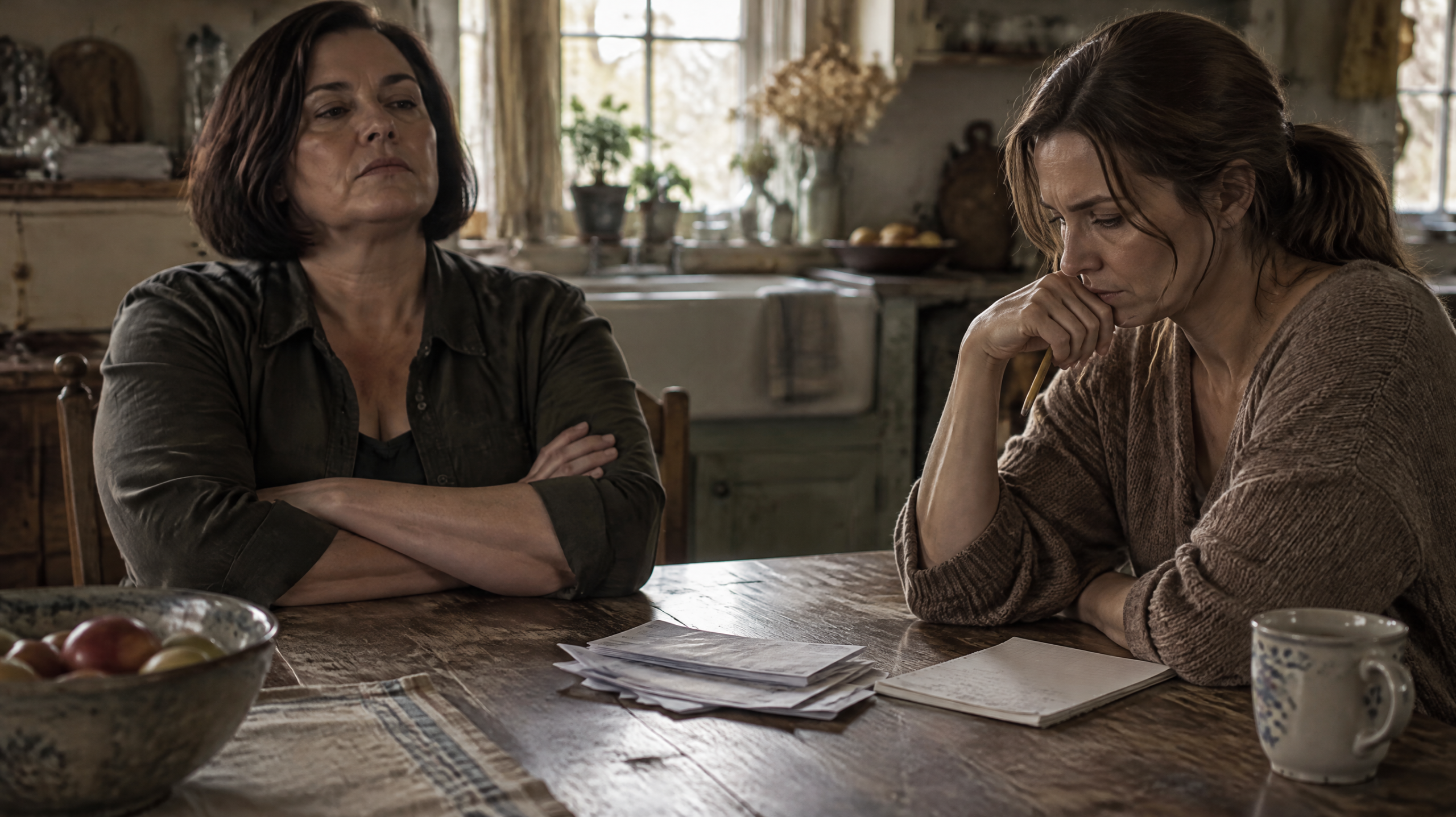
The slips were from the bank in town. Withdrawals, all cash, dated in March. I did the arithmetic on the back of a feed receipt and did it twice, because the first answer made me sick.