

The first time my stepdaughter called me just the wife, she did it in front of a hospital social worker while her father was still learning how to hold a cup again.
She said it with her arms folded and her chin tilted up, like she was correcting a billing mistake instead of talking about the woman who had been sleeping in a vinyl chair beside his bed for six nights.
“With respect,” Heather told the social worker, “she’s just the wife. I’m his daughter. If anyone is deciding where he goes next, it should be family.”
I remember looking down at the paper coffee sweating through my hand and thinking that there are insults you can prepare for and insults that only hurt because they confirm what someone has wanted you to know all along.
Mark and I had been married for twelve years.
I met him when his daughters were already grown enough to resent any woman who laughed at their father’s jokes. Heather was twenty when we started dating, old enough to be polite in public and cold in private. Her younger sister, Elise, was softer, but she followed Heather’s lead the way younger siblings do when they are tired of paying the emotional price for disagreeing.
I never tried to replace their mother. Their mother made sure nobody forgot she existed, even after the divorce. She still called me “the woman from the yoga class” three years after Mark and I got married, as if refusing to learn my name would somehow roll time backward.
But I did build a life with him.
I knew how he liked his eggs when he was nauseated. I knew which pharmacy tech would actually call when a prescription was delayed. I knew he got quiet, not loud, when he was scared. And for the last three years, after his first stroke and the diabetes complications that followed, I knew every one of his medications by shape, color, and the exact hour his hands started to shake if lunch ran late.
Heather knew how to post Father’s Day tributes.
That sounds cruel, and maybe it is, but it is also true.
She came by on holidays with expensive bakery cakes and took photos from flattering angles. She called her father “my rock” online and then disappeared when the insurance forms had to be faxed, when the podiatrist changed his dressings, when he needed help getting to the bathroom at two in the morning because his left leg had gone numb again.
Every family has one person who performs love and one person who does it. Most of the time, they are not the same person.
Mark collapsed in our kitchen on a Tuesday morning while I was arguing with the toaster. One second he was standing at the counter reaching for his glucose monitor. The next, the glass of water slipped out of his hand and shattered across the tile.
The ambulance came in eleven minutes. Heather got to the hospital three hours later and acted like she had arrived in the middle of a crime scene I had caused.
“Why didn’t anyone call me sooner?” she demanded in the ICU waiting room.
I stared at her. “I called you from the ambulance. Twice.”
She glanced away. “I was in a meeting.”
I almost said of course you were, but I was too tired and too frightened to spend energy on the obvious.
The neurologist said Mark was lucky. The stroke was smaller than the first one, but it hit his speech and his right hand. He would need inpatient rehab before he could come home safely. I said yes before the doctor finished the sentence.
Heather said we should “wait and see.”
“He hates facilities,” she told anyone who would listen. “He’ll do better with family.”
It was an easy thing to say when she did not mean her own family.
By the fourth day, she had shifted from concern to strategy. She asked whether the house was too much for me now. She asked whether I had thought about selling. She asked whether her father had updated “all the paperwork” after the first stroke.
I answered carefully because hospitals amplify everything. Fear, resentment, old power struggles — they all sound louder under fluorescent lights.
Then came the discharge meeting.
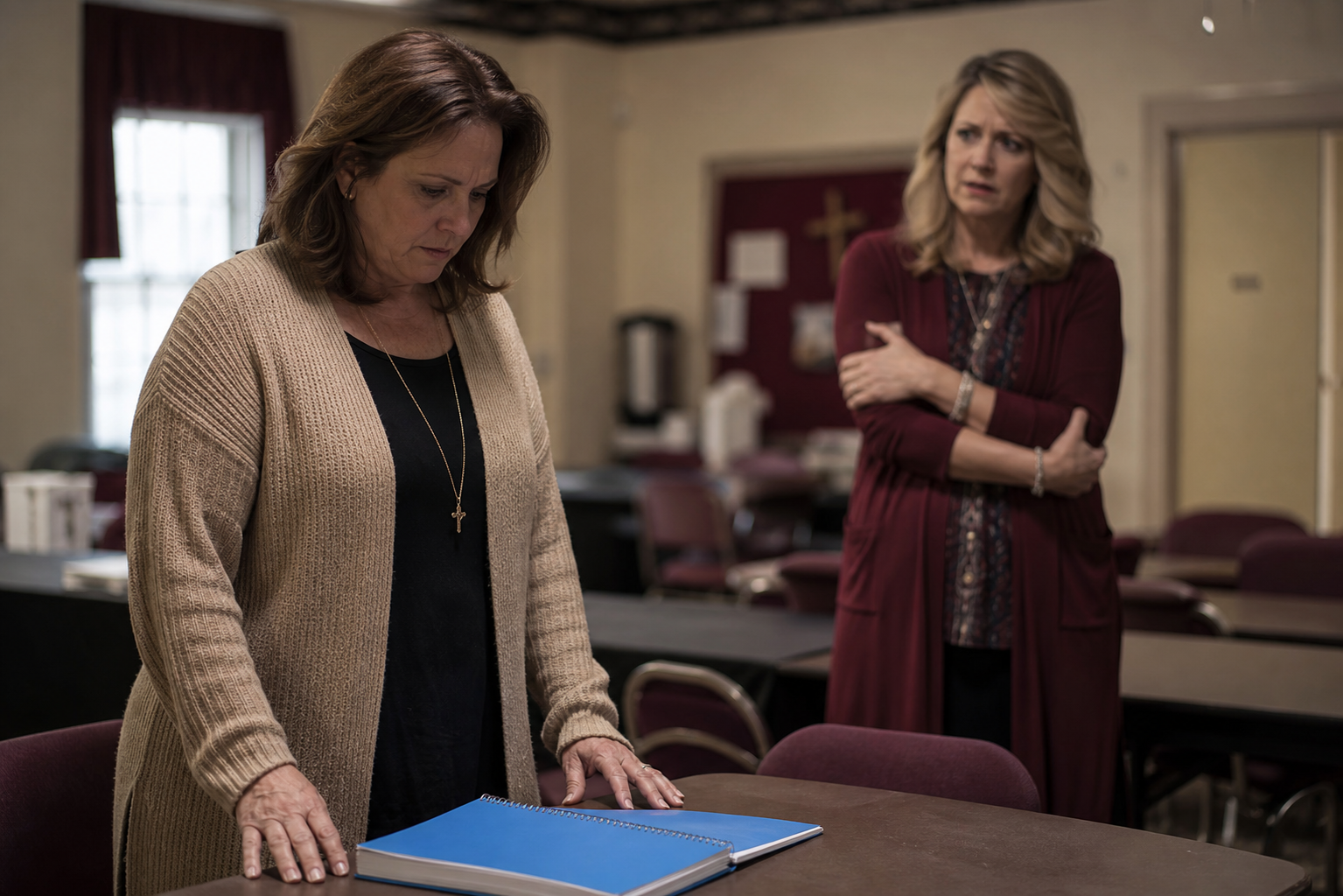
It was me, Heather, the hospital social worker, and a rehab coordinator with a yellow legal pad. Mark was upstairs with physical therapy, relearning how to button a shirt without cursing.
The social worker, Denise, asked the standard questions first. Who lived in the home. Whether there were stairs. Whether someone could manage medications. Whether transportation to follow-up appointments was reliable.
I answered all of them because I actually knew the answers.
Heather kept interrupting.
“She’s making it sound harder than it is,” she said. “My father does better when people don’t hover.”
Denise kept writing.
“I can take him to my place for a while,” Heather added. “He needs his real family around him, not more of this patient mindset.”
I felt something hot move up the back of my neck. “Your place is a third-floor walk-up, Heather.”
“He won’t be climbing stairs alone.”
“Your son sleeps in the living room,” I said before I could stop myself. “Where exactly is your father supposed to do rehab?”
Her face changed. “Wow. There it is. You’ve been waiting to say what you really think of me.”
Denise lifted one hand, calm as a crossing guard. “Let’s stay focused on the discharge plan.”
That should have been the moment the conversation got practical again. Instead, Heather leaned back in her chair and gave Denise a tight smile.
“With respect, she’s just the wife. I’m his daughter. If anyone is deciding where he goes next, it should be family.”
I did not answer right away because I was suddenly afraid that if I opened my mouth, all twelve years of swallowed humiliation would come out at once.
Denise looked at both of us for a second, then turned to the folder in front of her.
“Actually,” she said, opening the chart, “your father completed updated directives after his fall in March. Mrs. Calder is listed as his healthcare proxy and primary discharge contact.”
Heather laughed once, short and stunned. “Because she was standing over him when he signed it.”
Denise did not flinch. She pulled another page from the file.
“There’s also a note from that same visit, written in the presence of nursing staff,” she said. Then she read it aloud. “If there’s any confusion, ask Nora. She’s the one who manages my day-to-day care and knows what home actually requires. I do not want to recover in Heather’s apartment.”
The room went so quiet I could hear a cart rattling somewhere in the hallway.
I had never seen that note before.
Heather went white, then red. “He wrote that after one argument.”
Denise set the paper down. “Maybe. But it’s still part of the record, and it matches the rehab team’s recommendation. He needs a ground-floor environment, medication oversight, and somebody who can attend the caregiver training tomorrow morning.”
Heather looked at me like I had planted the whole hospital.
“You did this on purpose,” she said.
It should have felt good to win that moment. Instead, I just felt tired.
“No,” I said. “I did the part nobody wanted to do.”
She stood up so fast the chair legs scraped the floor. “Enjoy playing martyr.”
Then she walked out.
I cried in the bathroom two minutes later, not because she had insulted me but because Mark had known this might happen and planned for it without telling me. Some part of him had already understood that loving someone through illness also meant protecting them from the people who only showed up once there was power to fight over.
That night, Elise called.
“Heather says you embarrassed her,” she said carefully.
I leaned against the kitchen counter in the family waiting area and closed my eyes. “Heather embarrassed herself.”
Elise sighed. “I’m not taking sides. I just think maybe Dad needs peace right now.”
It is amazing how often women are told to create peace out of other people’s dishonesty.
“Peace for who?” I asked. “For your father, or for the person who wants to feel better without helping?”
She did not answer for a long time.
The next morning, the rehab nurse taught me how to help Mark transfer safely from bed to chair if his balance gave out. I took notes. I recorded the timing of his insulin adjustments. I learned the signs that meant his speech trouble was fatigue and not another emergency.
Heather did not come.
When I went upstairs afterward, Mark was awake and irritated because someone had pureed his eggs again.
He looked at my face for a long moment and said, slowly, “She made trouble.”
I pulled the chair closer to his bed. “A little.”
He shook his head once. His words were still halting, but his meaning was clear. “Home. With you.”
It was the closest thing to a speech I had heard from him all week, and it settled something inside me I had been too afraid to name.
I kissed his forehead and said, “Okay.”
He squeezed my hand, then added, with visible effort, “No stairs. No drama.”
I laughed so hard I nearly scared the nurse.
Mark came home four days later.
Heather arrived that evening with a grocery bag full of things he was not allowed to eat and a face full of injured righteousness. She stayed exactly nine minutes.
Before she left, she said, “I hope you’re happy.”
I surprised both of us by answering honestly.
“No,” I said. “I’m exhausted. There’s a difference.”
She stared at me.
So I kept going.
“If you want to be his daughter, be his daughter. Visit him. Learn the meds. Sit with him while he does the exercises he hates. Take him to follow-up appointments. But if what you really want is credit without responsibility, I’m not helping you pretend anymore.”
Her mouth opened, then closed.
For once, she had nothing rehearsed.
She left without kissing her father goodbye.
Two days later, she posted something vague online about being “shut out by controlling people during family crises.” Elise sent me a screenshot and an apology I think she meant.
I did not respond to the post. Anyone who actually knew what had happened was either too decent to join the performance or too ashamed.
What I did do was keep the door open for real help.
I texted both girls a list of Mark’s therapy days and visiting times. I said they were welcome anytime they wanted to participate in his recovery. Not witness it. Not narrate it. Participate.
Elise came the following Sunday and learned how to help with the leg brace.
Heather still hasn’t.
Maybe one day she will decide that loving her father matters more than competing with me for the title of who counts. I hope so, for his sake.
But I stopped trying to earn family status from people who only recognize labor when they can stand on top of it.
If that makes me hard, then maybe hard is what was required. Maybe there comes a point when loyalty to the sick person matters more than loyalty to the loudest relative in the room.
Would you have handled Heather differently, or drawn the same line?