

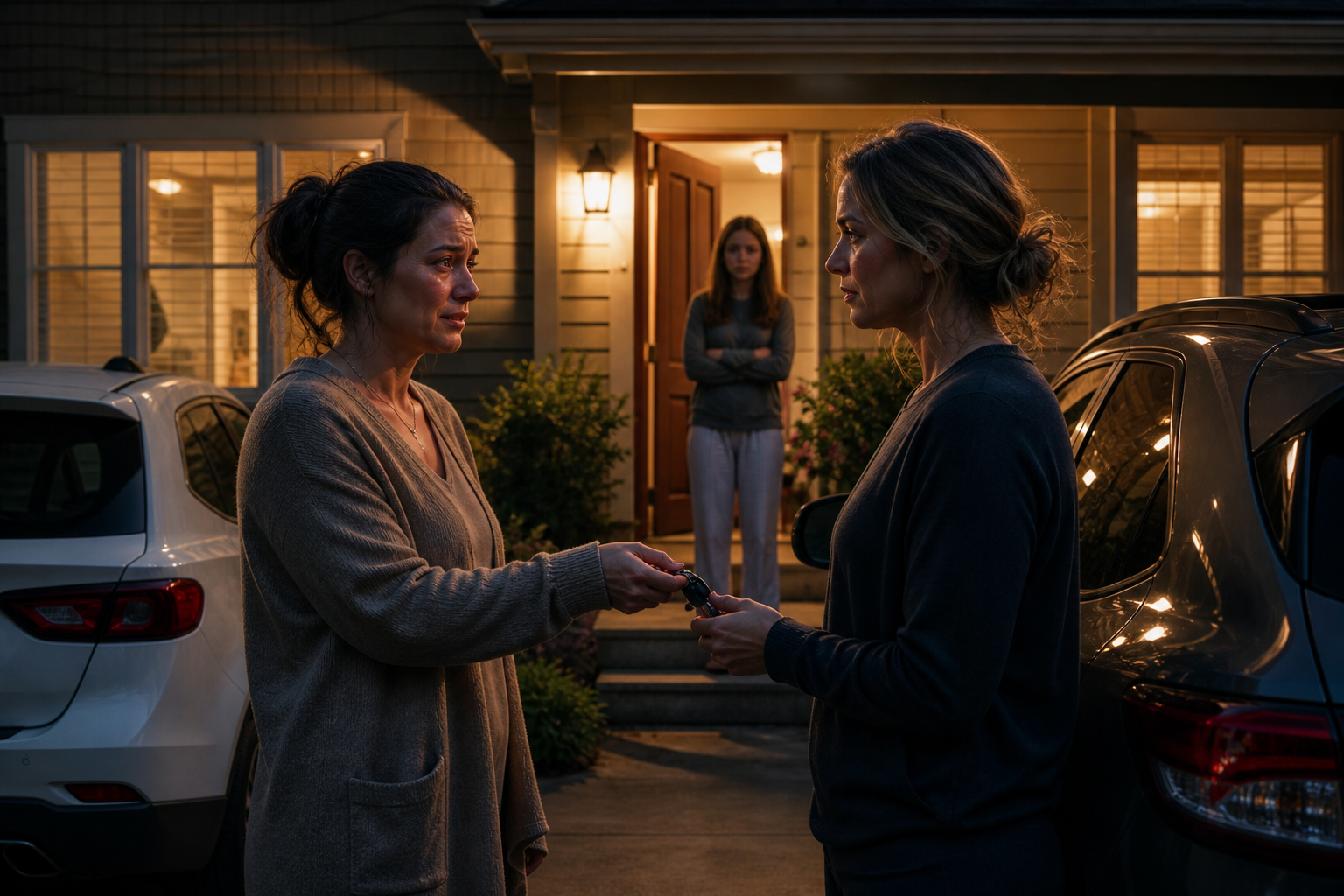
I thought our babysitter was leaving because my daughter had become difficult after starting middle school. Then she showed up crying in my driveway, handed me my spare key, and said there were things my husband only said when he knew I was still at work.
My babysitter returned my spare key like it was evidence.
She was standing in my driveway at dusk, crying so hard she had to keep wiping her face on the sleeve of her cardigan, and for a second I thought someone had died. Emma had watched my daughter, Sophie, after school for nearly two years. She was twenty-one, patient, sensible, studying education at the community college, and one of the only people Sophie had liked immediately after my husband and I moved into the new district. Nothing about Emma suggested drama. She was the kind of young woman who labeled leftover pasta before putting it in the fridge.
So when she held out the key and said, ‘I can’t come back tomorrow,’ my first thought was that something must have happened in her own family. My second thought, embarrassingly enough, was relief that this might not be about us. We had been having a hard enough year already. Sophie had just turned twelve and entered that raw, watchful age where every ordinary conversation feels like a possible insult. My husband, Mark, said she was becoming moody. I said she was becoming perceptive. Those are not the same thing, though certain fathers work very hard to confuse them.
Mark and I had been married thirteen years. From the outside, we looked steady. He coached Sophie’s soccer team one season. He grilled on weekends. He remembered to pick up my migraine prescription if I texted him before lunch. But steadiness can be a stage set. Up close, ours had started to warp in tiny ways. He was increasingly sarcastic with Sophie, especially when I was not around to interrupt. He called her dramatic when she cried, lazy when she forgot one chore, entitled when she asked whether he had thrown away her art project during one of his sudden cleaning moods. Every time I pushed back, he told me I was too soft and that girls needed thicker skin before the world taught them the hard way.
I told myself he was a strict father, not a cruel one. That is another sentence I hate in hindsight. Women waste years editing men’s behavior down to a version they can survive describing.
Emma stood beside her car twisting her key ring until the metal clicked against her fingernail. I asked whether Sophie had done something. Emma shook her head so quickly it almost looked offended. ‘No. God, no. She’s a kid.’ Then she said, very quietly, ‘It’s Mark. I just… I can’t be part of this anymore.’
The world tilted in that particular way it does when your body understands a sentence before your pride allows it. For one horrible second I thought she meant an affair. Not because I suspected one, but because betrayal likes familiar costumes. Emma saw my face and immediately said no, nothing like that. If anything, the relief made what came next worse.
She told me Mark spoke differently when I worked late. He mocked Sophie’s voice after she went upstairs. He called her manipulative if she asked for help with homework twice. He would read texts from me out loud in a whiny tone and tell Sophie, ‘See? Your mom thinks both of us are helpless.’ One afternoon, when Sophie forgot her gym bag at school and cried because she did not want detention the next day, Mark had laughed and said, ‘Maybe if you spent less time performing and more time thinking, people would like being around you.’ Emma said Sophie went completely silent after that. Not dramatic. Not loud. Just silent in a way that frightened her.
I wanted to reject every word. Not because Emma was untrustworthy, but because accepting her account would mean admitting I had been leaving my daughter alone inside a smaller, meaner house than the one I thought I was paying for.
Then Emma said something that removed the last place I had to hide. She told me Sophie had asked her not to say anything because ‘Mom already looks tired all the time.’ My daughter had been protecting me from my own marriage.
I thanked Emma, though the words felt absurdly small. She cried harder and apologized for not telling me sooner. I told her she had told me now, which was more courage than the adults in this story had managed so far. After she left, I sat in my parked car for a full minute gripping the steering wheel and trying to decide whether to scream first or go inside first.
Sophie was in the kitchen pretending to do math homework. That was the detail that broke me: pretending. The worksheets were open, but her pencil had not moved in ten minutes. When she looked up and saw my face, she became very still. Children know when truth has finally outrun the adults.
I asked her to come sit with me on the couch. I told her Emma had spoken to me. I promised I was not angry with her. Then I asked, ‘Has Dad been saying cruel things when I’m not here?’ She did not answer right away. She just stared at her hands and rubbed her thumb over a spot of dried glue near her nail. Finally she nodded.
Once she started talking, it came in pieces. Not because she was lying, but because pain often stores itself in fragments. He said she was exhausting. He told her not to cry so loudly because the neighbors would think she was spoiled. He asked whether she planned to fail at life as casually as she failed at emptying the dishwasher. Once, after she asked if he could come to her orchestra concert, he said he would attend if she could promise not to squeak her way through another beginner song. She laughed when she repeated that line to me, and the sound was wrong from a twelve-year-old. Too old. Too practiced. A laugh designed to step around humiliation without touching it.
I asked why she had not told me. She shrugged in that small adult way children do when they have accepted a burden nobody should have handed them. ‘Because you always fight after,’ she said. ‘And then he says I made trouble.’
That sentence rearranged my entire understanding of our house. Mark was not only cruel in private. He was training our daughter to experience his cruelty as an administrative inconvenience she was responsible for causing. That is the kind of damage that sinks deeper than yelling. It teaches a child to distrust her own alarm.
Mark came home at 7:15 carrying takeout and talking about traffic. I met him in the hallway before he got to the kitchen. Sophie stayed on the couch where I could see her. I asked him whether he had told our twelve-year-old that people would like her more if she thought instead of performed. He froze, then did what men like him do best: he smiled in disbelief. ‘You’re taking a child’s version of things over mine?’ he asked. Not denial. Just immediate redirection.
I said Emma heard him. He rolled his eyes. He called Emma dramatic and immature. I said Sophie heard him. He actually had the nerve to answer, ‘Well, maybe she needs to.’ That was the moment the argument ended and the decision began.
I told him to put the food down and leave the house. He laughed because he thought I was escalating for effect. Then he looked over my shoulder and saw Sophie crying silently into the hem of her sweatshirt. Something in his face changed—not remorse, exactly, but the first flicker of understanding that his usual audience had stopped cooperating. He started saying he was trying to toughen her up, that fathers joked differently, that girls today were too sensitive. I told him not to dress contempt up as parenting in front of me ever again.
He left that night for his brother’s apartment, still messaging me paragraphs about how I was undermining his role as a father. The next morning, I called a therapist for Sophie before I called a lawyer for myself, which should tell you everything about where the real emergency was. Mark kept insisting we were overreacting to tone. But tone does not make a child hide her tears in the bathroom until the babysitter leaves. Tone does not make her apologize for ‘starting trouble’ when an adult insults her. Tone is what people blame when they want to shrink abuse down to a misunderstanding small enough to keep dinner plans intact.
Emma never came back as our babysitter, and I do not blame her. She had already done more for my daughter than many relatives would have. Sophie still sees her occasionally for coffee and bookstore trips, which I encourage, because I want my child to remember there were adults who believed her before the evidence had a neat folder.
Mark now tells people I threw him out over discipline differences. Let him. The truth is uglier and therefore less useful at barbecues: I threw him out because my daughter had learned to rehearse her own harmlessness in his presence, and once I saw that clearly, love for him stopped mattering nearly as much as safety for her.
I used to think a mother’s job was to protect her child from obvious danger. Now I know it is also to recognize the quieter kind—the danger that smiles in family photos, pays the mortgage on time, and calls cruelty honesty until a little girl starts speaking about herself in his voice.