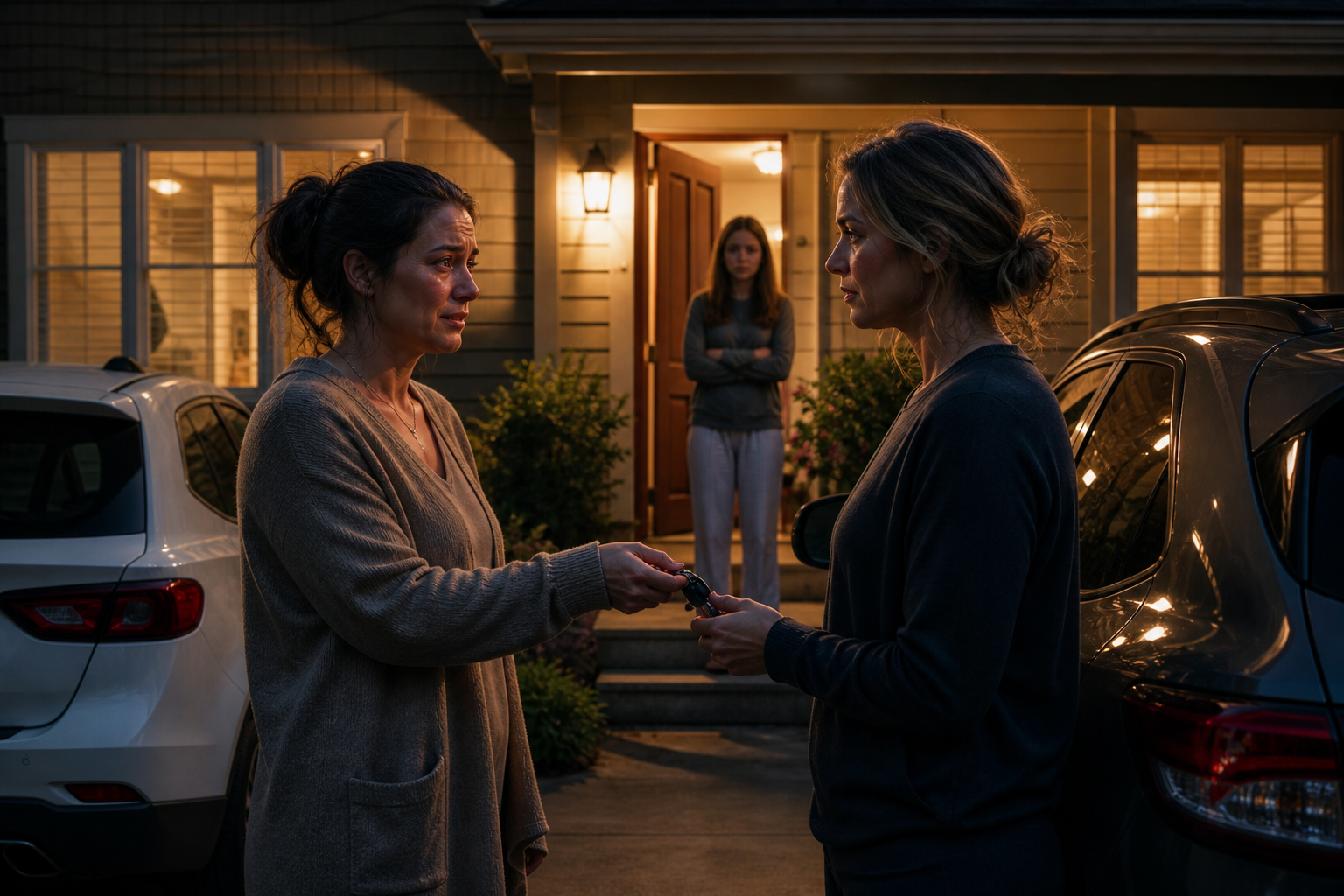


I only went to the twenty-four-hour pharmacy for migraine medicine and a thermometer for my son. Then the pharmacist smiled at my husband’s profile on the insurance screen, said she always remembered his birthday, and accidentally introduced me to a version of my marriage I had never been allowed to see.
The woman at the pharmacy knew my husband’s birthday before I did, and that should tell you exactly how my marriage ended.
At the time, though, I thought it was just a strange sentence floating through a bad evening. My son had a fever. My head was pounding hard enough to make the fluorescent lights feel personal. I had driven to the twenty-four-hour pharmacy in slippers and a coat thrown over pajama pants, carrying our insurance card, my phone at three percent, and the kind of tiredness that makes every decision feel like an accusation.
My husband, Eric, was supposed to be in Chicago that night for a regional sales conference. That was what the calendar said, what his texts said, and what the half-packed suitcase by our bedroom wall had said when I left for work that morning. He had kissed our nine-year-old son, Mason, on the forehead before school and promised to bring him one of those tiny skyline snow globes from the airport gift shop. It was such a normal father detail that I never thought to question the trip itself.
The pharmacist was maybe thirty, maybe younger, wearing her brown hair in a low clip and speaking in the efficient, gentle voice people use when they know customers are one inconvenience away from tears. She took the insurance card, typed in Eric’s information because he was the primary holder, and then looked at the screen with a little spark of recognition. Not shock. Not confusion. Recognition.
She smiled and said, almost to herself, ‘Oh. Eric’s birthday is next week, right? The fourteenth?’
I remember blinking at her because my mind did something strange and childish before it did anything useful. I thought, No, that’s not right. Eric’s birthday is the sixteenth. Then I heard myself say exactly that out loud. The pharmacist’s smile disappeared so fast it felt like a light switching off in a back room. She apologized and said she must have mixed him up with another regular. Another regular. At midnight. At a pharmacy on the far side of town my husband had never mentioned using.
If you are waiting for me to become brilliant immediately, you will be disappointed. I laughed awkwardly, paid for the medicine, and drove home with the bag on the passenger seat while my thoughts arranged themselves into little harmless shapes. Maybe she knew him through the insurance account. Maybe he had picked up prescriptions for his mother. Maybe I had misspoken. Maybe I was more tired than I realized. Women can build entire temporary shelters out of maybe when the alternative is admitting the weather has already turned.
At home, Mason fell asleep on the couch while I texted Eric that the fever was down a little and asked whether his flight had landed. He responded two minutes later with a photo of a hotel room television and the message, ‘Long day. Call you tomorrow?’ The room looked generic enough to work as proof for someone who wanted to be fooled. I set my phone down and felt the first honest piece of dread settle in my stomach.
The next morning, after I dropped Mason at school, I drove back to the pharmacy with coffee I did not want and a calm expression I had to rehearse at two red lights. The same pharmacist was there. I told her I needed to ask something uncomfortable and that she could either tell me the truth or tell me nothing, but she should not insult me with kindness. She went pale in the face in a way that answered more than her words did.
She told me her name was Dana. She said Eric had been coming in for months, usually late, usually after what he called work dinners. He picked up stomach medicine once, razors another time, and one prescription for antibiotics he joked he hoped I never found out about because I worried too much. She said she knew his birthday because he had flirted with her about it while she was ringing up a bottle of bourbon-flavored cough syrup for him in June. She said she had not slept well since seeing my face the night before because she had realized too late that the wife in his stories and the woman holding the insurance card were the same person.
There had not been an affair with Dana. That came as no comfort. What there had been was worse in a quieter way: a whole second version of my husband assembled in ordinary places I never visited. A version who complained about his controlling wife. A version who had favorite late-night counters, favorite lies, favorite women to perform wounded charm for while waiting on receipts. Dana said she had shut him down after he asked whether she ever got off late enough for a drink. She showed me the timestamped messages from the business card he had slipped across the counter when she refused to give him her number directly. One of them was sent while he had been sitting across from me at Mason’s school concert.
When I got back to my car, I did not cry. I did something colder. I opened our shared credit card app and searched the pharmacy address. There were seven charges over four months, none of them large, all of them at hours he had supposedly been entertaining clients, stuck in traffic, or catching late flights. Then I checked the parking garage invoices from the conference hotel in Chicago. There weren’t any. Then I checked our family cloud for the photo he had sent from the hotel room. It had been taken three weeks earlier.
I spent the afternoon gathering the kind of evidence decent marriages never require. Timestamps. Charges. Screenshot metadata. The messages Dana forwarded to me with a short note that read, ‘I’m sorry this is how you had to find out.’ By six o’clock my grief had sharpened into administration.
Eric came home the next evening carrying airport coffee and a snow globe for Mason, playing the role of returning father so naturally it made me feel sick. He asked how the fever was. He kissed my cheek. He even complained about airline delays before I said a single word. I waited until Mason went upstairs to shower, then I set the pharmacy receipt, the hotel photo metadata, and Dana’s screenshots in a neat row on the kitchen table like place settings.
He looked at them for a long time. Not guilty at first. Annoyed. That was the part I still cannot forgive. Annoyed that I had interrupted the version of events he planned to keep enjoying. Then came the usual vocabulary of men caught living two inches outside the truth: misunderstanding, flirtation, bad judgment, nothing physical, rough patch, lonely, pressure, not what it looks like. I let him say all of it because confession often reveals itself best when uninterrupted.
What he finally admitted was almost boring in its selfishness. He had not been in Chicago. He had canceled the trip after the company merged teams, but instead of telling me, he used the empty hotel budget as cover for what he called ‘space.’ He stayed downtown, drank too much, drifted through bars and late-night errands, and liked the version of himself strangers met. Less responsible. Less observed. Less married. He said Dana was just someone who made him feel seen. I asked what he thought I had been doing for eleven years if not the exhausting labor of seeing him whole.
He cried then, which I suspect he mistook for depth. I was beyond tears myself. I asked whether he had cheated physically. He said no, and for once I believed him, mostly because I understood suddenly that fidelity is not only measured in bodies. Sometimes betrayal is the repeated decision to build intimacy out of your spouse’s absence, to make a public hobby of being misread while someone else does the private work of loving you accurately.
Mason came downstairs halfway through the argument wearing dinosaur pajamas and clutching the snow globe Eric had brought him. He asked whether Daddy really went on a plane. That question split the room wider than anything else. Children do not care about the official category of the lie. They care that the world feels different under their feet.
Eric moved into a short-term rental that weekend. My mother called it a dramatic response to flirting. My sister called it overdue. Dana transferred to a different location a month later, which I understood even before she said she was tired of men who turned convenience into intimacy and women who arrived at the counter paying for it. Mason’s fever broke in a day. Mine took longer.
People still ask whether I really ended a marriage over a pharmacist remembering the wrong birthday. I always say no. I ended it because for one accidental second, a stranger knew exactly which version of my husband she had met, and I realized I had spent years defending the version he only rented to me.