
🎧 Listen to this story
Full narration — My Wife Said the Credit Card Balance Was a Computer Glitch — Then Our
Narrated by Dramateller
I noticed the Visa balance climbing in April. Nothing dramatic — nineteen hundred dollars over what I remembered. When I asked, Maya shrugged and said a return hadn’t posted yet. It made enough sense that I didn’t look again.
In May, it was forty-two hundred. “I bought your birthday gift and it’s still pending,” she said. My birthday wasn’t until September, but I told myself that was her way of being organized.
By July, the card was at eleven thousand, and Maya had an answer for every text I showed her. Returns. Deposit holds. One-time fees. A computer glitch in the bank’s system that kept double-counting things. She worked in marketing and talked about finance with just enough confidence that I felt stupid pushing harder.
Then the letter came.
Our mortgage servicer sent a notice addressed to both of us — a form letter about a mandatory meeting with our loan officer to “discuss account status.” It wasn’t threatening in tone. It was worse. It was polite and official, the kind of letter that assumes you already know what you did wrong.
I put it on the kitchen counter and asked Maya that night if she knew anything about it.
“I’m sure it’s a mistake,” she said, not looking up from her phone. “They send those out all the time.”
She was wrong about that. They don’t.
The meeting was Tuesday morning. We sat in a small glass office while our loan officer, a tired man named Paul, closed the door and folded his hands on his desk.
“I’m going to be direct,” he said. “Your mortgage application for refinancing was denied because of the current debt-to-income ratio. But that’s not why I asked you here.”
Maya was looking at the floor.
“Your accounts show an additional line of credit I don’t think you’re aware of, Mr. Morrison. Opened eighteen months ago. Your wife’s signature is on it. The balance currently sits at thirty-seven thousand dollars. It’s in collections.”
I stared at him.
“We also have three retail cards — two department stores and one furniture outlet — that are each past ninety days. They’re reporting to the bureaus under your shared address.”
I turned to Maya. She still hadn’t looked up.
“I can give you a moment,” Paul said, and left the room.
The silence after the door closed was the worst part.
“It’s not what you think,” she said, finally.
“Then tell me what it is.”
She told me. It had started two years ago, when her friend Jenna invited her to a boutique shopping event — the kind with champagne and racks of things you don’t need. Maya charged a dress. Then a coat. Then a bag she saw an influencer wear. The marketing job paid fine, but it didn’t pay for the life she was trying to live alongside her friends.
So she got another card. Then another. The interest buried her faster than she expected, and by the time she realized she was in trouble, she was too ashamed to stop.
“I was going to fix it,” she said. “I kept thinking I’d get a bonus or a raise and pay it down and you’d never have to know.”
“That’s forty thousand dollars, Maya.”
“I know.”
“Forty thousand that I’m also on the hook for.”
“I know.”
I sat there for a long time. Two years of questions answered. Two years of her lying to my face about a computer glitch while I signed mortgage papers based on a credit report I should have checked myself.
I thought about the four vacations we didn’t take because she said we needed to save. The promotion I passed on because I thought we were being careful with debt.
She had been careful, in her way. Careful to keep me from seeing the truth.
“Paul’s going to come back in,” I said. “I need to know what else there is before he sits down.”
“There’s nothing else.”
“I need the truth, Maya. All of it.”
She opened her purse, took out a folded envelope, and slid it across the table. Inside was a second notice — this one from the retail cards’ collection agency, threatening legal action.
I had ten days to respond.
“Is that everything?”
She nodded.
“Okay.”
When Paul came back, I asked what our options were. He walked us through consumer credit counseling, debt consolidation, and what happens if a lien gets placed on the house. I took notes because Maya was crying too hard to write anything down.
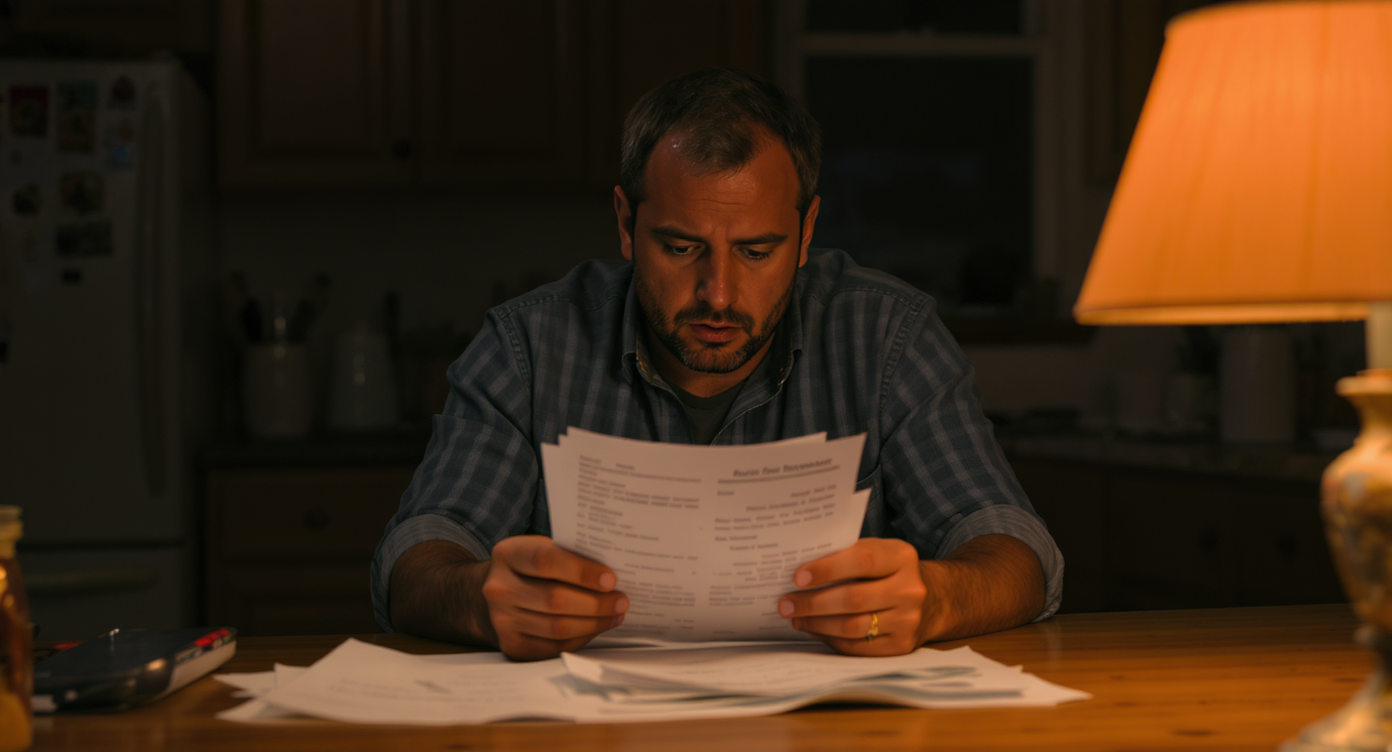
We drove home in silence. She went into the bedroom and closed the door, and I sat at the kitchen table and opened the bills I should have opened six months ago.
The hardest part wasn’t the money. It was the years of small lies that led up to that glass office. Every “it’s fine.” Every “don’t worry about it.” Every time she hid her phone when I walked into the room and I told myself I was being paranoid.
I wasn’t being paranoid. I was being trusting, and she used that trust to dig a hole big enough for both of us.
We’re still in the house. We’re still married. We have a payment plan and a counseling appointment, and Maya goes to a support group for compulsive spending on Wednesday nights. She comes home red-eyed and quiet, and some nights I can look at her without seeing the folder in Paul’s hand.
Some nights I can’t.
I still don’t know if staying was the right call or just the easier one. Maybe those are the same thing sometimes.
Would you have been able to rebuild trust after a financial betrayal this big, or would the lies have been the dealbreaker?