
🎧 Listen to this story
Full narration — My Wife’s Family Called My Business a Hobby at Every Dinner — Th
Narrated by Dramateller
For seven years, I sat at the end of the Ross family dinner table and let them hand me the smallest serving of humiliation with the same practiced ease they handed me the smallest portion of roast chicken.
Every Sunday at six o’clock, my wife Natalie’s mother, father, and two older brothers gathered in the dining room of the Victorian house on Maple Drive. Every Sunday, before the main course made its way around the table, someone found a way to ask me when I was going to get a real job.
My brother-in-law Garrett was the most creative. He ran a regional real estate firm that his father had essentially handed him after college, which meant he had plenty of time and plenty of confidence. “How’s the workshop going, Mark?” he’d ask, loud enough for the whole table to hear. “You land any big orders from the craft fair circuit?”
My brother-in-law Derek was less creative but louder. He’d tap his wine glass and announce to no one in particular, “I still think you’d kill it in pharmaceutical sales. My buddy Craig cleared two-fifty last year. And that’s a real career, you know? Benefits. A 401k. Things my sister deserves.”
Natalie would squeeze my hand under the table. She never said anything. She never defended me. She loved me, and I knew she did, but the Ross family script had been written long before I arrived, and she didn’t have the lines to rewrite it.
My father-in-law, Harold Ross, was the worst because he was the quietest. He’d watch me across the table with this patient, bemused expression, like I was a stray dog his daughter had brought home. He never insulted me directly. He didn’t have to. The look said everything: You’re not what I wanted for her. You’re still not. But here you are.
What none of them knew — what I never bothered to tell them — was that my father had started a precision-machining shop in Detroit in 1987, and I had taken it over when he retired in 2016. What none of them knew was that I had spent ten years modernizing the equipment, landing defense subcontracts, and building the kind of quiet, boring business that didn’t make cocktail-party conversation but did generate seven figures in annual revenue with zero debt and a very private balance sheet.
I didn’t drive a luxury car. I drove a 2019 Ford F-150 with toolboxes in the bed. I didn’t wear expensive watches. I wore Carhartt pants and steel-toe boots five days a week. I didn’t talk about my work because there was nothing to prove to people who had already decided what I was.
Then the email came.
It was a Tuesday afternoon in March when Harold Ross’s executive assistant called my office line. Not my cell. My office line, which meant she had looked up the number for Ross Transportation Group’s vendor directory and found my shop listed under precision components.
“Mr. Brennan, Mr. Ross would like to meet with you this evening. He said it’s urgent.”
I almost laughed. In seven years, Harold Ross had never requested a meeting with me. He’d never visited my “workshop.” He’d never asked a single question about what I actually did with my time.
I said yes because curiosity outweighed every other feeling.
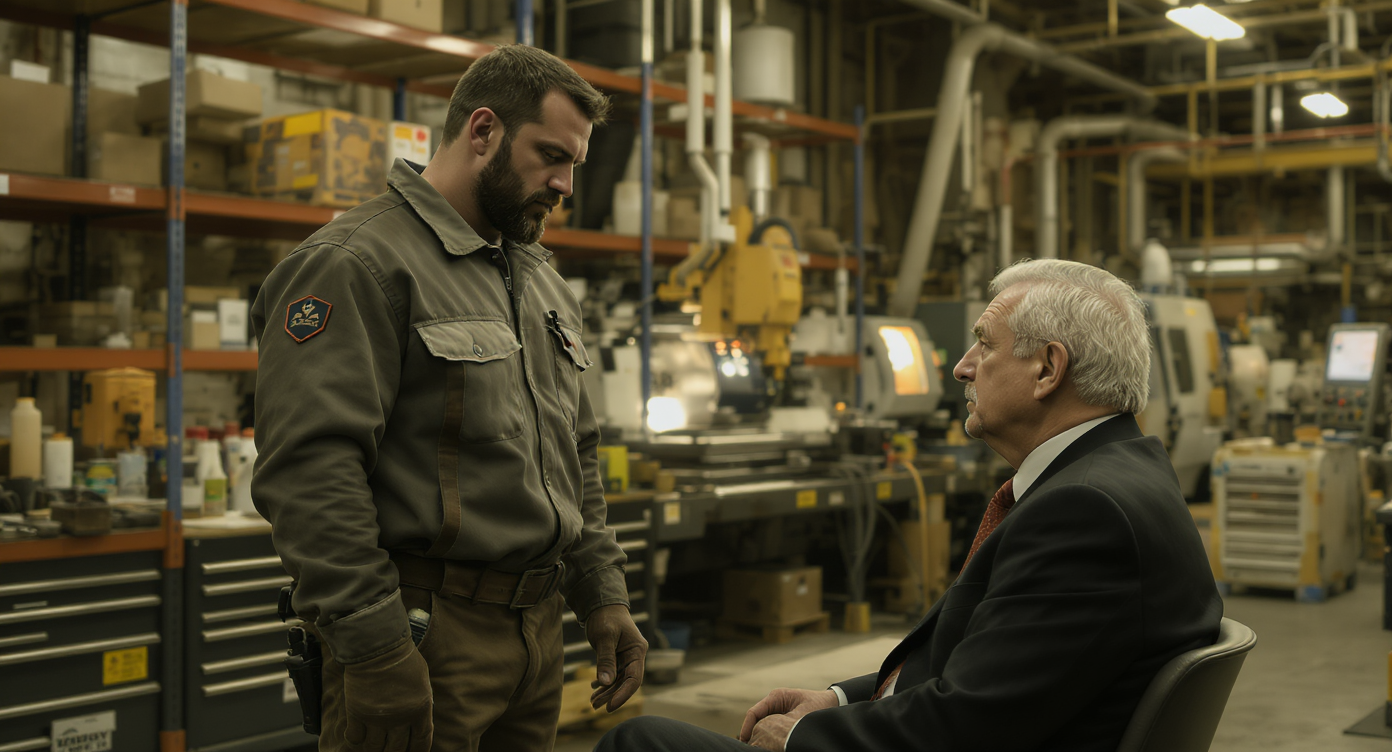
He showed up at my warehouse at six-thirty that evening, wearing the kind of expression I had never seen on his face: something between embarrassment and desperation. He walked through the shop floor without saying a word, past the CNC machines and the inventory racks and the three employees who were still running the second shift. He stopped at my office door and looked at the framed photo of my father receiving a supplier excellence award from a Fortune 500 aerospace company.
“Harold,” I said, closing the door behind us. “What can I do for you?”
He sat down in the chair across from my desk and folded his hands in his lap like a man who had never had to ask for anything in his life. “Mark, I need to talk to you about something. And I need you to keep this between us.”
I nodded.
“Ross Transportation is in trouble. We’ve been carrying a debt load that I thought we could manage, but two of our largest clients defaulted on their contracts last quarter, and the bank has called in our line of credit. I have thirty days to cover a shortfall of one point two million dollars, or they start seizing assets.”
He said it like he was reading a weather report. I could see his hands trembling.
“I’ve approached every bank, every private lender, every investor I know. No one will touch us. The company’s over-leveraged and under-collateralized. A week ago, someone in my accounting department mentioned that your business — that you might have —”
He stopped. The word capital wouldn’t come out of his mouth.
I let the silence sit for a moment. Then I said, “You want to borrow money from me.”
Harold Ross, who had spent seven years looking at me like a stray dog, could not meet my eyes. “Yes.”
I didn’t say yes that night. I said I would think about it, and I drove home with my hands gripping the steering wheel so hard my knuckles ached.
Natalie was in the kitchen when I walked in. She saw my face and asked what was wrong. I told her. I told her everything — the meeting, the request, the number.
She sat down at the kitchen island and stared at the counter for a long time. Then she said, very quietly, “You can actually do that, can’t you?”
“Yes.”
“All those years. Every Sunday. Every joke about your hobby.” She looked up at me. “Why didn’t you ever say anything?”
I sat down across from her. “Because I didn’t need them to know what I was worth. I needed you to know. And you did. You never defended me at that table, but you also never asked me to be someone else. You just held my hand under the table and let me be who I was.”
She started crying. Not loud crying, but the kind that moves through you without asking permission.
“What are you going to do?” she asked.
“I don’t know yet.”
The next Sunday, I sat at the Ross family dinner table one more time. Garrett made a joke about my schedule being flexible now that I was working for myself. Derek asked if I had considered getting a realtor’s license since I clearly had so much free time. Harold said nothing.
Natalie squeezed my hand under the table.
I looked at Harold across the roast chicken and said, “I’ve thought about your proposal. I’ll help. But on my terms.”
The whole table went quiet. Garrett’s fork stopped halfway to his mouth. Derek looked at his father like he had missed something important.
Harold set down his knife. “What terms?”
“The loan is secured against fifteen percent equity in Ross Transportation. Repayment in five years at market interest. And at the next family dinner, you will tell everyone at this table exactly what your company makes, where it gets its components, and who owns the precision-machining shop that has been supplying your vendor list for the last three years without any of you knowing.”
The silence was absolute.
Garrett said, “Wait — what?”
Harold Ross looked at me for a long moment. Then he picked up his wine glass, took a slow drink, and said, “Mark owns Brennan Precision. They’ve been on our approved vendor list since 2019. They manufacture seventeen percent of the critical components in our fleet management system.”
Derek’s face went white. Garrett blinked three times and said nothing.
I picked up my fork and took a bite of the chicken. “The chicken is excellent tonight, Linda,” I said to Natalie’s mother, who had not said a word all evening.
That was three months ago. The loan paperwork was signed the following week. Ross Transportation is still operating. My shop is still running. And the Sunday dinners have been quieter ever since.
Garrett doesn’t ask about my craft fair orders anymore. Derek stopped suggesting pharmaceutical sales. Harold looks at me now with something I don’t have a name for yet — gratitude, maybe, or the kind of respect that only shows up after humiliation runs its full course.
Natalie still squeezes my hand under the table. But these days, she also smiles when she does it.
I don’t think I’m a cruel person. I could have written a check and never said a word. But some truths need to be spoken out loud at the table where the damage was done, not whispered in private afterwards.
Maybe that makes me petty. Maybe it means I cared more about their opinion than I wanted to admit. Maybe both.
All I know is that the stray dog finally stopped being hungry.
Would you have helped, or let them figure it out on their own?