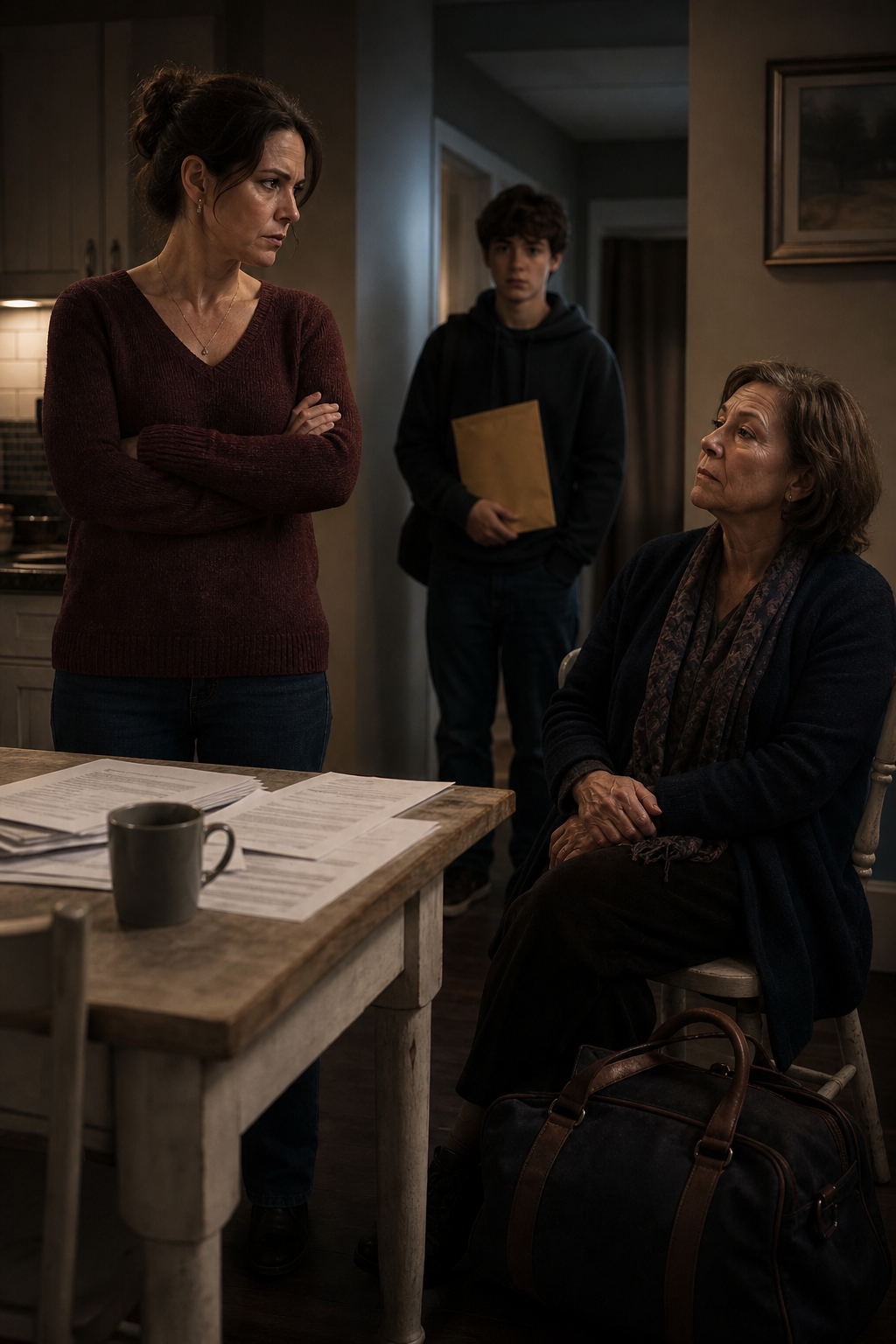


“He just needs a place to keep his tools for a few weeks,” my daughter said, standing in my kitchen like she was delivering terms instead of asking a favor.
Her father had been my ex-husband for twelve years, but Ava still said your father in a voice that made me feel like I was the one who had walked away from the family. She was twenty-four, old enough to know what her father was like and still young enough to believe every new apology sounded different from the last one.
I looked out at the detached garage behind my house. It was the one thing in the divorce I had fought hardest to keep. Not because I loved the building itself, but because it meant space. Privacy. One locked door on a property that was fully mine.
“Why can’t he rent a storage unit?” I asked.
Ava sighed. “Because he’s behind on everything right now. He lost the apartment, Mom. He’s staying with Tyler, and Tyler says the tools are taking over the whole place.”
That alone told me more than she meant to tell me. If a grown man had lost his apartment and was already wearing out his welcome somewhere else, a few tool chests were not the real problem.
“Storage only,” I said. “No working out there. No customers. No key. If he needs something, he calls me first.”
Ava relaxed so fast it was almost painful to watch. “Thank you. Seriously. He said you’d never help him, and I told him he was wrong.”
I should have paid more attention to that sentence.
The first week looked exactly like what she promised. Mark came by on a Saturday afternoon with two dented red tool chests, a floor jack, and three plastic bins full of parts. He kept his smile soft and his eyes lowered, like a man entering church after a long absence.
“I appreciate this, Jenna,” he said. “I know I don’t deserve it.”
That was another thing Mark was good at: saying the right self-aware sentence before doing the wrong thing anyway.
I unlocked the garage, watched him carry everything in, then locked it again when he left. He didn’t argue. Ava texted me three heart emojis that night as if I had restored world peace.
By the second week, I noticed grease spots on the driveway behind the garage. Not many. Just enough to make me stop on my way to the mailbox and stare.
When I asked Ava whether her father had been back there, she answered too fast.
“He only stopped by to grab a socket set,” she said. “You said he could call first. He called me because he knew you were at work.”
“That is not the same thing,” I said.
She immediately got defensive. “Why does everything with him have to become a trial? He’s trying to get back on his feet.”
I almost laughed because I had heard some version of that for twenty years. When we were married, it was He’s under pressure. Then it became He didn’t mean it like that. Then He just needs one break. Sometimes people don’t change their lines. They just change who they ask to recite them.
Two days later, my neighbor Marisol knocked on my door with her gardening gloves still on.
“I didn’t want to be nosy,” she said, “but there were two cars lined up behind your fence this morning. Then I heard an air compressor.”
My stomach dropped.
I walked straight to the garage and found the side door unlocked.
Inside, my neat shelves of paint cans and holiday bins had been pushed against the wall. Mark had set up a folding worktable. Extension cords snaked across the concrete. A sedan I had never seen before sat halfway inside the bay with its front tires on metal ramps.
Mark looked up from under the hood like I had interrupted him in his own shop.
“Before you start,” he said, wiping his hands on a rag, “this is temporary.”
There is something almost impressive about the confidence of a person who gets caught and still opens with instructions.
“Get the car out,” I said.
“Jenna, listen—”
“No. Get the car out of my garage.”
He straightened up slowly. “I’m doing a couple cash jobs. That’s all. Nothing major. Ava knows.”
Of course she did.
“You used my property for business without asking me,” I said. “You do not get to stand in my garage and explain why I should be calm.”
Mark’s face changed then. Just enough for me to see the old version of him underneath the sorry one.
“You always did love control,” he said.
That sentence ended any temptation to negotiate.
I told the owner of the sedan he had ten minutes to move it before I called a tow truck. He apologized to Mark, not to me, which told me exactly how the arrangement had been presented. By the time the car left, Ava was already pulling into the driveway.
“You embarrassed him,” she said.
“He turned my garage into a business,” I said.
“He was finally making money.”
“With my address. Without my permission.”
She folded her arms. “You could have given him a chance to explain.”
I wanted to ask how many chances a man gets before his daughter starts counting in decades instead of afternoons, but I bit it back. There are arguments you can win and still lose.
That night I changed the garage code, added a padlock to the side gate, and stacked his tool chests just inside the main bay so he could collect them the next day under my supervision.
I thought that would be the end of it. It wasn’t.
Three mornings later, a white city SUV pulled up in front of my house while I was on a work call. A man in a navy windbreaker stepped out holding a clipboard and a printed sheet.
He introduced himself as a city inspector and asked whether I was the owner of the property.
When I said yes, he glanced at the paper and said, “We received a registration notice for a home-based auto repair operation at this address, along with a complaint about vehicle traffic. I need to verify whether commercial work is being conducted in the detached garage.”
I felt the kind of anger that clears your mind instead of clouding it.
“No,” I said. “And if my ex-husband used my address on anything, he did it without my consent.”
The inspector asked to see the garage. By then I had already stripped it back to my shelves, my ladder, my bins, and Mark’s boxed-up tools waiting for pickup. The worktable was gone. The cords were gone. The compressor was gone.
He nodded, took a few photos, and then showed me the registration printout.
The business name was generic enough to sound legitimate. The address was mine. The listed contact number was Mark’s. But what caught my eye was the emergency contact line.
It was Ava.
That hurt more than I expected.
The inspector said he would note that the owner denied authorizing any business use and that the garage was not currently operating as a shop. Then he handed me a copy of the complaint summary and suggested I keep it in case “the responsible party disputes the record later.”
I called Ava after he left. She didn’t pick up. She texted instead that she was at work. I sent her a photo of the registration form with her name circled.
She called in less than thirty seconds.
At first she tried outrage. Then she tried explanation. Then she finally landed on the truth.
Mark had told her he only needed a temporary business address so he could reopen his mobile mechanic account, get insurance quotes, and prove he was working. He promised no one would ever actually come to my house. He promised he was almost stable again. He promised he would tell me himself once he had something to show for it.
“Do you hear how insane that sounds?” I asked.
Her voice cracked. “I was trying to help him.”
“By helping him lie to me?”
She started crying then, the way she used to when she was sixteen and caught between the parent who set limits and the parent who knew how to turn every limit into a wound. For a second I almost slipped into comforting her the way I used to.
Instead I said the one thing I should have said years ago.
“You are allowed to love your father,” I told her. “But you are not allowed to make me pay for it.”
There was a long silence on the line after that.
Mark came for his tools that evening. He arrived with the same injured expression he had worn at the end of our marriage, as if consequences had happened to him out of nowhere.
“You could ruin this for me,” he said quietly.
“No,” I said. “You used my home like it was yours to risk. You ruined it for yourself.”
He looked past me toward the house, maybe hoping Ava would appear and soften the scene for him. She didn’t. For the first time in a long time, she stayed out of the middle.
Ava came by two days later. She didn’t defend him this time. She sat at my kitchen table and admitted she had spent so much of her life trying to keep a version of her father alive that she stopped noticing who he actually was.
I told her I understood that better than she thought I did.
We’re still working our way back from it. I trust her more than I trust him, but trust is not something you fix with one apology and a hug over reheated lasagna. It takes longer when the betrayal arrives wearing a familiar face.
I kept the garage. I kept the locks. I kept the complaint copy in a folder by the desk in case Mark ever decides my address belongs to him again.
Maybe that makes me hard. Maybe it just means I finally learned that helping family and funding their deception are not the same thing.