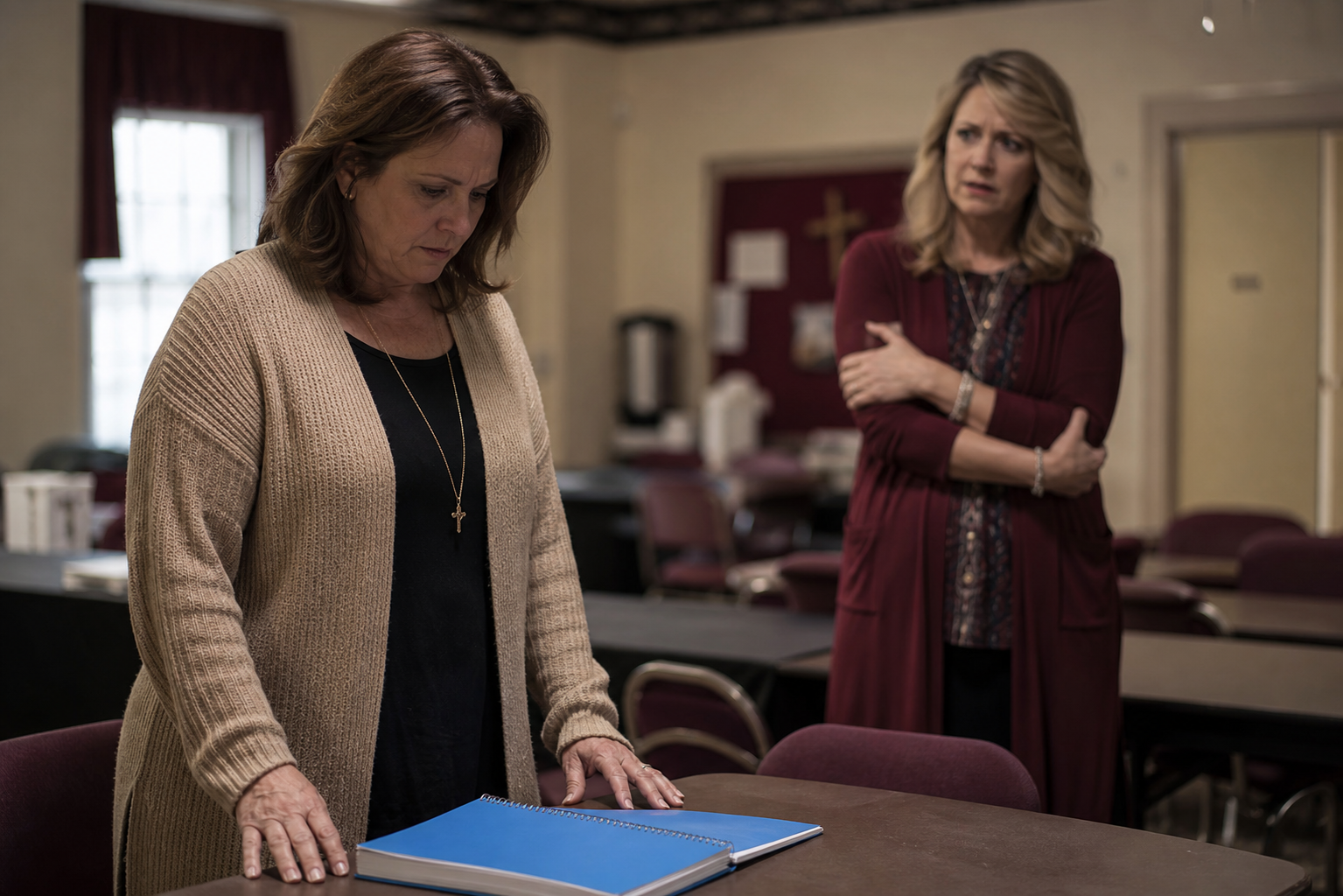


My son told my husband he wasn’t really family three weeks before Thanksgiving, and somehow he still expected us both to help him buy a house.
I was standing at my kitchen island when the first part happened. I had one hand in a bowl of stuffing cubes, my reading glasses sliding down my nose, and my phone balanced against the coffee maker on speaker. My son, Evan, had called to ask what time we were eating on Thanksgiving, which should have been a simple conversation.
Instead, he said, “I just want to be clear that I’m coming to see you. I’m not doing some fake family holiday with Richard.”
I thought I had misheard him.
“Fake family?” I asked.
He let out the same impatient breath he used to make at seventeen whenever I asked a question he didn’t want to answer. “Mom, come on. He’s your husband. That doesn’t make him my family.”
Richard was in the den, close enough to hear my side of the conversation if not every word. We had been married for four years. He had never once tried to replace Evan’s father, who died when Evan was nineteen and still carried his grief like a live wire inside him. Richard had been careful from the beginning. He never called himself a parent. Never demanded Father’s Day. Never tried to discipline a grown man. He just showed up quietly and consistently in the ways that matter more than speeches.
He fixed the porch railing when Evan said he’d get to it and never did. He drove me to physical therapy after my knee surgery. He sat in an urgent care waiting room with Evan last winter when Evan sliced his hand open trying to install his own garbage disposal and then told everyone later that “my mom’s husband happened to be nearby.”
Richard happened to be nearby because he dropped everything and came.
I lowered the volume on the phone and said, “He lives here, Evan. He’s my husband. He’ll be at Thanksgiving.”
“Then I’ll stop by earlier,” he said. “Before he gets back, or after.”
There was a kind of insult in how practical he made it sound, like he was scheduling around a plumber instead of a man I loved.
“No,” I said, and even I sounded surprised by how quickly it came out. “That’s not how this is going to work.”
He went quiet. “So you’re choosing him.”
People say that sentence when they want to skip over every difficult layer and turn a boundary into a betrayal.
I said, “I’m choosing not to let you treat my home like a divided territory.”
He hung up on me.
That should have been the part that hurt most, but it wasn’t. The worst part came ten minutes later when I turned around and found Richard pretending to look for a tape measure in the junk drawer, giving me the privacy of acting like he had heard nothing.
“You don’t have to do that,” I said.
He looked up. “Do what?”
“Make yourself smaller so I don’t feel worse.”
His face changed then, just a little. Hurt, then control. “I’m not asking you to fight with your son over me, Claire.”
That was Richard. Even his pain arrived politely.
But the truth was, this was not the first time Evan had asked me to divide my life neatly down the middle so his discomfort never had to brush against my reality. He had skipped my fiftieth birthday dinner because Richard was there. He had referred to my marriage as “your second life” in a tone that managed to make happiness sound like infidelity. When I invited him to a barbecue with Richard’s daughters and grandchildren in June, he asked if “all those people” would expect him to play family.
I kept telling myself time would soften him.
Time had done the opposite. It had simply taught him that if he stayed cold long enough, everyone else would work around it.
For two days, I heard nothing from him. Then on Sunday afternoon he texted me: Need to talk. Important. Can I come by Tuesday?
I stared at the message long enough that Richard finally looked over from his chair and asked, “Bad?”
“Probably,” I said.
Tuesday night, Evan arrived with a folder under his arm and that strained brightness people wear when they are asking for something they think should already be theirs. He kissed my cheek, nodded at Richard without really seeing him, and sat down at the dining table like he was late for a meeting.
“I found a townhouse,” he said. “Two bedrooms. Good neighborhood. The monthly payment would actually be lower than what I’m paying in rent.”
I said that sounded promising.
Then he opened the folder.
Mortgage estimate. pre-approval letter. bank statements. a typed page with bullet points highlighted in yellow.
“I just need co-signers,” he said. “My lender said if I had two stronger applicants, I could lock this in before the rate moves again.”
He slid the papers across the table. Across from him, Richard stayed still enough to be mistaken for calm by someone who didn’t know him.
I looked at the first page and then at my son. “You want both of us to co-sign?”
“Well, yeah.” He gave a short laugh. “That’s why I came in person.”
Something hot and almost childish flashed through me then. Not because he needed help. Parents help their children when they can. It was the casualness of it. Three days earlier, Richard had not been family enough to share a holiday meal. Now he was apparently family enough to share financial liability for thirty years.
Richard spoke before I could.
“Evan, have you gone over the risks here?” he asked, voice steady.
Evan’s shoulders tightened instantly. “I’m not asking for a lecture.”
“He asked a fair question,” I said.
“I know what co-signing is, Mom.”
“Do you?” Richard asked gently. “Because if you miss payments, it hits our credit. If you lose your job, we’re exposed. If there’s major damage or you need out early, it’s not just your problem anymore.”
Evan leaned back in his chair. “I knew this was a mistake.”
There it was again—the maneuver he had perfected over the last few years. Ask for something big. If you hear anything except immediate agreement, act wounded enough to make everyone else defend themselves.
I asked to see the rest of the folder.
He hesitated for half a second, which was all I needed to notice.
There was a credit-card statement folded into the back. Another with a balance transfer offer paper-clipped on top. And tucked behind the pre-approval letter was a notice from his auto lender showing two late payments from the spring.
“Evan,” I said quietly, “why am I seeing this for the first time?”
“Because it’s handled.”
“Two late car payments and twelve thousand dollars in revolving debt is handled?”
He rubbed a hand over his jaw. “I had a rough few months.”
“You told me work was going great.”
“It was. Then commissions dipped. Then rent went up. Then my transmission died. This is exactly why I didn’t want to get into every detail.”
Richard asked, “Have you talked to a loan officer about waiting six months and cleaning some of this up first?”
Evan snapped his head toward him. “I wasn’t talking to you.”
The room went so silent I could hear the refrigerator motor kick on.
Richard pushed his chair back slightly, not dramatic, just enough to create space. “All right,” he said. “Then I’ll leave this to you two.”
That should have relieved me. Instead, it made everything unbearable.
Because if Richard had raised his voice, or acted defensive, or demanded respect in some grand theatrical way, it would have been easier to retreat into the old habit of smoothing everyone down. But he didn’t. He just stood, gathered his water glass, and started toward the den like a man who already knew what role he had been assigned in this house.
“No,” I said.
Both of them looked at me.
“Sit down, Richard.” Then I turned to my son. “And you don’t get to come into our home, ask us to sign onto your debt, and speak to my husband like he’s an intruder.”
Evan stared at me, stunned. “Your husband?”
“Yes. My husband. The man you said wasn’t family enough for Thanksgiving but apparently is family enough for a mortgage application.”
His face flushed. “That’s not the same thing.”
“Then explain the difference.”
“This is practical.”
“Exactly,” I said. “That’s what makes it worse.”
He stood up so fast the chair legs scraped the floor. “I knew you were going to do this. Make me sound selfish because I don’t want to pretend Dad can be replaced.”
There are accusations so old they almost become furniture in a family. That one had been sitting between us for years.
I stood too. “No one is replacing your father. Not in this house. Not in my heart. Not in yours. But grief is not a free pass to use people when it helps you and erase them when it doesn’t.”
His eyes actually filled then, which nearly undid me. For one dangerous second I saw the twenty-year-old who had come home from the hospital after identifying his father’s body and sat on the back steps with his hands shaking because he didn’t know what to do with his anger.
But grief had started this. Entitlement was carrying it now.
I said, more softly, “If you want a relationship with me that doesn’t include the man I built a life with, what you really want is a version of me that no longer exists.”
He looked at Richard, maybe expecting rescue, maybe expecting pity. Richard only said, “I don’t want to stand between you and your mother, Evan. But I won’t help you build something you’re willing to hang on our backs while pretending I don’t belong at the table.”
Evan laughed once, sharp and humiliated. “So that’s a no.”
“It’s a no to co-signing,” I said. “And it’s a no to this arrangement where you decide when Richard counts.”
He shoved the papers back into the folder. “Unbelievable.”
I surprised myself then by sliding my own envelope across the table.
I had not planned to. I had written it that morning after a miserable night of pacing, because some part of me knew where this conversation was headed. Inside was a check for three thousand dollars.
“If you want help,” I said, “this is what I’m willing to do. It’s a gift, not a loan. Use it to pay down the credit cards or fix your savings cushion. Meet with a financial counselor. Reapply when you’re actually ready to carry a mortgage on your own.”
He looked at the envelope like it offended him.
“I don’t need charity,” he said.
“Then you definitely don’t need our signatures.”
He left without taking the check.
After the door slammed, I sat back down so hard my knees bumped the underside of the table. My whole body started shaking. Richard came around the table and put one hand lightly between my shoulders, not claiming victory, not saying I told you so, just steadying me while I cried over something bigger than the argument we had just had.
I was crying because there is a grief that belongs to losing a husband, and another grief that belongs to realizing your grown child has built an identity around punishing you for surviving it.
For a week, Evan didn’t call.
Then my sister texted that he was telling relatives I had chosen my “new family” over my own son. My aunt left me a voicemail saying adulthood is hard and maybe I should have signed because “boys need support later than girls do.” Even my cousin Jenna, who once had to move back in with her parents after a divorce, asked whether this was really the hill I wanted to die on.
Maybe it was.
Because the hill was not the mortgage. The hill was whether love means allowing your child to dishonor your marriage while still demanding access to its benefits.
If family holiday ultimatums are your kind of read, you might also like “If She Sits at My Table, I Won’t” — The Thanksgiving That Split Our Family.
Two Sundays later, Evan came by without calling. He looked exhausted. Older, somehow. He stood on the porch with his hands in his jacket pockets and said, “I was angry.”
I said, “I know.”
He didn’t apologize right away. Real apologies are rarely that tidy. Instead, he asked if he could come in and talk. Richard was grading estimates for a volunteer housing project at the dining table and started to stand. Evan stopped him.
“You can stay,” he said, not warmly, but not with contempt either.
It was the first decent thing he had said in weeks.
He told us he had met with the loan officer again. The townhouse was gone. Another buyer had moved faster. He had also met, reluctantly, with a financial counselor his friend recommended, who informed him that buying right now would have been reckless even with co-signers. He said hearing it from a stranger made him realize he had come to us wanting rescue, not help.
Then he looked at Richard and said, “I was wrong about how I spoke to you.”
Richard nodded once. “Thank you.”
It wasn’t a movie scene. Nobody hugged. Nobody healed completely in one conversation. But something rigid finally loosened. Evan took the check that night after all, with the condition that he would use it exactly how I intended and show me the balances once the cards were paid down.
And on Thanksgiving, he came at three o’clock, rang the bell, handed Richard a pie from the bakery he likes, and said, awkward as a teenager, “I figured if I’m eating here, I should bring something.”
Maybe that sounds small. In some families it would be. In ours, it felt enormous.
I still don’t know whether refusing to co-sign made me wise or just tired. Maybe both. But I know this much: love can help carry someone forward, and still refuse to become collateral for the version of them that only shows up when they need a signature.