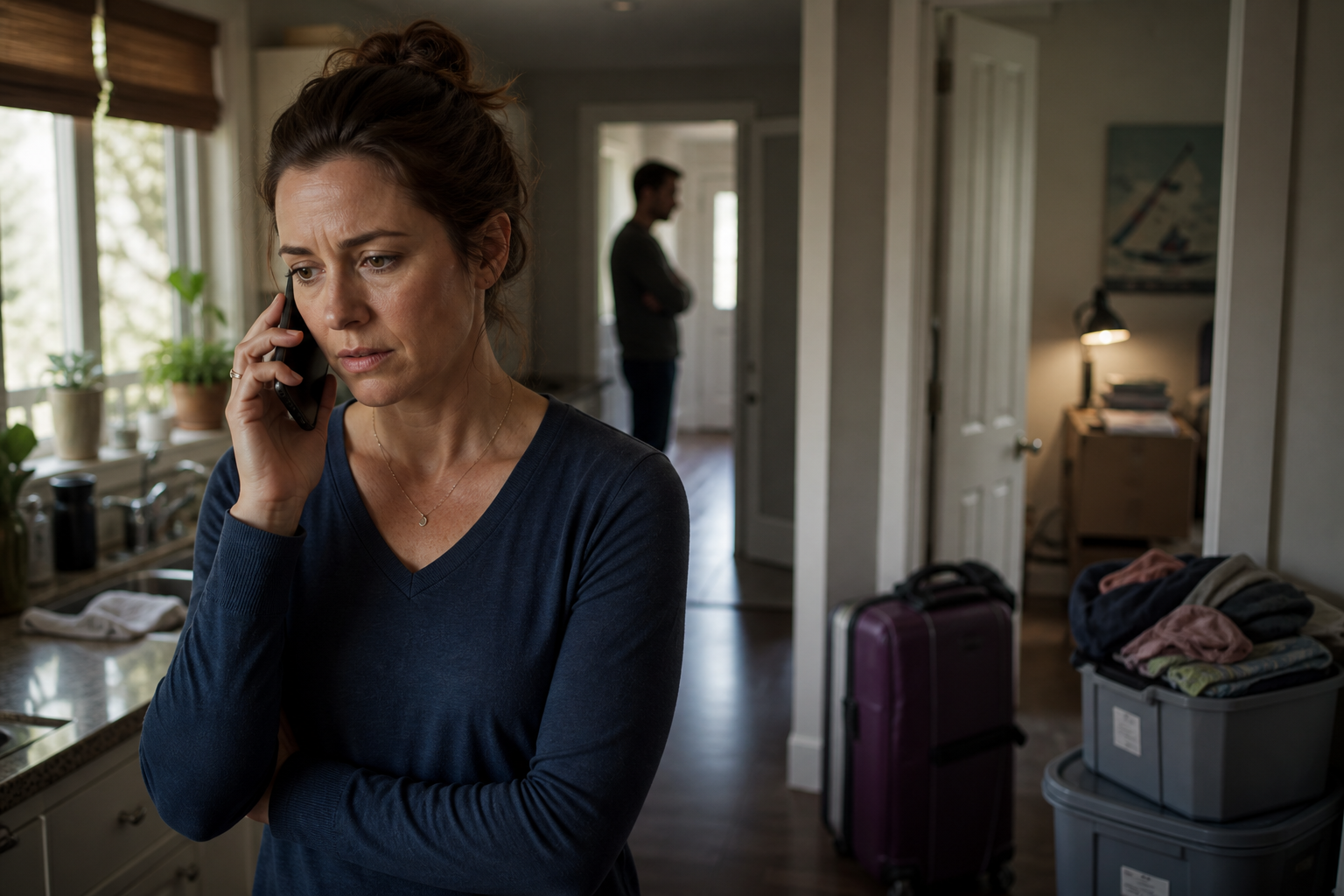

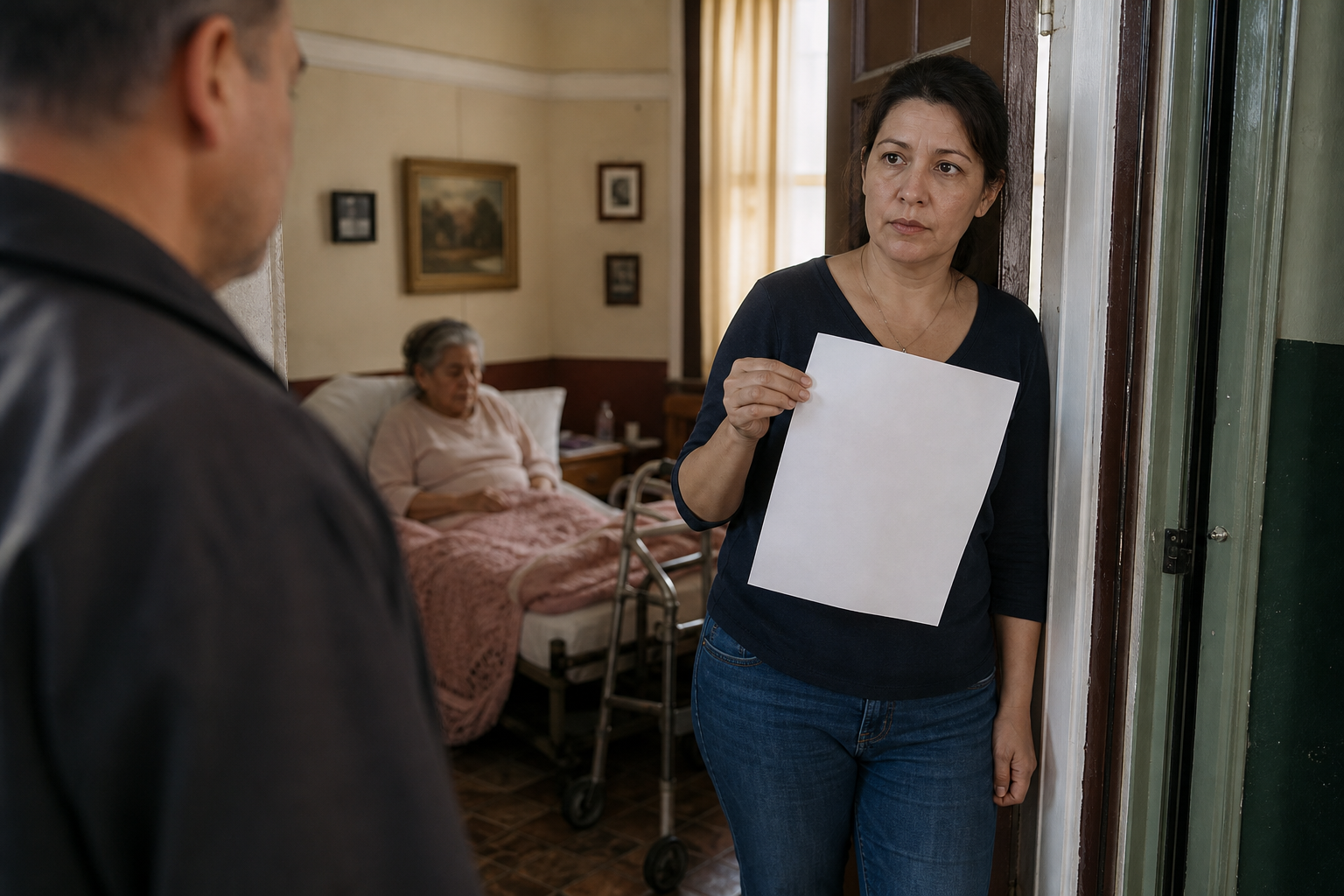
The notice was taped to my door before seven in the morning, still damp at the corners from the hallway humidity.
UNAUTHORIZED OCCUPANT MUST VACATE WITHIN 72 HOURS OR TENANCY MAY BE TERMINATED.
I read it twice in my socks, holding my coffee in one hand and my mother’s pill organizer in the other, while she called my name from the dining room I had turned into her recovery space.
That was the moment I knew my landlord had decided my mother’s bad month was a bigger inconvenience than his own lies.
My mother, Helen, had been home from rehab for twelve days.
She had suffered a small stroke after a fall in her kitchen, and the hospital had made it very clear that sending her back to her split-level house alone would be reckless. My older sister, Dana, said she would help “however she could,” which in our family usually means offering opinions from a safe distance. She had two college-aged sons, a husband who traveled, and a talent for sounding overwhelmed before anyone asked her to do anything specific.
I had a first-floor apartment, a steady schedule at the insurance office, and enough guilt to make a dangerous combination with both of those facts.
So I brought Mom home with me.
I moved my small dining table against the wall, borrowed a twin bed from my cousin, rented a shower chair, and learned how to wrap the blood pressure cuff without pinching her skin. At night I slept on the couch so I could hear her if she tried to stand up alone. During the day I answered emails from work on my lunch break while scheduling physical therapy, neurologist follow-ups, and the parade of home-health visits that suddenly ran my life in neat one-hour blocks.
It was exhausting.
It was also the easiest decision I had made all year.
My landlord, Mr. Kessler, had owned the building for as long as I had lived there, which was almost six years. He liked to describe himself as a “practical man,” by which he meant he fixed nothing until it threatened his rent checks. The back stair light was always out. The laundry room door never locked properly. Every winter he acted surprised that the radiators banged like pipes in a ship. He collected complaints the way some people collect junk mail: annoyed by them, never responsible for why they kept arriving.
When I texted him from rehab to say my mother would be staying with me for a few weeks after discharge, he responded with a thumbs-up.
Three days later, after the visiting nurse van started showing up, his tone changed.
He caught me in the hall while I was carrying in a bag of adult nutrition shakes and said, “I didn’t realize this was becoming a care situation.”
I told him it was temporary.
He said, “Temporary has a way of becoming permanent when family gets comfortable.”
I should have heard the warning in that. Instead, I heard only what I was used to hearing from men like him — irritation that another person’s difficulty had entered his line of sight.
Then came the notice.
Mom looked up from her bed when I walked back in holding the paper. One side of her mouth still pulled slightly when she was tired, and she had begun to hate the look people got when they saw her notice it too. “What is that?” she asked.
I lied automatically. “Nothing important.”
She held out her hand anyway.
My mother spent forty years reading faces in a beauty salon chair. Even after the stroke, she could still hear what people were trying not to say.
By noon, Dana had called with advice I had not asked for.
“Nina, maybe don’t make this a fight,” she said. “If he’s being difficult, maybe Mom should stay somewhere more appropriate for recovery.”
More appropriate.
That is the kind of phrase people use when they want to dress up surrender as wisdom.
I asked if she was volunteering her guest room.
She got quiet for a beat and then said, “You know I can’t with the stairs.”
My mother heard enough of that conversation to turn her face toward the wall after I hung up. That hurt me more than the notice did. She had spent her whole life being the woman other people leaned on — the one who drove across town with soup, kept spare house keys, remembered birthdays, showed up after funerals with folded tables and paper plates. Now one bad fall and one frightened body later, everyone suddenly wanted to discuss placement.
That night, I read my lease three times at the kitchen counter.
It said nothing about a parent recovering in my apartment for a few weeks. It barred subletting. It limited “long-term occupancy” without defining it. It was vague in exactly the way men like Kessler prefer: loose enough to threaten with, slippery enough to defend later.
The next morning I found water dripping through the dining room ceiling and landing in a slow, cold tap beside my mother’s bed.
I put a mixing bowl under it and texted Kessler a photo.
No answer.
The physical therapist, a blunt woman named Rochelle, glanced up at the stain and said, “That leak’s been there longer than today.”
She was right. Once I started looking, I saw the whole shape of it — the brown ring spreading under old paint, the warped trim along the corner, the soft spot near the light fixture. While Mom practiced standing from the bed without using both arms, I heard heavy footsteps above us, then a sharp male voice, then something metallic scraping the floor.
“How many people are up there now?” Rochelle asked.
I said I thought three.
She gave me a look that said I should think harder.
By evening it was obvious the upstairs unit was not a normal upstairs unit anymore.
Men came and went at odd hours. There were always more shoes outside the door than I could match to the faces I saw. A hot-plate smell drifted down the hallway most nights, even though the building rules technically banned portable burners. One of the upstairs windows had been screwed half-shut last winter after a “repair,” and the back exit from the second floor was blocked with old mattresses Kessler kept promising to remove.
I had noticed all of it before.
I had just never needed the pattern to mean anything.
The woman in 1B, Mrs. Lopez, made it mean something.
She knocked on my door that Thursday afternoon carrying a loaf of sweet bread for my mother and waited until Mom was napping before lowering her voice. “He’s afraid of inspectors,” she said, jerking her chin upward. “That’s why he wants your mother out.”
I stared at her.
Mrs. Lopez told me Kessler had split the upstairs apartment into extra sleeping rooms with cheap partition walls after the last tenants moved out. He rented by the bed when he could, cash when possible, and ignored every complaint as long as nobody official came asking questions. Last month, she said, one of the upstairs men had tripped a breaker running a space heater and a microwave off the same extension cord.
“He doesn’t care about guests,” she said. “He cares about people with clipboards.”
Suddenly the notice made perfect sense.
My mother’s home nurse. The physical therapist. The medical supply delivery. The shower chair in the hall. The recovery bed in plain view from the doorway. None of that made Kessler nervous because it was inconvenient. It made him nervous because it increased the odds that someone would look too closely at the building he was pretending was ordinary.
That realization changed something in me.
Up until then, I had been arguing from defense — trying to prove my mother had a right to stay. Once I understood what he was hiding, I stopped feeling defensive at all.
Kessler finally came by in person Friday morning with another notice and a face arranged into false patience.
He stood in my doorway, glanced past me toward my mother’s bed, and said, “I’m trying to handle this professionally.”
I said, “Then start with the leak over her bed.”
He ignored that. “Your lease is for one tenant, Nina. I can’t have residents moving relatives in indefinitely, especially when there are medical liabilities.”
“Twelve days is indefinitely?”
He sighed like I was being emotional on purpose. “If something happens to her here, it comes back on me.”
That was the line that almost worked, because fear is persuasive when it borrows the shape of concern.
Then I thought about the blocked upstairs exit. The extra shoes. The hot plates. The water coming through my ceiling from an apartment he swore was up to code.
“If you’re suddenly worried about safety,” I said, “we should talk about the upstairs unit.”
His whole face changed for one second.
Just one.
But it was enough.
“That’s none of your business,” he said.
“My ceiling says otherwise.”
He stepped closer and lowered his voice. “Get her out by Monday, and I won’t push this further.”
There are moments when you can feel your life sort itself into a before and an after, and they rarely look dramatic from the outside. Mine looked like standing barefoot on cheap hallway carpet, holding a second threat from a man who had counted on me being too tired to fight him.
I said, “I’m not moving my mother because you need fewer witnesses.”
Then I closed the door.
If caregiving and housing conflicts are your kind of read, you might also like My Neighbor Said My Mother’s Wheelchair Ramp Was Lowering Property Values — Then the HOA Opened Her File.
I filed the complaint ten minutes later.
Not just one complaint. Two. One with the city housing office about the leak and possible illegal occupancy, and another with the fire marshal about blocked egress and improvised rooms upstairs. Rochelle had given me the right department number on a sticky note before she left. Mrs. Lopez gave a statement. So did one of the upstairs tenants after I caught him outside smoking and asked whether he knew there was no second clear exit in an emergency. He laughed without humor and said, “Lady, we all know.”
The inspector arrived Monday at 9:20 in the morning.
The fire marshal arrived fourteen minutes later.
Kessler tried charm first. Then annoyance. Then outrage. He told them I was a disgruntled tenant trying to create problems because he had asked me to follow the lease. The housing inspector asked to see the water damage in my apartment. The marshal asked to inspect every exit path in the building.
That was when Kessler started sweating.
From my doorway, I watched them go upstairs.
I heard the first raised voice when they reached the landing.
I heard the second when they opened what had once been the living room and found freestanding partitions, extension cords knotted under rugs, and mattresses arranged so tightly there was barely a clear path between them. Then came the sound of another door opening — the small back room Kessler had apparently turned into a sleeping space too — and the fire marshal saying, sharp and unmistakable, “This window is not a legal egress.”
When they came back down, the marshal asked Kessler why the upstairs back exit was obstructed and why a unit licensed as a two-bedroom apartment appeared to be operating as a rooming house.
Kessler looked at me like I had set his money on fire with my bare hands.
Maybe I had.
He was cited on the spot. The upstairs unit was partially vacated that afternoon. The leak above my mother’s bed, which had somehow resisted repair for three days, suddenly became an emergency maintenance issue by dinner.
By Wednesday I had a call from a tenants’ legal clinic telling me that retaliatory eviction notices tend to collapse when city paperwork starts piling up. By Friday, Kessler had backed off every threat he had made and was speaking to me in the clipped, careful tone men use when they realize the person they dismissed now has records.
My mother stayed six more weeks.
Long enough to move from walker to cane.
Long enough to make her own tea again and complain about my grocery brand choices, which was the most encouraging sound in the world.
Long enough to stop apologizing every time someone knocked at the door.
One evening, after her physical therapist had gone and the apartment was briefly quiet, she said, “I thought I was the trouble.”
I was rinsing dishes. I turned the water off and looked at her.
“You were never the trouble,” I said.
She nodded slowly, like she was trying to believe me with her whole body, not just her mind. “I know that now,” she said. “But I needed to see who was.”
Dana, of course, later told me I had made the whole situation “bigger than it needed to be.” That is easy to say when you were never the one being told to clear out your mother so someone else could keep collecting cash upstairs. I told her if “smaller” meant handing over my mother’s dignity to protect a landlord’s side business, then bigger had been exactly the right size.
We moved out two months later, on my terms, into a better apartment across town with wider halls, kinder management, and windows that actually opened the way they were supposed to. My mother went back to her own house in the spring, with grab bars installed and a neighbor checking on her every morning. Kessler’s building stayed tied up in violations for months.
I don’t know whether calling the city made me brave. I think it mostly made me finished.
Finished explaining why care matters. Finished pretending that politeness is the same thing as fairness. Finished letting men call something a liability when what they really mean is a witness.
Maybe that makes me difficult.
Maybe it means I finally learned that a home does not become less yours just because someone you love needs space to heal inside it.