

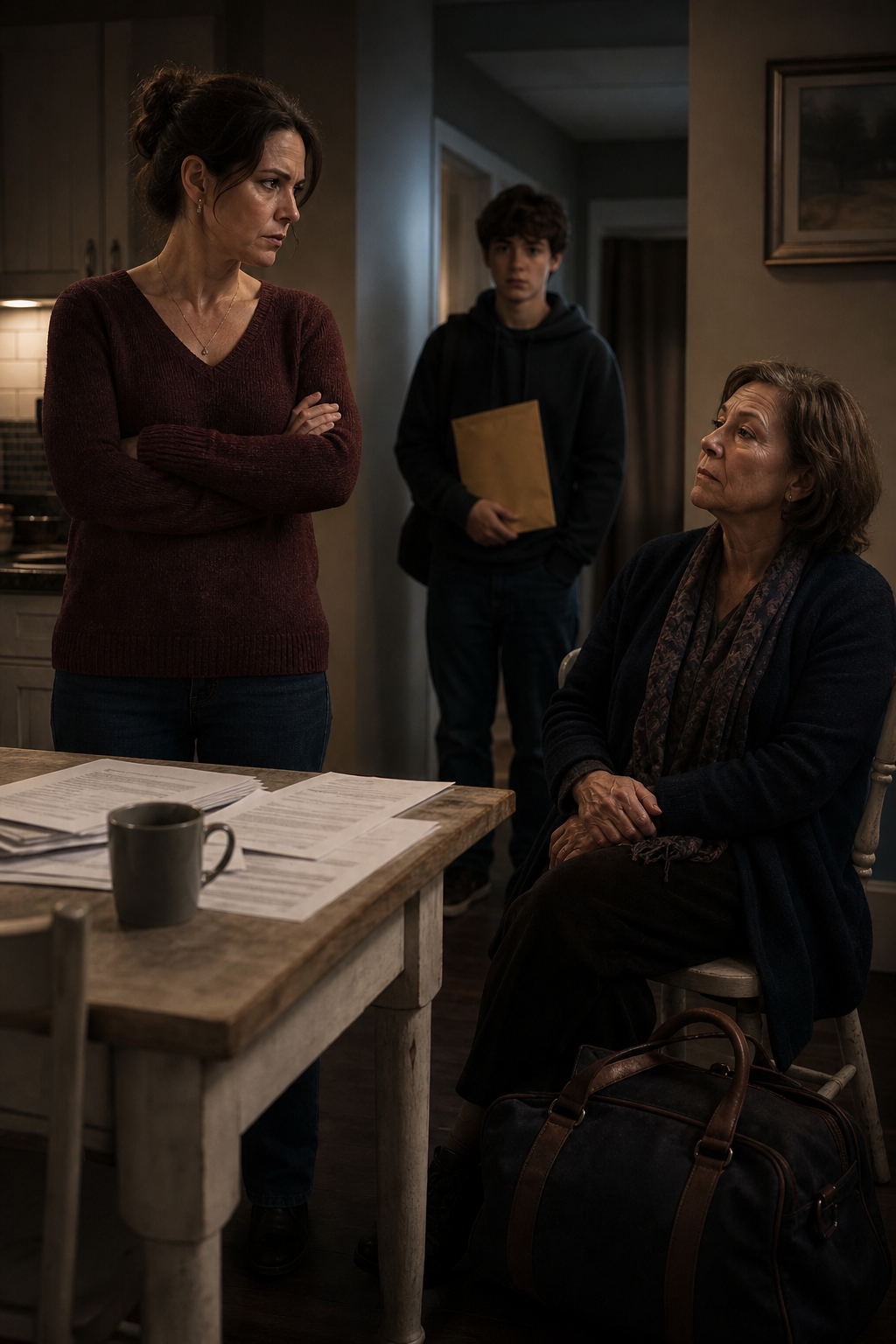
My mother asked for my couch on a Thursday night. Three weeks later, my son held up our lease renewal packet and asked why her name was on it.
I had not seen Denise in person in nineteen years.
Not since the summer she left me with my grandmother, two trash bags of clothes, and a promise so casual it took me years to understand it was a lie. She said she just needed to get herself together. She said she would come back before school started. I was fourteen then. I am thirty-eight now, old enough to have a son only two years younger than I was when she decided motherhood was something she could put down and maybe pick up later.
So when she appeared outside my apartment building in November with a wheeled suitcase, a soft beige coat, and that careful face people wear when they need mercy more than honesty, I honestly thought I was looking at the wrong woman.
“Lana,” she said, like she had just seen me last month instead of before my first cell phone, first job, first heartbreak, first pregnancy, first everything. “I didn’t know where else to go.”
I should have kept walking.
Instead, I buzzed her in.
The version she gave me over tea at my kitchen table was almost believable if you squinted. The boyfriend in Florida was gone. The room she had been renting from a friend had become unavailable. Her knees were bad. Her savings were worse. She only needed a place to sleep until winter passed and she could get into senior housing.
“I’m not asking for forever,” she said. “Just a little time. I know I don’t deserve even that.”
That last line was smart. People who say they don’t deserve your help are often the hardest to remove once they get it.
My son Owen was doing homework at the counter, pretending not to listen. After she went to the bathroom, he looked at me and said, “That’s really your mom?”
I nodded.
“Are you letting her stay?”
I stared into my tea long enough for the answer to become obvious.
“For a little while,” I said.
He didn’t argue. That made it worse.
I told myself I was doing the adult thing. The kind thing. The thing I would want my own child to do if life ever broke me open in public. My grandmother had been dead for four years by then. My sister Marisol lived in Arizona and liked to offer wisdom from safe distances. When I called her, she said exactly what I knew she would.
“Maybe this is your chance,” she said. “People change.”
That is easy to say when the changing will be happening in somebody else’s living room.
At first, Denise was almost easy to have around. She folded blankets before I woke up. She washed dishes I had already meant to wash. She praised Owen’s manners so lavishly you would have thought I had single-handedly invented politeness. She told the retired woman downstairs that I was “the daughter who saved me.” She said it with a damp little laugh that made me sound generous and made her sound delicate.
I started getting that look from people in the building. The approving one. The one that says good woman, difficult burden.
I hate how flattering that can feel when you’re tired.
Then the small boundary crossings started.
She gave our apartment number to a church pantry without asking because they were “dropping off essentials.” She used my expensive face cream because “we’re family.” She told Owen stories about me that should not have belonged to her anymore, about the way I used to cry over math homework and sleep with the hallway light on.
Every time I tightened up, she softened.
“I’m sorry,” she’d say. “I’m out of practice being part of a home.”
That line made me feel cruel for hearing the manipulation in it.
Around the second week, our super, Mr. Kessler, stopped me by the mailboxes and said, “I’m glad your mother found somewhere stable.”
I froze with my keys in my hand.
“Stable?” I asked.
He shrugged. “At our age, we all need a little help sometime.”
It was such an ordinary answer that I told myself not to read into it. People in old buildings know everything and nothing at the same time.
But that same evening I found Denise in the lobby talking to him again. She smiled too quickly when she saw me. Mr. Kessler lifted a manila envelope and said, “No rush on the paperwork. End of the month is fine.”
Denise slid the envelope under a grocery flyer before I reached the kitchen.
“What paperwork?” I asked.
She did not miss a beat.
“Just a senior transit application,” she said. “They need proof I’m staying somewhere local.”
I should have asked to see it.
I didn’t, because Owen had a geometry test the next morning, because I had just worked a ten-hour shift at the dental office, because some part of me was still trying to prove I was not the bitter daughter everyone expects an abandoned child to become.
By the third week, Denise had begun speaking about my apartment like it was a family decision instead of a temporary arrangement. She told a cashier at the pharmacy, “We live over on Mercer.” She asked whether Owen thought the hall closet could fit a small dresser if we “reorganized.” She started collecting her mail from the stack on the table before I got home from work.
Then Saturday happened.
I was in the laundry room downstairs when Owen came in holding a large white envelope from the management office.
“Mom,” he said, quiet in that way kids get when they have already realized something is bad. “Why is Grandma Denise on this?”
He handed me the packet. At the top was our annual lease renewal. Under current occupants, where it had always said Lana Ruiz, Owen Ruiz, there was a third line typed neatly below ours.
Denise Carter.
For a second I actually thought I might throw up.
“Where did you get this?” I asked.
“Mr. Kessler left it by the door. She told me to put it on the table, but then I looked because I thought maybe there was something I had to sign for school stuff.”
He looked scared, which made me feel instantly guilty. None of this was his fault, and he was already carrying it in his shoulders.
“You did the right thing,” I told him.
Denise came out of my bedroom carrying folded towels like we were in a detergent commercial. The second she saw the packet in my hand, her face changed.
Not shocked. Caught.
“You put your name on my lease?” I asked.
Owen slipped back toward the hallway, but Denise said, “Don’t make it dramatic.”
That sentence did something cold to me.
“Answer me.”
She set the towels down and crossed her arms like I was the one behaving badly. “I wasn’t trying to steal your apartment, Lana. I just needed stability on paper. The housing counselor said it would help if I could show current residency.”
“So you forged your way into my lease?”
“I didn’t forge anything. Mr. Kessler said it was normal to update occupants at renewal.”
“Normal for the people who actually live here to decide that.”
Her eyes flicked toward Owen. “I didn’t think you’d react like this in front of your son.”
There it was. The old trick. Shame me for the scene instead of the reason for it.
I called the management office right then because if I had waited, she would have spent the night turning this into a misunderstanding. Mr. Kessler answered on the second ring. I put him on speaker.
“Can you tell me why my mother’s name is listed as an occupant on my renewal?” I asked.
There was a pause. Then the kind of cautious office voice people use when they realize there has been too much confidence and not enough permission.
“She said you wanted her added since she was residing there full-time,” he said. “She provided identification and asked for the updated packet.”
Denise actually looked offended when I turned toward her.
“You told him I wanted that?”
“I told him you knew I was staying,” she snapped. “Which you did.”
Mr. Kessler cleared his throat over the speaker. “If there’s been a misunderstanding, Ms. Ruiz, don’t sign the renewal yet. Come by Monday and we can correct the occupant list before processing.”
Correct it. Like she had typed herself into a grocery order by mistake.
If stories about absent parents trying to come back on their own terms pull you in, you might also like My Father Sent Me a Birthday Card After Twenty-One Years — Then His Wife Asked Me to Take Him Home.
After I hung up, Denise started crying. Real tears this time, which somehow only made me more tired.
“You have no idea what it feels like to be scared at my age,” she said.
I laughed once, and it came out harsher than I meant it to.
“No,” I said. “I only know what it felt like to be scared at fourteen.”
That landed. I could see it land. But hurt is not the same as accountability.
She said she had been planning to tell me. She said I was punishing her forever for the worst mistake of her life. She said blood should matter more now that we were all older.
What I heard was this: I need something, so your history should become less expensive for me.
I told Owen to take his backpack and go wait downstairs with our neighbor Mrs. Levine for ten minutes. He did not ask questions. Kids know when the room has become too adult.
Then I told my mother she had until Monday morning to leave.
She stared at me like I had slapped her.
“You would put me out over paperwork?”
“I’m putting you out because you lied to my landlord and tried to make yourself permanent in my home without asking me.”
“I had nowhere else.”
“You had a phone. You had words. You had three weeks to tell the truth.”
She slept that night on my couch anyway, sniffling under the blanket my grandmother made, and I lay awake furious that even then I felt guilty for not bringing her a glass of water.
The next morning, Marisol called after Denise got to her first. My sister said I could have handled it with more compassion. She said older women panic. She said family should not be turned back out into the cold.
“Then book her a ticket to Arizona,” I said.
Marisol got quiet after that. Principle often does when it meets logistics.
On Monday I took my lunch break at the management office and had the occupant list corrected in writing. Mr. Kessler apologized twice. He admitted Denise had made it sound like we were all aligned and that I was “at work all the time.” I told him that women like my mother build whole bridges out of other people’s assumptions.
By then, Denise had gone to stay with a friend from church across town. She left the apartment neatly made, my extra key on the table, and a handwritten note about how she hoped someday I would understand desperation.
I understood desperation just fine.
I just no longer confuse it with permission.
That night Owen sat at the kitchen table while I shredded the bad renewal copy into a grocery bag. He watched for a minute and then said, “You always tell me trust is earned, not announced.”
“I do,” I said.
He nodded toward the bag. “Then I guess you did what you had to do.”
Maybe that sounds cold. Maybe some people would have let her stay through winter and called it healing.
But I spent too many years learning how to build a safe home out of instability to hand part of it over just because the woman who created the instability finally ran out of better options.
She asked for my couch.
What she really wanted was a claim.
And this time, I did not sign anything away.