
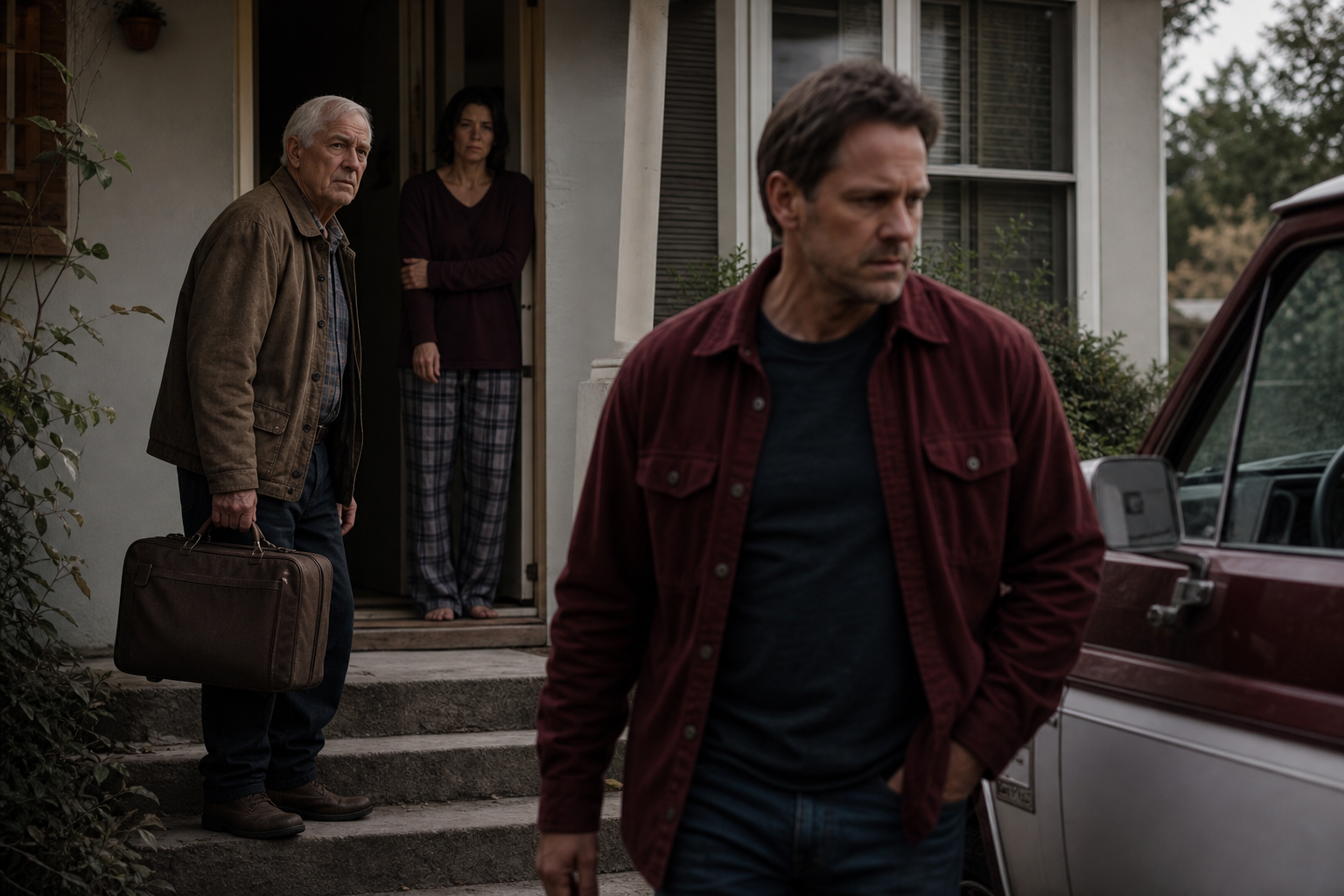
My brother left our father on my porch with a suitcase at 7:12 on a Saturday morning, then asked if Dad still kept the truck title in the kitchen drawer.
He said it casually, like he was asking whether we still bought the same coffee.
I stood there in my socks, one hand still on the deadbolt, looking from my father’s face to the old brown suitcase by his shin to my brother Shane already halfway back down the steps.
My father, Earl, was seventy-four and trying very hard not to look confused. That was the part that got me. He still had too much pride to admit when he didn’t understand what was happening, which meant he often stood inside other people’s decisions like a man pretending he had chosen the room himself.
“What truck title?” I asked.
Shane gave me the same annoyed smile he’d been using on me since we were teenagers, the one that meant I was making things difficult by noticing them.
“His Ford,” he said. “I’m just asking if he still keeps papers in that junk drawer. Relax.”
Then he looked at Dad and clapped a hand once, like this was all temporary and cheerful. “You’ll be okay here for a few days.”
A few days.
That was the first lie of the morning.
My father had been living alone since my mother died six years ago, but “alone” had become a technical term. I handled his cardiology appointments, refilled his prescriptions, argued with his insurance, brought over casseroles he claimed were “too much trouble,” and checked that he had actually taken his evening pills instead of dropping them into the little blue dish by the sink and forgetting them there.
After his minor stroke in April, the forgetting got worse.
Not dramatic-movie worse. Real-life worse. He lost words in the middle of sentences. He left the freezer open. He called my daughter Ava by my sister’s name twice in one week, and my sister had been dead for eleven years. He could still drive short distances during daylight, according to his doctor, but only if someone kept an eye on how often he got turned around.
I was the someone.
I am thirty-nine, married, and the mother of two teenagers who act like they can survive on air and protein bars but somehow still empty my refrigerator every two days. My husband, Nate, teaches high school history and has the calm voice of a man who can de-escalate both sophomore boys and my family with almost equal skill. We lived twenty minutes from Dad. Shane lived forty-five minutes away and somehow still managed to describe himself as “the one who was always there for him.”
What Shane meant by “there” was that he called when he needed something.
Last year it was Dad’s generator after a storm.
Before that it was a “short-term” loan that turned into eleven months of silence.
Before that it was asking Dad to co-sign for work equipment he swore would help him stabilize his contracting business.
Shane had a gift for turning irresponsibility into urgency. By the time anyone else understood the situation, he was already presenting himself as the injured party.
Dad still made excuses for him.
“Your brother has a lot on his plate,” he would say, which in our family translated loosely to: Please don’t make me look directly at what your brother is doing.
That morning, Dad picked up the suitcase handle and said quietly, “Shane thought it might be easier if I stayed with you until Monday.”
“Why Monday?” I asked.
He hesitated. “He said he had some things to sort out at the house.”
The house.
Dad’s house.
I looked at Shane again. He had stopped by the truck now, one hand on the open driver-side door.
“What things?” I asked.
“Tessa, please.” He sighed like I was exhausting him. “The upstairs bathroom pipe burst last night. I shut the water off, but the place is a mess and I don’t want him there while I deal with it.”
“So call a plumber.”
“I did.”
“And in the middle of this emergency, you had time to ask me about the truck title?”
His jaw tightened. “Because if the truck needs to be moved, I need to know where the keys and papers are. Not everything is a conspiracy.”
My father shifted beside me. “Girls,” he said automatically, using the word he had used when our mother was alive and there were still enough women in the room for that joke to make sense.
I almost corrected him. Then I saw how hard he was gripping the suitcase handle and let it go.
“Come inside, Dad,” I said.
Shane started to say something else, but Nate had come up behind me by then. He had on sweatpants and that look he gets when he’s still polite but no longer remotely fooled.
“You can text us the plumber update,” Nate said.
Shane gave him a thin smile, got into the truck, and drove away without carrying the suitcase back up or looking once in the rearview mirror.
Inside, Dad sat at our kitchen table with both hands wrapped around a mug of coffee he barely drank.
My daughter came in, took one look at his face, and wordlessly put a cinnamon roll on a plate in front of him. He smiled at her like she had offered him dignity instead of pastry.
That’s when I noticed the folded paper sticking out of his cardigan pocket.
It was a reminder card from a shipping store that offered notary services.
Monday. 10:30 a.m.
Dad saw me reading it and frowned. “Your brother said we had to get a form witnessed.”
“What form?”
He looked embarrassed. “Something about the truck. Or insurance. I’m not sure.”
My stomach dropped so fast it felt physical.
“Did you sign anything already?”
“Not yet.” He rubbed his forehead. “He wanted me to wait until Monday because he said you would only overreact.”
There are certain moments in adult life when anger arrives so cleanly it makes you feel calmer before it makes you feel hot. That was one of them.
I asked Dad whether Shane had said anything else. After a few false starts, he admitted Shane had been pushing him to “let him use” the Ford for a while because Shane’s own truck was “having problems.” Then Dad said the sentence that settled everything for me.
“He also asked whether I thought maybe it was time to stop rattling around in that house by myself.”
There it was.
This was not a bathroom leak. This was a collection plan.
Get Dad out of the house. Get him in my care under the language of family emergency. Get the truck signed over before anyone slower, stricter, or more informed could stand in the doorway.
I called the number Shane had texted me for the “plumber.” It went to voicemail with a generic recording and no company name.
Then I drove Dad back to his place.
Nate came with us. So did my son, mostly because he has inherited my inability to sit home quietly when something feels wrong.
The upstairs bathroom was dry.
No burst pipe. No buckets. No warped baseboards.
But the garage side door was open, and Dad’s red metal toolbox was sitting near the driveway like someone had already started deciding what counted as extra.
In the kitchen, three drawers were pulled halfway out.
That junk drawer too.
Dad stood in the middle of the room and said, very softly, “Oh.”
I wish I could say that was the moment everything became clear to him, but betrayal rarely arrives as one sharp clean note when it comes from family. It arrives in a series of small humiliations your heart tries to reorganize into misunderstanding.
I closed the drawers, checked the file cabinet in the hall closet, and found the truck title still there. The envelope with Dad’s house insurance policy was there too, but it had been opened and shoved back in upside down.
When Shane finally answered his phone, I put him on speaker.
“Where are you?” I asked.
“Busy.”
“The bathroom is fine.”
Silence.
Then: “I told you it was mostly handled.”
“You also told Dad he needed to stay with me until Monday so you could sort things out.”
He exhaled hard. “Because he can’t manage there alone anymore, Tessa. You know that.”
“What does that have to do with the truck?”
“I was trying to solve multiple problems at once.”
That phrase would have sounded efficient in any other mouth. In Shane’s, it sounded like theft with a planner.
Dad spoke up then, not loudly, but clearly enough that Shane went quiet at once.
“Were you trying to take my truck?”
There was a pause so long I could hear traffic through Shane’s side of the call.
“I was trying to keep it in the family,” he said.
Dad sat down at the kitchen table like his knees had simply stopped negotiating with him.
“It is in the family,” he said.
Shane pivoted fast, the way people do when they realize truth is less useful than guilt.
He started talking about how hard money had been. About his business slowing down. About gas prices. About how I already had a stable husband and a nicer house and somehow always got credit for being responsible while he got judged for falling behind.
Then he said what he had probably been thinking all along.
“You want control of everything.”
I laughed, and not nicely.
“No,” I said. “I want you to stop circling Dad every time you need cash, equipment, or a story that makes you sound like the son who shows up.”
He hung up on me.
Within twenty minutes my aunt Linda texted that family shouldn’t turn everything into paperwork. My cousin Rachel said Shane was under “a lot of pressure.” An hour later, Shane sent a group message saying I had “kidnapped” Dad from his own support system.
My support system, apparently, was what he called himself after dropping a seventy-four-year-old man on my porch with luggage.
Dad read the messages over my shoulder and looked older with each one.
That part made me angrier than the truck.
Not the money. Not the lie. The way Shane had turned Dad into a stage where other people could perform their opinions about family loyalty while none of them had to refill a pill organizer, sit through cardiology appointments, or notice when a frightened old man stopped arguing because he no longer trusted his own memory enough to win.
On Monday morning, I took Dad to an elder-law attorney.
I told Shane where we were going. He called five times and left two voicemails about betrayal, greed, and how I had always needed to be the martyr. Then he texted that if I made Dad sign “those papers,” I would regret humiliating him.
Dad listened to the first voicemail, then asked me to delete the rest without playing them.
The attorney was kind, direct, and blessedly unimpressed by family mythology. She asked Dad, in plain language, what he wanted.
He wanted to stay in his house for now.
He wanted help with bills and appointments.
He did not want to sign over his truck.
He did not want Shane taking papers out of his drawers.
He wanted someone to tell him, clearly, what he was agreeing to before anyone put a pen in his hand.
So we did the adult thing Shane had spent years trying to avoid.
Dad signed financial and medical powers of attorney with me as the primary agent and Nate as backup. We added a note for his physician about cognition concerns. We made a list of automatic payments, legal documents, and the names of every neighbor with a spare key.
Then Dad did one thing I did not expect.
He asked the attorney to draft a letter revoking any informal permission Shane believed he had to borrow, move, sell, or store property from the house.
“I should have said no sooner,” Dad told her, staring at his own hands. “I kept thinking helping him was the same thing as loving him.”
I reached across the desk and squeezed his wrist.
“A lot of us got taught that,” I said.
Shane did not speak to me for three weeks after that. Then he did what he always does when shame starts burning holes in his version of events. He called Dad directly and acted wounded.
Dad surprised me again.
He told Shane he was welcome to come by on Sunday for lunch if he wanted to talk honestly. He was not welcome to ask for the truck, the tools, or any document with his name nowhere on it.
Shane never came.
Instead he kept telling relatives I had manipulated Dad while he was vulnerable. Maybe some of them believe him. Families are often more comfortable with the myth of the controlling daughter than the truth about the son who arrives only when there’s something left to carry away.
Dad still lives at home.
I still do the medications and appointments, but now we also have a home aide three afternoons a week, paid for by selling a fishing boat Dad had not used in years instead of the truck Shane thought he could quietly absorb into his next emergency.
Sometimes Dad apologizes for “causing trouble.” Every time, I tell him the same thing.
He didn’t cause the trouble.
He just finally saw it in daylight.
If you know what it feels like when family calls sacrifice love, you might also read “Sell the House for Your Brother” — What My Mother Said at My Kitchen Table.
Shane still tells people I took over Dad’s life.
Maybe that makes me controlling in his version of the story. In mine, it just means I finally learned that protecting someone is not the same thing as making them available.