
The first time I saw the red shutoff tag hanging from my mother’s front door, I thought it had to be a mistake.
My mother had lived in that little ranch house for thirty-seven years. She paid bills the same day they arrived, kept rubber bands around coupons she might never use, and still wrote birthdays on a paper calendar she hung beside the kitchen phone. Even after online banking became normal, she balanced her checkbook at the table with a pencil and a pair of reading glasses chained around her neck.
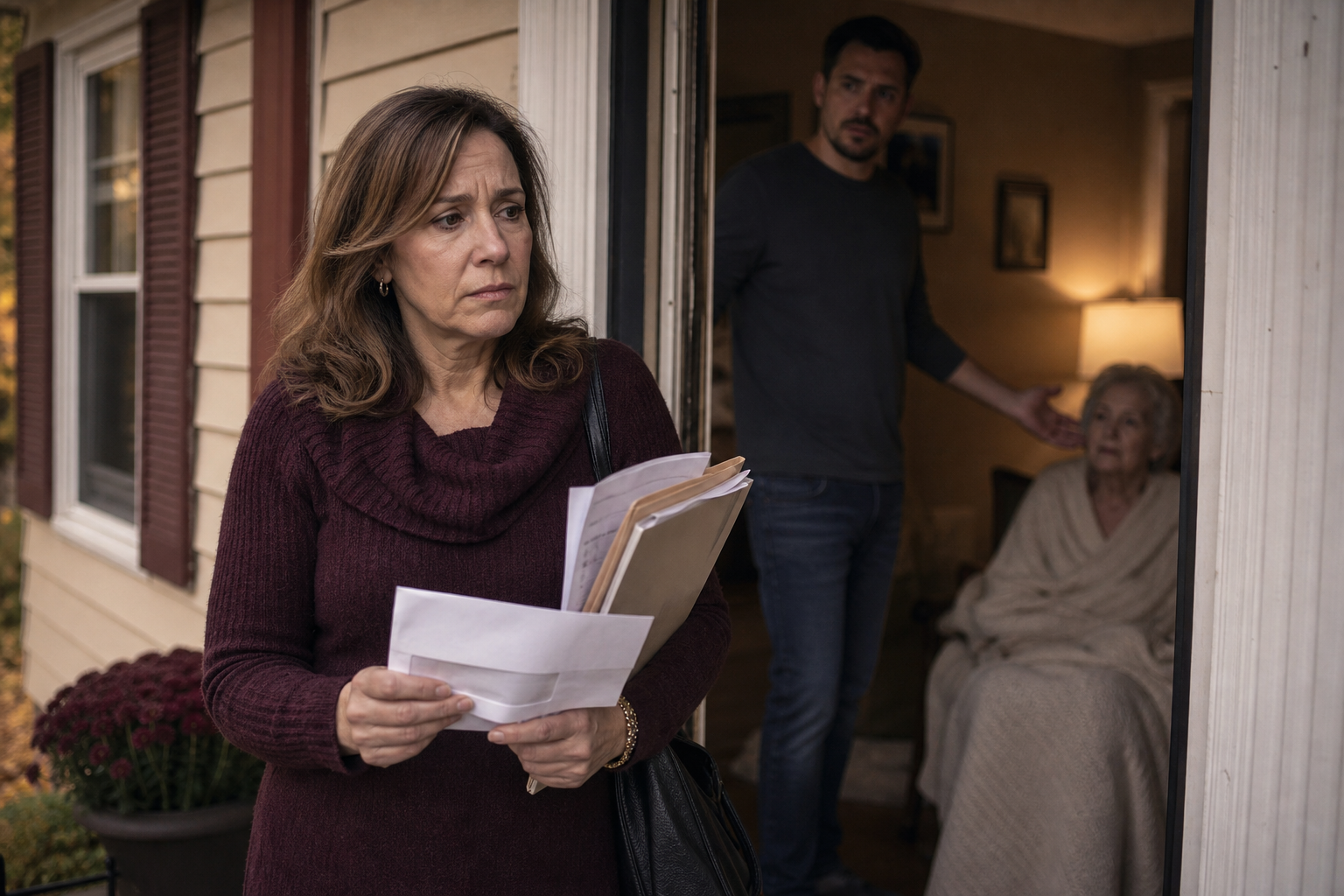
So when I saw that bright warning notice clipped beside the storm door, I stood there with my grocery bags cutting into my fingers and read it three times before I let myself believe it was real.
FINAL NOTICE. SERVICE INTERRUPTION SCHEDULED.
Inside, I could already hear the television. My brother, Eric, liked to keep it loud enough that nobody could think clearly in the same room.
He had moved into Mom’s house four months earlier, right after she fell in the laundry room and fractured her hip. He told everyone the same thing: he was there to help her recover. That was the phrase he used, over and over, in front of neighbors, church friends, and the cousins who only called when they wanted family updates without any family responsibility.
“I’m just doing what needs to be done,” he would say, like he deserved a medal for sleeping in the room where I used to keep my high school trophies.
I wanted to believe him. I really did.
I work full-time at a dental office forty minutes away. I have two teenagers, a husband who travels three days a week, and a life built around calendars, refill reminders, and the kind of invisible labor nobody notices until it stops. When Mom got hurt, I handled the orthopedic appointments, the insurance calls, the physical therapy schedule, and the forms for the walker she hated using. Eric said moving in would take the pressure off me.
At first, I was grateful.
Then little things started to bother me.
Mom’s refrigerator kept getting emptier, even though she was giving Eric money for groceries. Her pain medication refill was delayed twice because, according to the pharmacy, the copay had not been covered yet. Eric suddenly had new work boots, a fresh phone screen, and enough gas money to drive across town every night to “clear his head” with friends.
Whenever I asked about the bills, he got offended in a hurry.
“You think I’m stealing from her?” he asked once, standing in Mom’s kitchen with a spoonful of cereal halfway to his mouth. “You really think that little of me?”
I said I thought very highly of accountability. He called me dramatic. Mom told us both to stop bickering.
That was my mother’s favorite word for anything painful: bickering. She used it when my father drank away the mortgage payment one winter and when Eric borrowed my first car without asking and brought it back with a crushed fender. In our family, what should have been named clearly was usually softened until it almost disappeared.
I carried the groceries into the kitchen and set them on the counter. Mom was in her recliner with a blanket over her lap, looking smaller than she had before the fall. Eric was stretched across the sofa with one ankle over his knee, remote in hand, as if he were a guest at a vacation rental instead of a forty-two-year-old man living off our mother’s recovery.
I held up the red notice. “What is this?”
Eric barely looked at it. “Probably a system error.”
“A system error clipped to the front door?”
He shrugged. “I called last week.”
Mom looked from him to me and pressed her lips together. That was when I knew he had not called anyone.
“Mom?” I asked.
She adjusted the blanket. “He said he was taking care of it.”
There was a tone in her voice I had not heard since I was a child and she was trying to protect us from bad news before she had figured out how. It wasn’t confidence. It was hope dressed up as confidence.
I opened the drawer beside the stove where she kept stamps, pens, and coupons. Under the church bulletin and a takeout menu were three more envelopes from the power company, one from the water department, and a late notice from her supplemental insurance plan.
None of them were mistakes.
“Eric,” I said, too calmly, “where is the money Mom gave you for these bills?”
He sat up then, all wounded pride. “You don’t get to interrogate me in front of her.”
“I actually do when her utilities are about to be shut off.”
Mom started to say my name in that warning voice mothers use when they want peace more than truth.
I hated that I cut her off, but I did.
“No, Mom. Not this time.”
Eric stood and grabbed the envelopes out of my hand. “I was moving things around,” he snapped. “I covered groceries, your precious pharmacy copays, stuff for the house. It all comes out in the end.”
“With whose money?”
He didn’t answer.
Mom’s face changed first. I watched understanding move across it in slow, humiliating stages. She looked at the notices, then at Eric, then down at her own hands.
“I gave you the electric money two weeks ago,” she said quietly.
Eric ran a hand over his mouth. “I needed to float some things.”
“Float what things?” I asked.
He laughed once, bitter and defensive. “My truck payment. Insurance. Life. You know, the things people need when they’re trying to get back on their feet.”
There it was. The family script. He wasn’t dishonest. He was trying. He wasn’t using her. He was struggling. And because he was struggling, everyone else was expected to become a supporting character in his life.
Mom whispered, “You used the money I set aside for the utilities?”
“I was going to put it back.”
“When?” I asked. “After they shut off her power? After she missed another medication refill?”
He turned on me hard then. “You love this, don’t you? You’ve always loved being the responsible one because it gives you somebody to look down on.”
I almost reacted. Then I looked at my mother sitting there in her own house, ashamed and frightened because her son had converted her kindness into a line of credit, and something in me went cold and very steady.
I picked up my phone and called the power company on speaker.
Eric swore under his breath. Mom kept saying, “Please, not like this,” but I had spent too many years watching problems become emergencies because everyone was so committed to avoiding one uncomfortable conversation.
The representative confirmed that the account was ninety-one days overdue and service would be disconnected by five o’clock unless the balance was paid that afternoon.
Ninety-one days.
Four months of Eric living there. Three months of Mom believing he was handling the bills. Nearly a week of August heat with a recovering seventy-year-old woman one unpaid balance away from losing air conditioning and refrigeration for her medication.
I paid the balance while the representative was still on the line.
Eric muttered, “Unbelievable.”
I turned to him. “What’s unbelievable is that Mom broke a hip and somehow you still found a way to make her recovery about your truck payment.”
Mom started crying then. Not loudly. That was what made it worse. She just folded in on herself and cried the way people do when humiliation finally outweighs denial.
After the call, I sat beside her and asked one question I should have asked months earlier.
“Did you give him your debit card too?”
She nodded without looking up.
Eric said, “She offered.”
“Of course she did,” I said. “She’s your mother.”
I drove Mom to the bank that afternoon. She brought her cane, her purse, and a silence so deep it felt heavier than anger. We moved her direct deposit into a new account, changed the online login, canceled the debit card Eric had been using, and set alerts for every withdrawal over twenty dollars. Two days later, she signed power-of-attorney paperwork naming me for finances and medical decisions if she needed help again.
Eric told the family I had manipulated her.
My aunt called to say I should have shown more compassion because “your brother’s had a hard run.” My cousin said men sometimes spiral after job loss and shame. Even my husband, who supported me, asked whether there had been a gentler way to do it.
Maybe there was.
But gentle had already been tried. Gentle was Mom handing him cash because he looked embarrassed. Gentle was me pretending not to notice the missing grocery money. Gentle was every version of silence that lets one person keep failing upward on someone else’s back.
I gave Eric one week to move out.
He called me cold. He said I cared more about rules than family. He said I was kicking him while he was down.
I told him being down did not entitle him to drag our mother down with him.
For three days, Mom barely spoke except to answer practical questions. Then, on the fourth morning, I came by before work and found her at the kitchen table with her checkbook open and a mug of tea cooling beside her.
“I keep thinking I should have known,” she said.
I sat down across from her. “You trusted your son.”
She looked toward the hallway where Eric had been sleeping, though by then the room was half empty. “I kept telling myself help doesn’t always look the way you expect.”
“Sometimes it doesn’t,” I said. “And sometimes it looks like help because that’s the easiest way to get close to the money.”
She winced, but she didn’t disagree.
Eric moved out the following Saturday. He left behind a broken lamp, an unpaid cell phone bill he had hidden under a stack of mail, and a long text message about betrayal. He said I had turned our mother against him. He said one day I would need grace too.
Maybe he’s right about that last part. Maybe one day I will need grace more than judgment.
But I don’t think grace and access are the same thing, and I don’t think love requires handing someone the keys to the house while they quietly shut off the lights.
If family loyalty traps are your kind of story, you might also read My Brother Brought Our Father to My Porch With a Suitcase — Then He Asked for Dad’s Truck.
My mother still asks about Eric more often than I want her to. I still drive over twice a week to sort prescriptions, check the mail, and make sure the bills are where they belong.
Maybe that makes me controlling in some people’s eyes. Maybe it just means I finally learned that protecting the person who keeps the family running is not cruelty — even when the person you have to protect her from is your own brother.