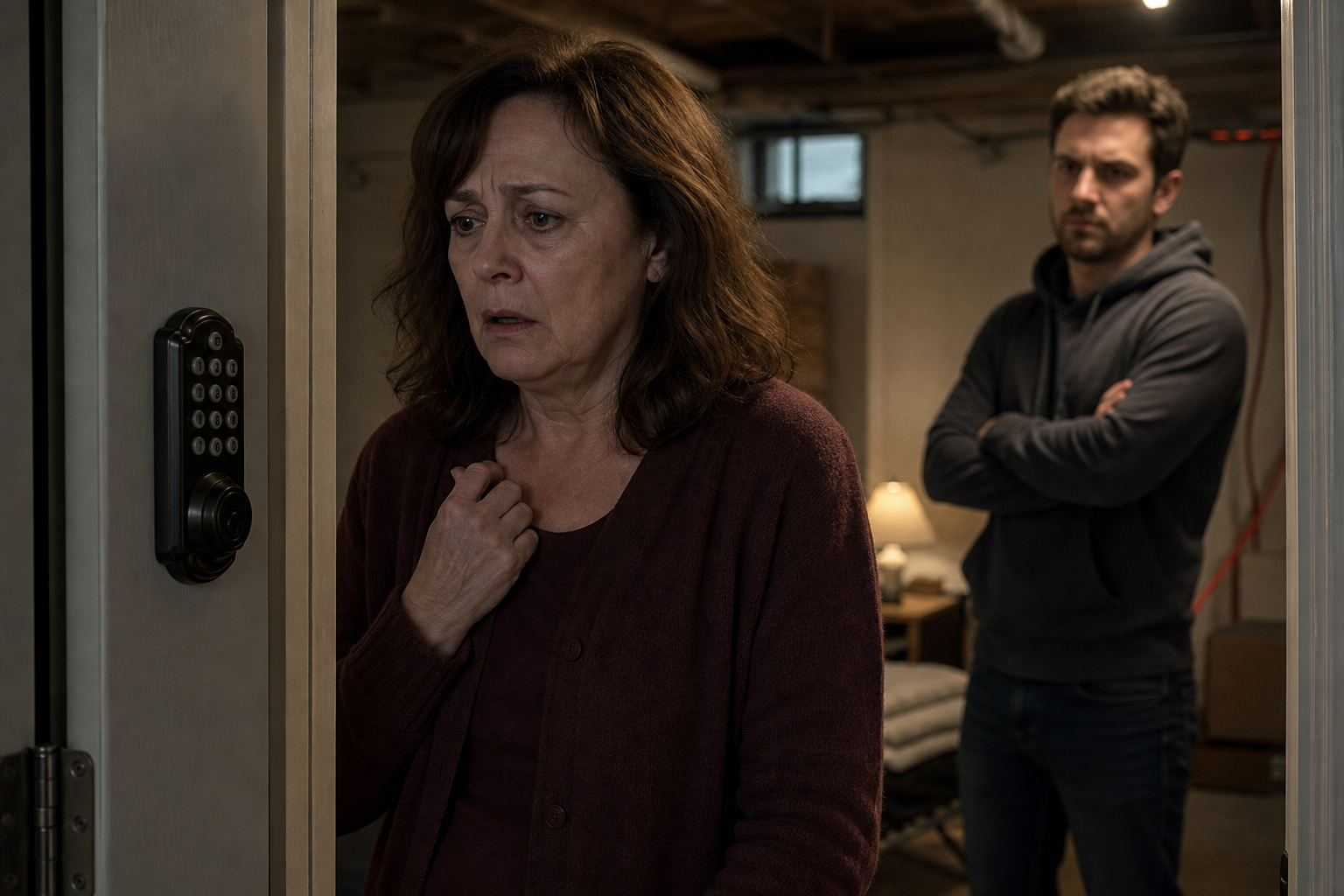

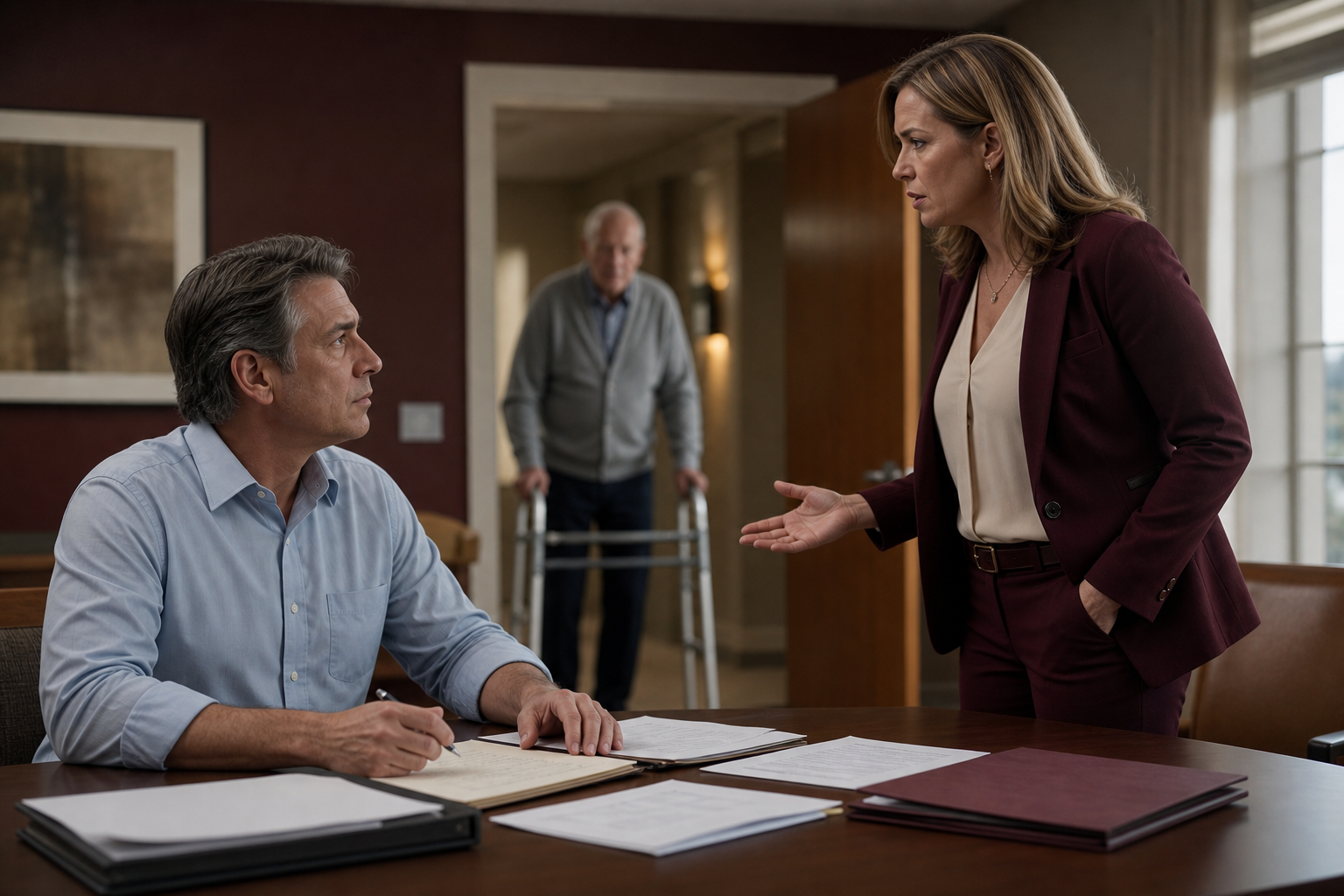
“Dad needs his real family making these decisions,” my sister said, standing at the end of the rehab conference table like she’d been there for every hard hour.
The nurse case manager looked at her, then at me, then down at the folder with my name clipped across the front.
That was the moment I understood Dana hadn’t driven in for my father’s discharge meeting to help. She had come to perform.
My father had his stroke seven weeks earlier, on a Tuesday morning so ordinary it still makes me angry to remember it. He had been rinsing out his coffee mug when he dropped it in the sink. By the time I got to the ER, the left side of his face had gone slack and his words came out in pieces that sounded like they belonged to somebody else.
Dana cried harder than I did that first day. She kept saying, “We’re going to do this together,” with both hands wrapped around mine. She ordered takeout for the waiting room, posted a blurry photo of our father’s hand on Facebook with a caption about prayers, and told every cousin we had that family was everything.
Then she went home two and a half hours away, and “together” became me.
I was the one who met the neurologist before work. I was the one who sat through insurance calls on speaker in my truck. I was the one who learned how to transfer my father safely from bed to chair without hurting his shoulder. My wife Lauren took over school pickups for our son, Eli, because I was either at the hospital, at the rehab center, or at Dad’s house trying to figure out which bills were on autopay and which ones had been sitting unopened in a ceramic bowl by the microwave.
My father, Arthur, had always been the kind of man who apologized for needing a second napkin. Watching him ask a nurse to repeat herself because his mouth would not keep up with his thoughts was its own kind of heartbreak. He hated the walker. He hated the thickened drinks. He hated that strangers now knew what medications he took before I did.
What he hated most was feeling like a job.
So I tried very hard not to make him one.
I brought him decent coffee in a travel mug every morning, even when he could only manage two careful sips. I shaved him when his hands shook too hard. I kept his electric bill current, dealt with the leaking gutter on his back porch, and drove to his house one Sunday just to throw out the milk in his refrigerator because I knew it would bother him to come home to the smell.
Dana, meanwhile, developed strong opinions from a distance.
She said rehab was keeping him too long. Then she said they were rushing him out. She said home health aides would make him feel old. Then she said bringing him home alone would be irresponsible. She called late at night when I was exhausted enough to agree with almost anything, and somehow every conversation ended with me feeling accused.
“You’re controlling the information,” she told me once.
I was sitting in Dad’s driveway at the time, eating pretzels for dinner and trying to find a pharmacy open after eight.
“I’m forwarding you every update they send me,” I said.
“That’s not the same as involving me.”
I almost laughed, but I was too tired. In Dana’s mind, being involved meant having the right to object. It never seemed to include showing up for the parts that smelled like bleach and stale coffee.
Things got worse when discharge planning started.
Dad wanted to go back to his own house. That mattered to me. He had lived there for thirty-eight years. My mother had planted the peonies by the mailbox before she died. He knew every creak in the hallway and every neighbor on the block. The rehab team said he could go home if he had grab bars installed, medication supervision, and someone coordinating his therapy schedule. So I arranged grab bars. I found a home health agency. I moved my workdays around. Lauren offered to cover afternoons when I couldn’t get away.
Dana hated that plan on sight.
She wanted Dad to move in with her “until he was strong again,” even though her husband traveled most weeks, she had no bedroom on the first floor, and she had not come to a single caregiver training session the rehab center offered.
When I pointed that out, she said I was being technical.
When the social worker asked whether Dana had completed the home safety checklist for her house, Dana said she hadn’t had time because her daughter was getting ready for senior pictures.
Then she started telling people I was trying to put Dad in “a program” because it was easier for me than having him under my roof.
That rumor got back to my aunt Linda, who sent me a text so loaded with judgment it might as well have come with a church bulletin attached. Your father needs family, not facilities.
I read it while standing in line to pick up Dad’s blood pressure medication.
I wanted to reply, Then tell family to come learn how to give it to him.
I didn’t. I had started conserving my energy the way people ration candles during a storm.
The rehab meeting was supposed to settle everything.
It was scheduled for ten on Friday morning in a small conference room off the therapy wing. I got there early because I had spent enough time in medical buildings to know that every useful conversation starts ten minutes before somebody says it does. The case manager, Denise, laid out a packet with discharge dates, therapy recommendations, and emergency contacts. The physical therapist stopped by with notes about the walker. The speech therapist added a page on swallowing precautions. I had questions written in a notebook because if I didn’t write them down, the details started blurring together by afternoon.
Dana arrived twelve minutes late in a blazer and heels, carrying iced coffee and indignation.
She didn’t say hello to Denise. She didn’t ask how Dad’s morning had gone. She put her bag on the table, looked at the packet in front of me, and said, “I don’t understand why Marcus is the only one making decisions here. Dad needs his real family at this meeting.”
It landed exactly the way she meant it to.
Like I was some overreaching administrator instead of the son who had been cleaning our father’s dentures at seven in the morning.
Denise kept her face neutral. People in her job must get very good at watching families tear at each other without flinching.
“You are both welcome to be part of the plan,” she said carefully. “The immediate question is who will be responsible for executing it.”
“I can do that,” Dana said. “But I’ve been shut out from the beginning.”
I felt something hot and ugly rise into my throat. For weeks I had been swallowing my anger because Dad needed calm more than I needed vindication. But that sentence almost broke me.
“Shut out?” I said. “Dana, I’ve been sending you every appointment time, every therapy note, every medication list—”
She cut me off with a wave of her hand. “Forwarding documents isn’t the same as asking what Dad wants.”
Before I could answer, the door opened behind us.
My father stood there with his walker, the rehab aide just behind his shoulder. He had insisted on coming for part of the meeting. His gray sweater hung loose on him now. He looked older than he had in March, and more tired than he would ever admit.
“I want to hear this myself,” he said, slow but clear.
The room changed after that. Dana softened her face immediately, the way people do when the audience they care about finally arrives. She moved to his side and touched his sleeve.
“We’re just trying to make sure you have family around you, Dad.”
He looked at her hand, then at me. He didn’t say anything.
Denise opened the folder.
“Before we talk about preferences,” she said, “I need to clarify a few practical items. Ms. Mercer, if you would like your father discharged to your home instead of his own, we would need confirmation that the caregiver training was completed and that the home safety modifications are in place.”
Dana blinked. “No one told me that was required.”
Denise turned the file toward her. “We called on July 28, August 2, and August 6. We also emailed the packet the same day it was sent to your brother. Mr. Hale attended all four training sessions and signed the medication and transfer instructions after each one.”
Then she looked at me. “You have been the responsible family contact on every form since your father’s admission.”
The physical therapist, a broad-shouldered man named Jerome, slid another paper across the table.
“We also needed measurements and photos from the entrance to your house,” he told Dana. “Without that, I can’t approve a safe discharge there. Your brother sent the measurements from Arthur’s house two days after I asked.”
There was a long, humiliating silence.
Dana’s face changed in stages—offense, disbelief, then the shaky anger of somebody realizing the performance had run out of room.
“I have a life,” she said finally. “I can’t just drop everything every time this place wants another signature.”
My father let out a breath that sounded older than his body.
“That’s the point, Dana,” he said quietly. “Marcus did.”
No one moved.
He lowered himself into the chair beside me with visible effort. Then he set one hand over the notebook where I had written my questions. It was not a dramatic gesture. That was why it hurt so much.
“I know what going home means,” he said. “I also know who has been here.”
Dana looked at him like he had betrayed her.
Maybe, in her version of the story, he had.
She started crying then—real tears, not fake ones, which somehow made it harder. She said I had always been the favorite because I lived nearby. She said everyone expected more from her because she had married someone with money. She said I liked making her look careless.
Some of that was probably true in the way family resentments are true: not precise enough to solve anything, but sharp enough to cut.
I could have fought with her. I could have listed every missed call, every ignored email, every night Lauren reheated dinner for me at nine-thirty because I was still at Dad’s house labeling pill bottles.
Instead I said, “This was never about making you look bad. It was about Dad not falling in the bathroom because nobody bothered to learn how to help him stand up.”
That ended it.
Denise finalized the plan: Dad would go back to his own house the following Monday. Home health would start that afternoon. I would remain the primary contact. Dana could come for weekends if she coordinated ahead of time, and if she still wanted him to stay with her later, she could complete the training and the home inspection first.
In the parking lot, she caught up to me before I reached my truck.
“You enjoyed that,” she said.
I had not slept through the night in weeks. My shirt smelled like hospital coffee. There was a grocery bag in my back seat with adult incontinence supplies I still hadn’t found the nerve to bring into Dad’s house while he was there to see them.
“No,” I said. “I just wasn’t willing to lie for you anymore.”
She stared at me for a second like she expected a different brother to step out of my body and apologize. When I didn’t, she got in her car and left.
Aunt Linda called that evening to tell me I should have been kinder. Family, she said, was not a competition.
I told her she was right. It wasn’t. Competitions require two people doing the work.
Dad came home on Monday.
The first week was hard. Harder than I had admitted to anyone. He was embarrassed by how much help he needed and angry at himself whenever his left hand failed him. Some afternoons he snapped at me for hovering. Some nights I drove home feeling guilty for wishing, just once, that I could be the sibling who only offered opinions.
But home helped him. The peonies were still there. The clock over the stove still ran three minutes fast. Eli brought over a deck of cards and sat with him on the porch. Lauren stocked the freezer with soups my father pretended not to notice until he asked whether there was any more of the chicken one.
Dana visited two weekends later with a pie from a bakery and a softness I did not entirely trust. She was careful with Dad that day. Careful with me too. Before she left, he asked her to call more and promise less.
She laughed like it was a joke. I don’t think either of us believed it was.
We’re better now, if better means we have stopped performing the argument in public. She still tells people I froze her out. I still have the emails, the discharge notes, and a folder full of forms with my signature on them because somebody had to be reachable when the phone rang.
Maybe I could have protected her pride more than I did.
But there comes a point in every family mess when protecting someone’s pride starts endangering the person everybody claims to love.
I reached that point in a rehab conference room, with my father’s future spread out in paperwork across a fake-wood table.
If that makes me the difficult son, I can live with it. I learned that blood may make you related, but it does not fill pill organizers, answer discharge calls, or keep an old man steady when he tries to stand.
Related stories: My Brother Said I Was ‘Trying to Control Mom’ — Then the Pharmacist Read Her Refill Dates Out Loud and “You’re Putting Her Away for Your Convenience” — What My Brother Said Before the Fire Department Knocked.