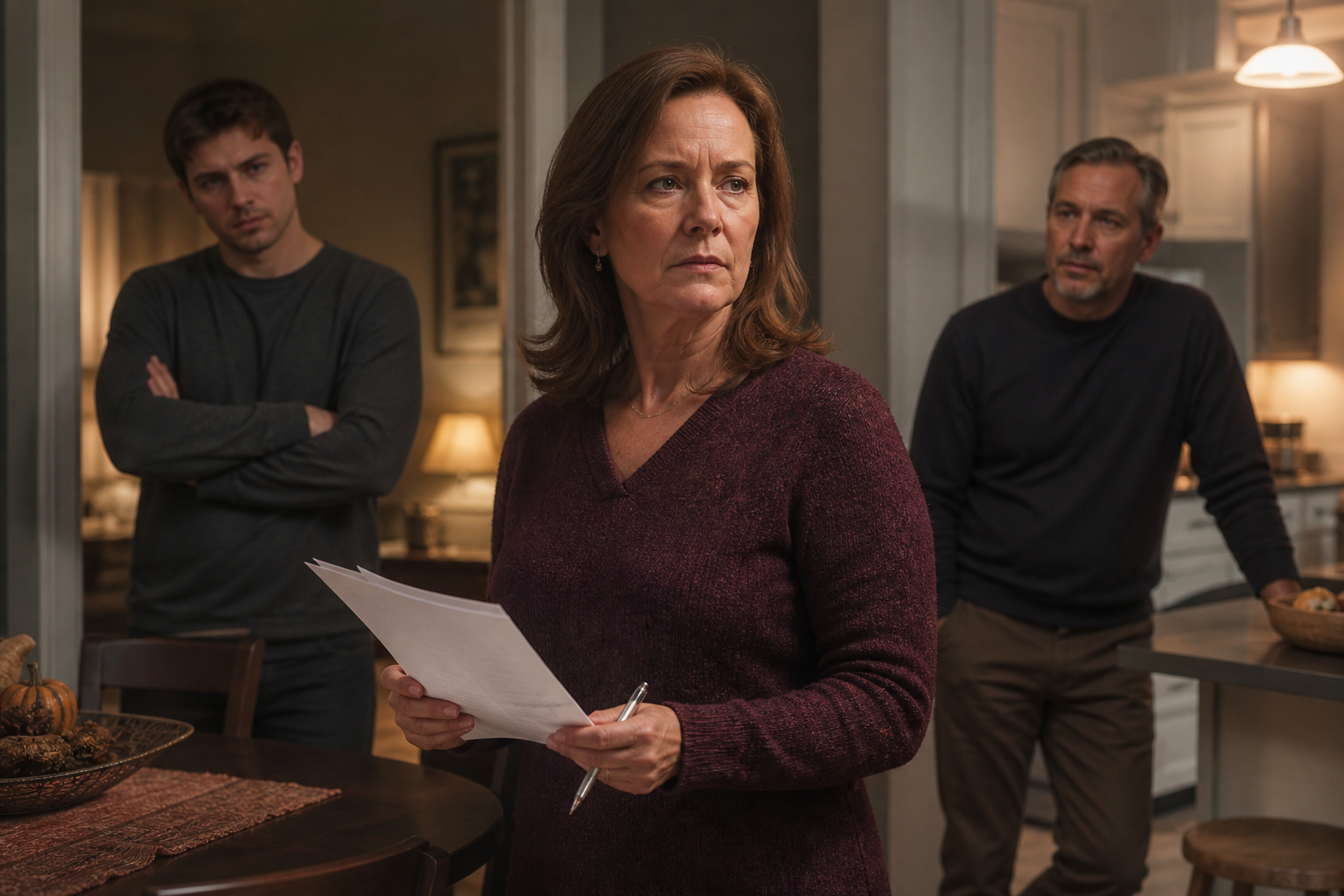

My brother said I was putting our mother away for my own convenience three days before the fire department knocked on her kitchen door.
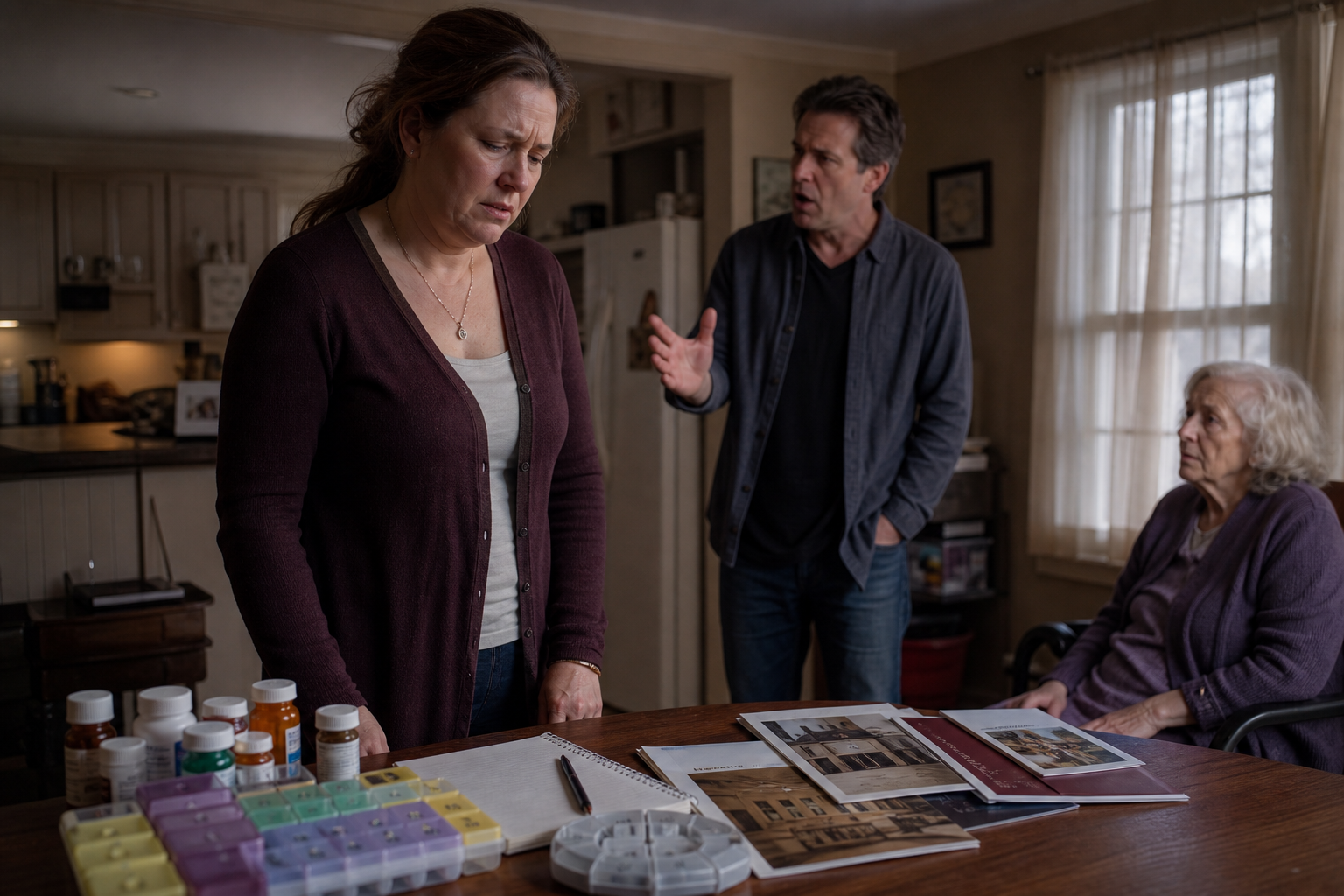
He said it at her table, with the pill organizer open between us and a half-finished cup of tea going cold near Mom’s hand. She was humming to herself and folding the corner of a paper napkin into tiny triangles, the way she does when she’s nervous and pretending not to listen.
“You just don’t want your life revolving around her anymore,” Darren said. “So now it’s assisted living. Easy solution.”
I had been up since 5:10 that morning. I had already called Mom’s cardiologist, argued with the pharmacy about a refill, changed her sheets after she spilled prune juice in bed, and canceled a client meeting because the home aide texted that she had the flu. So when he said easy solution, I laughed. I couldn’t help it. Not because it was funny. Because it was obscene.
Mom looked up at me, confused by the sound. “Are we fighting again?” she asked.
“No, Mom,” I said automatically, which was the family version of putting a towel over a leak and calling it fixed.
My name is Elaine. I’m forty-eight, divorced, and close enough to fifty that people keep telling me to protect my peace as if peace were a scented candle I forgot to buy. My mother, Ruth, turned seventy-eight in May. Two years ago, she got lost driving to the church she had attended for thirty-one years. Last winter, she left the bathtub running until it soaked through the hallway rug. In March, her neurologist stopped using the phrase mild cognitive decline and started saying words like progressive and supervision.
Darren heard all those words too. He just heard them from the safe distance of forty minutes away, in a townhouse with clean counters and no smell of liniment in the bathroom.
I heard them while holding Mom’s purse, her insurance card, and the wet tissues she kept shredding in her lap.
This wasn’t how I expected middle age to feel. My daughter, Tessa, was getting ready to leave for college in three weeks. I thought that would mean one kind of grief. Instead, I was living inside two at once: one child leaving exactly when she should, and one parent fading while still sitting right in front of me.
For a while, I convinced myself I could manage everything if I stayed organized enough. I made color-coded medication charts. I labeled freezer containers. I moved Mom into the small ranch house I bought after my divorce because it only had two steps at the front porch and a bathroom wide enough for grab bars. I told clients I had to limit evening calls. I stopped dating because every plan felt like something I would have to apologize for later. I even stopped going to Tessa’s Saturday soccer showcases if Mom had a bad morning, because one missed outing felt more forgivable than one missed dose.
Darren helped in the way people like to be praised for helping. He sent links to memory vitamins. He brought groceries twice a month, always the wrong kind of bread, then posted selfies with Mom on Facebook with captions about family being everything. If I asked him to stay with her on a Tuesday so I could make it to the office, he had a conference call. If I asked him to handle a neurology appointment, he wanted me to email him bullet points first.
But he had opinions. Endless, polished opinions.
He thought I was too strict when I took away Mom’s car keys after she backed into my neighbor’s mailbox and insisted the mailbox had moved. He thought I embarrassed her by putting a camera over the back door after she wandered into the yard at 2 a.m. looking for my dead father. He thought assisted living sounded cold, impersonal, expensive, and, in his words, like something people do when they’ve stopped trying.
He never said what people like me do after they’ve tried everything else.
The final push toward assisted living came the week Mom nearly doubled her blood pressure pills. I found the mistake because I got home early from work and saw Tuesday’s slot already empty at eleven in the morning. When I asked her about it, she smiled and said, “You told me to stay ahead so I took tomorrow’s too.” Then she burst into tears because she thought I was my aunt Carol for a full minute.
That night, after she finally fell asleep, I sat in my car and called three facilities from the parking lot outside our house because it was the only place nobody needed anything from me.
The one I liked best didn’t smell like bleach and old television. It smelled like soup. The director was a woman named Monica who spoke to residents like adults instead of problems. She didn’t overpromise. She just asked practical questions: Did Mom wake at night? Did she resist bathing? Could she still recognize medication? Had there been kitchen safety issues?
I answered yes, sometimes, often, no, and yes.
Monica said, very gently, “You sound tired enough to wait too long.”
That sentence followed me home.
I put down a refundable deposit the next day.
I didn’t tell Darren immediately because I wanted one full day without being cross-examined. I should have known that would never last. Mom mentioned “the nice apartment place” on speakerphone while he was checking in, and by that evening he was standing in my kitchen acting like I had forged her signature and sold her organs.
“She doesn’t belong in one of those places,” he said. “She belongs with family.”
“She is with family,” I said. “She’s with me. Twenty-four hours a day unless you count the hours when I’m racing to buy groceries.”
“That’s not fair.”
“No, it isn’t.”
Mom flinched at the tone, so I took a breath and lowered my voice. Darren did what he always did when reality cornered him: he turned the whole conversation into a judgment of my character.
“Ever since your divorce, you’ve wanted control over every room you walk into,” he said. “Maybe this feels efficient to you. But she’s our mother, not a scheduling problem.”
That hurt because it was expertly designed to. Darren has always known how to take a messy sacrifice and describe it in the ugliest possible language. It lets him feel morally superior without lifting anything heavy.
Then he played his favorite card.
“Tessa is leaving in a few weeks, right? So what, you’re trying to get your freedom back before the house gets too quiet?”
I stared at him. I honestly did not know whether to slap him or thank him for finally saying aloud the thing I suspected he believed all along.
Before I could answer, Mom said, very softly, “I don’t want to be a burden.”
That did it. Anger left me all at once, and what was underneath it was worse.
I sat beside her and held her papery, restless hand. “You are not a burden, Mom,” I said. “You are sick. Those are not the same thing.”
Darren looked away, which usually meant he knew he had gone too far but wasn’t interested in admitting it.
He offered his grand compromise the next morning. He would take Mom for the weekend while Tessa and I went to her college orientation. He said if I was really just tired, then two nights off would fix the panic and prove we didn’t need to rush a move.
Every instinct I had told me not to do it. Darren had never managed Mom alone for more than six hours. He didn’t understand how quickly one skipped meal became dizziness, or how easily she could mistake the stove knobs for the oven timer. But Tessa had already asked twice whether I was still coming to campus with her, and the second time she asked it with that careful voice children use when they’re trying not to want too much.
So I said yes.
I packed Mom’s overnight bag myself: pajamas, non-slip slippers, the quilt she likes folded at the foot of the bed, labeled pill packets for each day, emergency numbers on yellow paper, and a note in thick black marker on top that said DO NOT LEAVE HER ALONE WITH THE STOVE ON. I hated that it felt insulting. I hated more that it was necessary.
Darren rolled his eyes when he saw the note.
“Elaine, she raised two children. She can survive forty-eight hours without a user manual.”
“Call me when she takes the evening meds,” I said.
He kissed Mom on the head, took the bag, and told me to relax.
I have learned that whenever a man says relax to the person carrying the whole load, disaster is already stretching in the next room.
Tessa and I were in the admissions building lobby the next afternoon when my phone buzzed with an unknown number from Darren’s town.
It was a firefighter.
He asked whether I was Elaine Mercer and whether Ruth Mercer was my mother. Then he said there had been a smoke call at Darren’s house. No one was injured. My mother was safe. But could I return as soon as possible?
For one full second, the polished campus around me went blurry. Students were laughing near a vending machine. A mother across from me was fixing a crooked name tag on her son’s shirt. And I was hearing a stranger explain that my brother had stepped out “for about twenty minutes” and left Ruth alone long enough for a saucepan to burn dry on the stove.
Twenty minutes became forty-five by the time I got the whole story.
Darren had gone to meet his girlfriend for coffee because Mom was napping and he didn’t want to wake her by talking on the phone inside. When she woke up, she decided to make oatmeal. She turned on the wrong burner, set the pan crooked, then forgot it entirely. A neighbor saw smoke through the kitchen window and called 911.
By the time I reached his house, Mom was wrapped in a gray blanket in the back of an ambulance, not because she was hurt but because they had brought her outside and she was embarrassed. She looked at me and immediately started crying.
“I was making breakfast for your father,” she whispered.
My father died nine years ago.
Darren came jogging up the driveway in loafers, out of breath and defensive before he even spoke.
“It wasn’t like I abandoned her,” he said. “I was gone less than an hour. The neighbor overreacted.”
The fire captain, a woman with soot on one sleeve, turned toward him so slowly it almost counted as mercy.
“Sir, with respect, the neighbor probably saved your mother’s life,” she said. “She should not be unsupervised around a stove.”
There it was. The plain truth, from someone with no emotional stake in our family mythology.
Darren’s face tightened. “That doesn’t mean she needs to be institutionalized.”
I did not yell. I was too tired for yelling. Something colder and steadier took its place.
“No,” I said. “It means I was right that she isn’t safe like this, and you were willing to gamble with her because it was easier than admitting it.”
He opened his mouth, probably to accuse me of being dramatic, controlling, selfish, all his usual favorites. But the captain was still standing there, and Mom was still shaking under that ambulance blanket, and for once Darren looked like a man who had run out of room.
I took Mom home with me that night.
After she fell asleep, Tessa sat at the kitchen counter and asked if I was still considering the assisted-living place. I said yes. She nodded like she had been waiting for me to catch up to what everyone else could already see.
“I think you keep trying to prove you love Grandma enough to save her from being sick,” she said. “But that’s not a job anybody gets to win.”
It is deeply annoying when your child becomes wiser than you right in front of your face.
On Monday morning, I called Monica and told her to keep the room.
Darren called me heartless. Then he called me manipulative. Then he called our cousin Jen and my aunt Carol and suggested I was rushing Mom into a facility so I could sell the house more easily, which was an especially ugly lie because the house was mine, not Mom’s. The point wasn’t logic. The point was smoke. Darren has always believed that if he can cloud the room fast enough, nobody will notice who lit the match.
So I stopped arguing and started documenting. I sent the family group chat the medication error log, the neurologist’s recommendation, and the fire department incident number. Then I wrote one sentence: I will not debate our mother’s safety with people who are not providing her daily care.
No one answered for eleven minutes. In my family, that counts as a public silence.
Mom moved into assisted living the next Thursday. She cried when we unpacked her sweaters, then brightened when another resident asked whether she liked card games. By dinner, she had forgotten she was angry with me. I have not decided whether that was mercy or punishment.
Three weeks later, she knows the nurse named Paula, remembers where they keep the lemon cookies, and hasn’t missed a dose once. She still asks when she’s going home. Sometimes she means my house. Sometimes she means the brick ranch where I grew up. Once, she meant 1989. I answer each version as gently as I can.
Darren still isn’t speaking to me unless it’s to ask for updates he could get by visiting. He has visited twice.
I go every other day. Tessa leaves for school on Friday. The house will be quieter than I want. But it will also be the first quiet I didn’t purchase with somebody else’s safety.
Maybe some people will hear this story and decide I gave up on my mother too soon. Maybe my brother still tells it that way. But I know what her hands felt like that night outside the ambulance. I know how a burnt pan smells when it cools in somebody else’s kitchen. And I know love can turn into vanity if you keep insisting you alone should be able to carry what has already become dangerous.
I didn’t put my mother away for my convenience.
I moved her before my guilt burned the rest of us down.
Related reading: If this kind of family pressure feels familiar, you might also read My Stepdaughter Told the Hospital I Was ‘Just the Wife’ — Then the Social Worker Opened Her Father’s File and My Neighbor Said My Mother’s Wheelchair Ramp Was Lowering Property Values — Then the HOA Opened Her File.