
The first time I realized my son had stopped seeing my house as mine, I was standing in my own hallway with a bag of groceries cutting into my fingers and a keypad lock blinking at me from the basement door.
I actually looked behind me, as if I might have walked into the wrong house by mistake.
It was still my narrow yellow split-level with the scuffed baseboards and the dent in the wall where my late husband had once dropped a box of Christmas ornaments. It was still my hallway rug, my thermostat, my utility closet beyond that door.
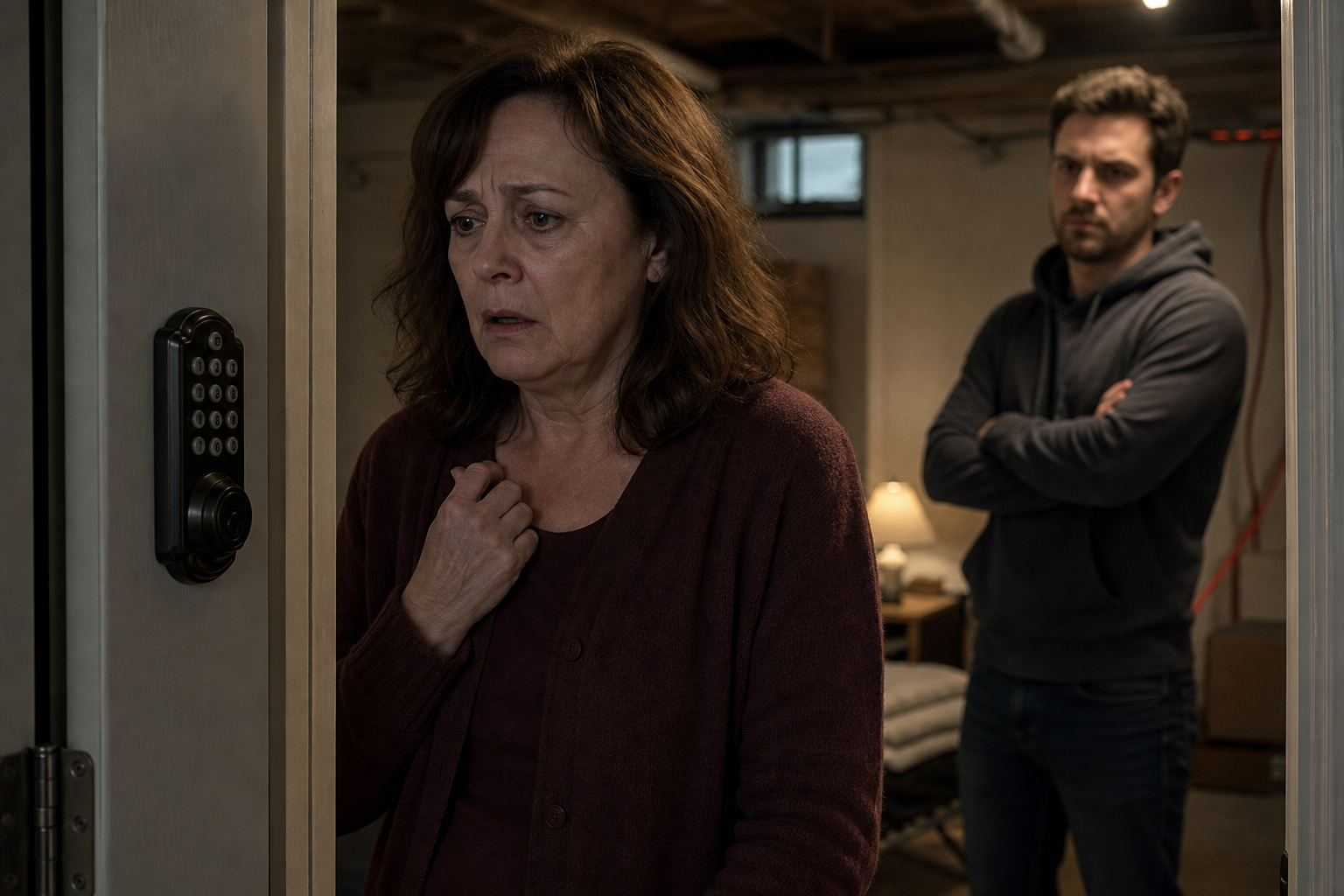
But there was a lock on it now. A black keypad deadbolt screwed into the wood like someone had turned part of my home into a place I needed permission to enter.
When my son, Nathan, came up the stairs from the basement and saw me staring at it, he didn’t even look embarrassed right away. He just looked irritated that I had gotten home early.
“Before you overreact,” he said, “it’s temporary.”
I set the groceries down on the floor because I suddenly didn’t trust my hands.
“Why is there a lock on my basement door?”
He rubbed one hand over his mouth, already tired of a conversation I had not agreed to have.
“Troy needed privacy.”
That was when I understood this had gone much further than the story I had been told.
Troy was Nathan’s friend from high school—the kind of friend who was always between jobs, between girlfriends, between plans, between apologies. Six weeks earlier, Nathan had asked if Troy could stay in the basement for “maybe ten days, two weeks tops” after a breakup. He said Troy was sleeping in his car, that it was too hot outside, that I was the only person he could ask because I was the only person with any heart.
I had said yes because I’m a mother, because I know what desperation sounds like, and because I made the mistake of thinking a favor still belongs to the person granting it.
My one condition had been simple: no rent, no long-term arrangement, and no pretending the unfinished basement was an apartment. It had a washer and dryer, shelves of holiday decorations, a utility sink, and a small finished corner my husband used to watch baseball in. It did not have a legal bedroom, a private entrance, or enough windows to make me comfortable with anyone sleeping down there for very long.
Nathan kissed my cheek and told me I worried too much.
For the first week, everything looked manageable.
Troy kept mostly to himself. He thanked me for the casseroles I pretended were leftovers. He showered before I woke up. Nathan said he was out all day filling out applications and trying to get back on his feet.
Then my basement started changing in little ways that were easy to explain one at a time and impossible to ignore all together.
A mini fridge appeared beside the old recliner. Then a microwave on a folding table. Then two long extension cords running along the base of the wall because, as Nathan put it, Troy “needed somewhere to plug things in.”
The laundry room began smelling like men’s body spray and takeout containers. My detergent got moved twice. One Tuesday night I came down to switch a load and found a pair of work boots, a duffel bag, and a hot plate sitting on top of the dryer.
“That can’t stay there,” I told Nathan.
“It’s not a big deal,” he said without looking up from his phone. “He’s just trying to feel normal.”
That phrase started showing up everywhere. The hot plate was about normal. The loud TV after midnight was about normal. The fact that Troy’s mail started arriving with my address on it was, according to Nathan, just part of helping someone feel normal.
What no one seemed to care about was whether I still felt normal in my own home.
I am fifty-eight years old. I work full time at a dental office. I have paid that mortgage alone since my husband, Alan, died four years ago of a heart attack so sudden I still sometimes expect to hear his truck in the driveway. I do not live lavishly. I live carefully. I know what my electric bill should look like in June. I know what my homeowners policy covers. I know exactly how much of my peace depends on being able to walk through my own house without wondering who is behind a closed door.
Nathan moved back in last winter after his contract job ended and his apartment lease ran out. He said it would be for three months while he saved money. He is thirty-two, smart, charming when he wants something, and too old to still act shocked when generosity has edges.
At first, having him home felt almost sweet. We ate chili at the kitchen table and watched old sitcom reruns. He took the trash cans to the curb without being asked. He called me “Ma” in that softened voice that still reminded me of the little boy who once cried because a bird hit our front window.
Then time passed, and gratitude turned into occupancy.
He stopped mentioning apartments. Started talking about my house like it had flexible unused space. Asked whether I really needed the basement storage shelves. Suggested I could park outside so Troy could use the garage side door without “tracking through the whole house.”
I said no to that one so quickly even he looked surprised.
After that, he became polite in the way people get polite when they think your boundaries are temporary obstacles instead of final answers.
Two Fridays before I found the keypad lock, my neighbor Celia caught me while I was bringing in the mail.
“Everything okay at your place?” she asked.
I said yes automatically.
She hesitated, then nodded toward my driveway. “I’ve just noticed more cars late at night. And somebody was smoking by your side gate at one in the morning.”
I thanked her and felt my face go hot.
That night I asked Nathan whether anyone besides Troy had been down there.
He laughed like I had accused him of running a nightclub.
“Mom, relax. A couple people came by after work. That’s it.”
“This isn’t a hangout spot,” I said. “And Troy was supposed to be here two weeks, not forever.”
Nathan pushed his chair back from the table. “He just needs a little more time.”
“Then he needs to ask me himself.”
“Why? So you can make him feel worse?”
That was the first moment I heard it clearly: the story in Nathan’s head where I was not the person housing them, feeding them, and carrying the risk. I was the obstacle keeping them from a setup they had already mentally claimed.
The next week, my electric bill jumped almost ninety dollars. When the HVAC technician came for the annual tune-up, he asked why there were blankets stacked near the furnace closet and whether someone was sleeping in the basement.
I felt instantly defensive, as if I were the one doing something sneaky.
“Temporarily,” I said.
He gave me a careful look. “You need that area clear. And if somebody’s using hot plates or space heaters down there, I’d shut that down. Fast.”
I went downstairs after he left and found both.
A small space heater glowed near the cot. A power strip snaked under a rug. The hot plate sat on the folding table beside a stack of ramen cups and paper bowls. There was even a second lamp I had never seen before, plus a cheap plastic drawer unit full of socks and T-shirts.
It no longer looked like a guest corner. It looked like someone had started building a life under my feet.
I told Nathan that night that Troy needed to be out by the weekend.
He accused me of having no compassion.
“I’ve had compassion for six weeks,” I said. “What I don’t have is permission to turn my basement into a rental unit.”
That was when he slipped.
“It’s not like I’m making money off it,” he snapped.
I stared at him. “I didn’t say you were.”
He looked away too late.
The truth came out in pieces after that. Troy had been giving Nathan cash for “utilities.” Nathan had told himself that didn’t count as rent. Nathan had also told Troy he could stay as long as he needed because, in Nathan’s words, “Mom won’t really throw anybody out.” My stomach dropped when I heard that, not just because it was manipulative, but because it meant my kindness had been discussed like a loophole.
I said Troy had to leave on Saturday.
Nathan said Saturday was unreasonable.
I said Sunday, then, and walked away before I said something cruel enough to live in the walls.
Monday was when I came home to the keypad lock.
Nathan had the code, of course. Troy had the code. I did not.
“You installed this after I told him to leave?” I asked.
“He needed to know his things were safe,” Nathan said.
“Safe from who?”
He threw his hands up. “From feeling like he doesn’t matter every five minutes.”
I laughed then, one sharp ugly sound. “This is my basement.”
“He’s not a tenant, he’s family.”
That sentence hung between us for a second, and I think Nathan expected it to soften me.
Instead it did the opposite.
Family does not put a lock on your door and leave you outside it.
Family does not collect cash from a friend and gamble with your insurance, your wiring, your mortgage, and your peace without even asking.
Family does not turn your house into a place you need a code to enter.
I asked Troy to come upstairs.
He came slowly, already knowing by my face that the arrangement had finally hit a wall. He was embarrassed enough to look younger than I remembered, which almost made it harder.
“Did you know Nathan was taking money from you?” I asked.
Troy looked at him first. That told me everything.
“I was just helping out,” he said quietly.
“Did you know I never agreed to that?”
He swallowed. “Nathan said you were okay with it if it stayed between us.”
Nathan muttered, “Come on.”
I turned to him. “No. You come on. Right now.”
It all came out then—how his hours had been cut, how he was behind on his truck payment, how he thought this was a temporary fix, how he had meant to tell me once things settled down. Every excuse sounded smaller than the lock on that door.
I told Troy he had until the next evening to move out and that I would return every dollar of cash Nathan still had in the envelope I found later in the kitchen junk drawer. I told Nathan the basement would be empty, the lock would be removed, and if he wanted to keep living in my house, he would start acting like a son and not a landlord.
He called me heartless.
He called me controlling.
Then, because wounded people reach for whatever hurts most, he said my father would have handled this differently.
That was the only time I raised my voice.
“Your father would have taken that lock off with a crowbar before dinner,” I said. “And you know it.”
No one spoke after that.
Nathan spent the night downstairs. I barely slept upstairs. In the morning I called a locksmith, then a contractor, then my insurance company to ask exactly what I needed to document. I was done being the last person to protect my own house.
Troy was gone by six that evening. To his credit, he apologized before he left. Not the slippery kind of apology that tries to spread blame around. A plain one. He said he should have spoken to me directly weeks ago. He said he knew the lock was wrong. I believed him.
Nathan stayed three more days.
He moved out after I handed him a simple written agreement with a move-out date, chores, and monthly contribution starting September first. He stared at the paper like I had insulted him.
“So that’s what I am now? A tenant?” he asked.
“No,” I said. “You’re my son. That’s why I let this go on too long.”
He left for a coworker’s apartment that weekend and has been cooler with me ever since. My sister says I should have found a gentler way to teach him a lesson. Celia says I was generous longer than most people would have been. I stripped the basement back down to shelves, storage bins, and the old recliner, and for the first time in two months, it looked like part of my house again.
I still hate that I had to become the villain in my own son’s story just to keep being the owner of my own home.
But there is a line between helping and disappearing, and I came too close to crossing it without noticing.
Maybe that makes me hard.
Maybe it just means I finally understood that if someone can lock you out of your own kindness, it isn’t kindness anymore. It’s surrender.
Related stories: My Daughter Said Her Father Was Only Storing Tools in My Garage — Then the City Inspector Asked About the Auto Shop and My Landlord Said My Mother Couldn’t Stay After Rehab — Then the Fire Marshal Opened the Upstairs Unit.