Desmond came in from the barn at seven and found me still at the table with the four pages squared in front of me and a pencil I had stopped using an hour before.
He read the top line twice. CUMULATIVE PAYMENTS: $78,412.00. Then he set it down flat, the way you set down something hot.
“That’s about right,” he said.
“That’s about right.”
He went to the stove and poured a cup of coffee he didn’t drink. His back was to me the whole time. “Mom said it was handled. Years ago. She said don’t worry about it, the county had it sorted.”
“The county had it sorted because I paid it. Every November. Out of my mother’s house money, the first year, and then out of mine.”
“I know.”
Two words. He said them into the coffee cup and then he turned around, and there was nothing on his face at all, which is worse than a fight.
“You knew.” My voice came out flat. “Eleven years, and you knew.”
“I knew you kept paying. I didn’t know how much.” He sat down across from me. “You never brought it up after the first year. I thought maybe you’d worked something out with Dad.”
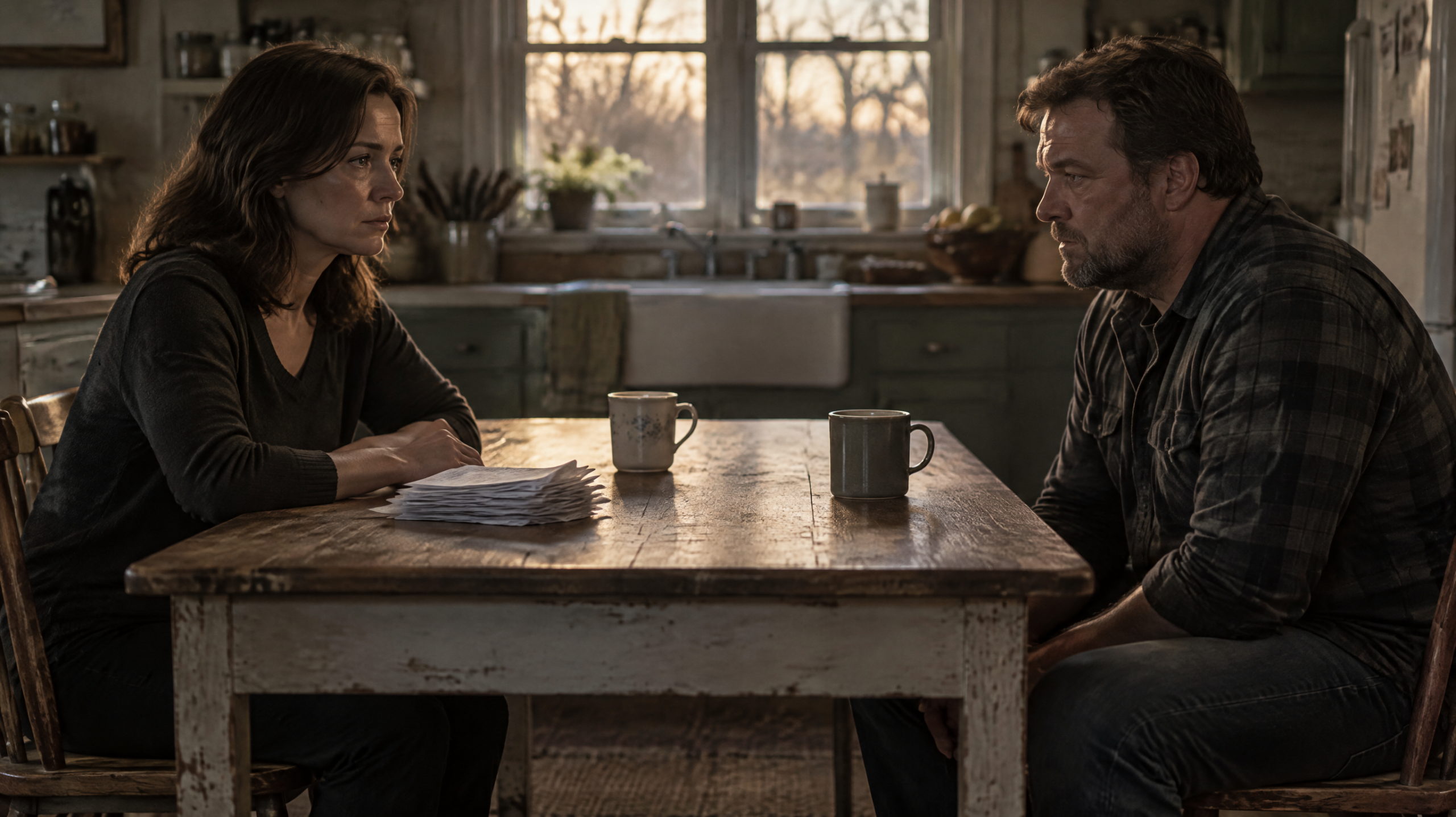
“I did work something out with Dad. He asked me in this kitchen. He said the ridge would be sold one day and I’d be paid out of it. He shook my hand.”
“Then it’s fine.”
“It is not fine, Des. My name is on a county ledger and my mail has been going to that farm for eleven years.” I turned the last page toward him, the parcel description, the address line. “Who takes it out of the box?”
He looked at the window instead of me. “Mom does the mail.”
“And you never once saw a statement with your wife’s name on it.”
“I don’t go through her mail.” Then, quieter, “I knew they came. All right? I saw one on the hall table in maybe 2019 and I put it back. I assumed if you wanted it you’d have asked for it.”
“Asked who? Nobody told me it was there.”
He rubbed his thumb along the edge of the table, back and forth, like he was sanding it. “I’m not going to pretend I handled it right.”
That was the closest thing to an apology I’d had from him in years, and it made me angrier than the silence had.
“Say something to your father,” I said. “Tomorrow. In front of me.”
“Not this week.” He said it fast, like he’d been holding it. “The anniversary isn’t until the twenty-first. Ilsa moved the party up for the band but the Mass is still the twenty-first, and then the dinner, the whole family, twenty-two of us. Dad’s had two stents since Easter. You want me to put this in front of him at that table?”
“I want you to put it in front of him before he dies thinking it’s settled.”
“After the twenty-first,” he said. “I’ll sit him down after.”
He took his coffee to the sink and poured it out. I sat there with the pages and thought about how he’d said after, as if after were a place you could get to.
Ilsa called me Tuesday morning and asked me to open the gate for the surveyor. Desmond was in town with the feed truck, she said, and she wasn’t walking up that hill in her good shoes. So I drove out and sat on the tailgate of my car until a green pickup came up the lane with a ladder rack and a magnetic sign on the door.
Marguerite Osei was older than me by twenty years, in boots that had been rained on, with a clipboard and a canvas bag and a folder she kept under her arm like a purse. She shook my hand and said she’d been hired to map the ridge before the partition, and did I know where the corner pin was from the old deed.