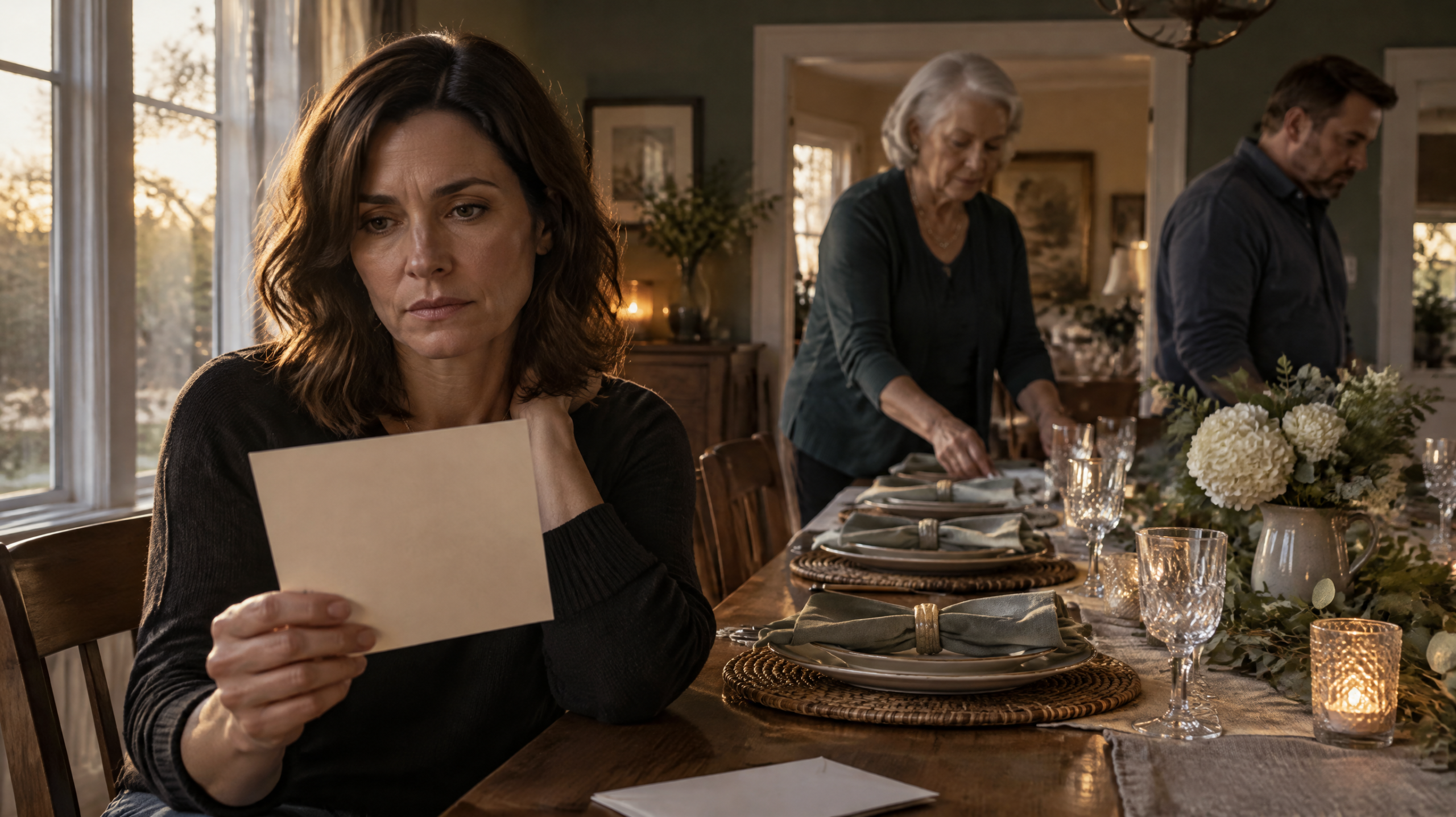
The invitation came on a Tuesday in a cream envelope with a gold seal that had been pressed too hard and split at the edge. I knew what it was before I opened it. Ilsa had been talking about the anniversary since Easter, and Ilsa does not do anything without a card.
I stood at the counter with my coat still on and read it twice.
Please join us in celebrating fifty years of Vernon and Ilsa Byrne. Saturday, the fourteenth of September, four o’clock. Dinner to follow.
Then the line under the verse, where the names go.
Norah Kelleher, family friend.
Not Norah Byrne. My maiden name, which I have not used on anything except my driver’s license since 2015, and after it, two words that put me on the far side of a fence I had been standing inside for eleven years.
Desmond came in from the garage with his knuckles black from a brake line and asked what was wrong. I turned the card around so he could read it.
He read it the way he reads a menu. Then he said, “She probably sent the list over before she had her coffee.”
“Somebody typed it,” I said. “Somebody typed my name out and then typed family friend after it. That is not a coffee mistake.”
“It’s a printer mistake. You know what she’s like with vendors. She gives them a list of names and the girl at the shop fills in the rest.”
“Then ask her for a reprint.”
He dried his hands on the towel and did not look at me. “I’m not calling my mother three weeks before her fiftieth anniversary to complain about a card. Two hundred people are coming. She’d cry for a week.”
“She can cry,” I said. “I’m the one holding a card that calls me a family friend.”
“Norah.” He says it softly when he has decided the conversation is finished. “It’s paper.”
I went upstairs and sat on the edge of the bed with my boots still on. He was not entirely wrong. It was paper. That was the part I could never make him understand. It had been paper for nine years.
The shoebox is in the back of my closet, under the winter sweaters. The first card in it is from a christening in 2017, and my name was there, scratched out with a blade until the card fuzzed. The next two were the same. After that they stopped scraping, because by then somebody had learned to type the whole list fresh and leave me off it. Nine cards, nine years. I have never shown them to anyone. I told myself that keeping them was the same as not caring, and it took me until this September to notice that a woman who keeps nine years of evidence in a shoebox has already decided what she is looking at.
The party was on a Saturday. I drove up to the farm on the Friday to help, because I always drive up on the Friday to help.
The barn smelled of pine shavings and the rented chairs stood in stacks against the wall. Ilsa had the seating chart spread over two hay bales, pinned down with coffee cups, and she was wearing the good cardigan with the pills on the elbows, which meant she had begun to enjoy herself.
“Table nine,” she said, and handed me a rubber-banded stack of place cards to set out. Mine was on top. Norah Kelleher, table nine.
Table nine was the last table, past the sixth row of family, nearest the dairy barn and the portable toilets. Its seats had gone to the neighbours. The Doyles, who farm the next road over. Sandra Pike and her brother. People I like, people I talk to at the feed store, but not people whose children I had watched grow up at tables eight through one.