We walked up together. She asked about the fence line, who mowed, whether the culvert had ever been replaced. At the top she stood a long time looking at the tree line and said, “Somebody’s kept this clear. That’s not nothing on a parcel nobody lives on.”
“Somebody has,” I said.
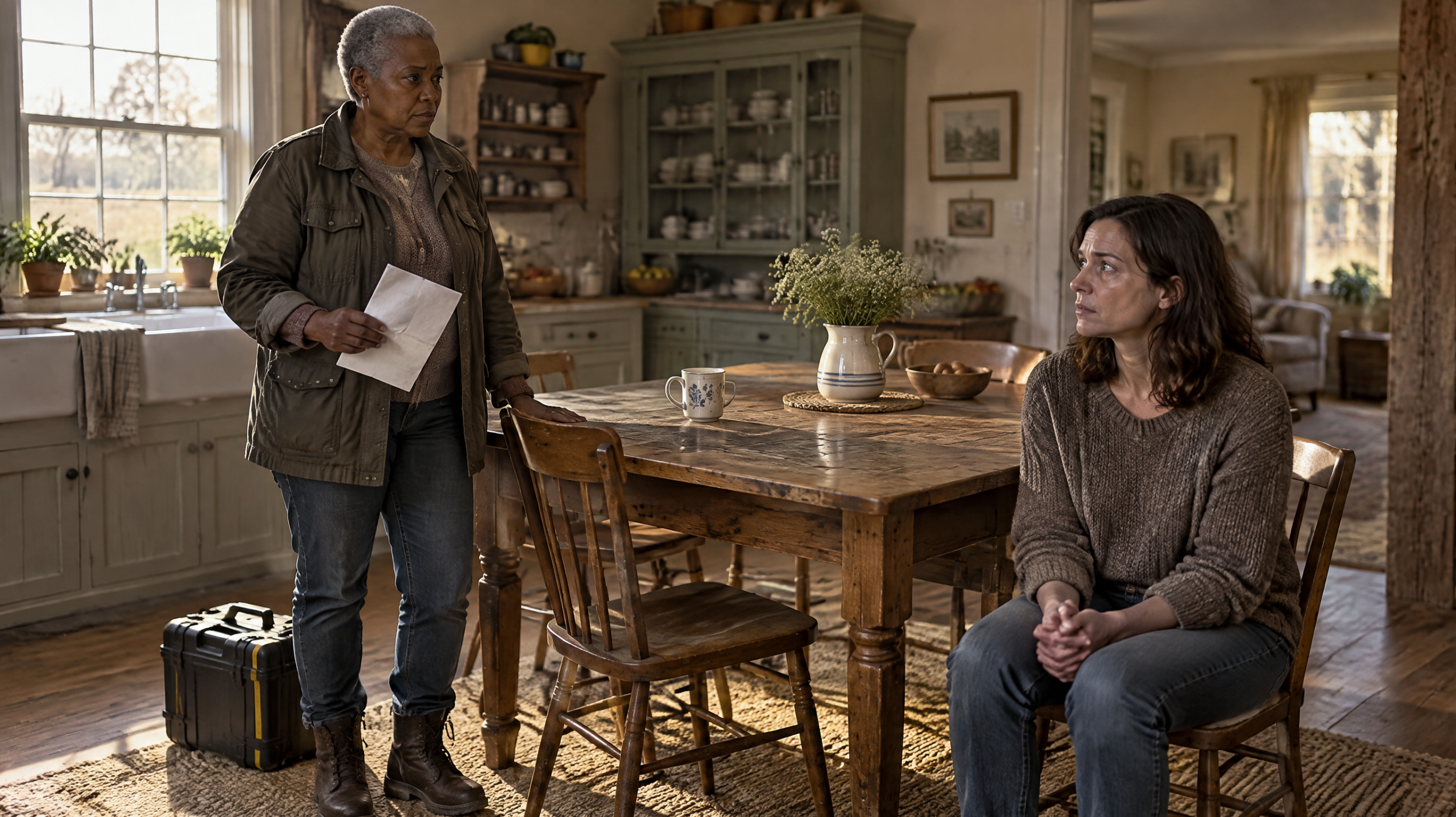
In the kitchen, Ilsa had the good cups out. Marguerite spread her map on the table and weighted the corners with a sugar bowl and a jar of honey, and then she took a single page out of the folder. Not a map. A printout.
“Before I file the partition,” she said, “I need to know who’s been paying the taxes. The county record has a payer of record that isn’t the owner, and that changes what I put on the plat.”
She turned it around. My name was in the box. Norah Kelleher, eleven entries, the last one ten months old.
“That’s Norah,” Ilsa said, before I could. “She’s family.”
“She’s the payer,” Marguerite said. “Are you the owner?”
“No,” I said.
“Are you a beneficiary of the estate?”
“No.”
Marguerite wrote something down and didn’t look at Ilsa while she did it, which I decided later was a kindness. “Then I need to flag it. I can’t draw a clean partition over a paid claim and pretend I didn’t see it.”
Ilsa laughed, one note of it, and set the honey jar down harder than she needed to. “Loans,” she said. “That’s all. Eleven years of loans, and we’ll repay every cent of it when the land goes. She’s been good to us. Nobody’s cheating anybody.”
Marguerite put her page back in the folder. “Then it’ll be easy to show,” she said. “A note, a ledger entry, anything with a date.” She zipped her bag. “I’ll have the plat to the attorney by the end of the month.”
I followed Desmond out to the barn that night. He had the purchase agreement on the feed room shelf, dog-eared, with a coffee ring on the cover.
“Six weeks,” he said, when I asked. “It closes in six weeks, and they want clean title. That’s why the surveyor’s here. That’s why everybody’s nervous.” He flipped to the schedule. “Gravel company. One point nine million for the whole parcel, and they’ve paid earnest money.”
“And my seventy-eight thousand?”
“Comes out of it.” He said it like a man reading a weather report. “Once it closes.”
“Written down where?”
He didn’t answer that. He put the agreement back on the shelf and squared it with the edge, and I stood in the barn door with the smell of diesel and hay and understood that I had been waiting eleven years for a handshake.
Thursday I drove to the county seat and asked for the probate file on Agnes Byrne. The clerk brought out two folders and a rubber band, and I sat at a table under a window with my coat still on.
The 2023 family settlement agreement was eleven pages. It listed the heirs by name and by share. Vernon. His sister in Kilkenny. Desmond. Desmond’s brother. A schedule of the parcels, the ridge among them, forty-one acres, no structure.
My name was not in it. Not once. Not as a creditor, not as a party, not in a footnote.
On the signature page, above the notary’s stamp, Desmond had signed his name and, under it, in his own handwriting, six words that had been typed for him: all claims held by his household. Beside that, a figure. $40,000.
I read it three times. Then I read the date, and I sat there while the clerk sorted something behind the counter, because I remembered that April. I remembered the two trucks that came that spring, the ones he said the bank had finally come through on.