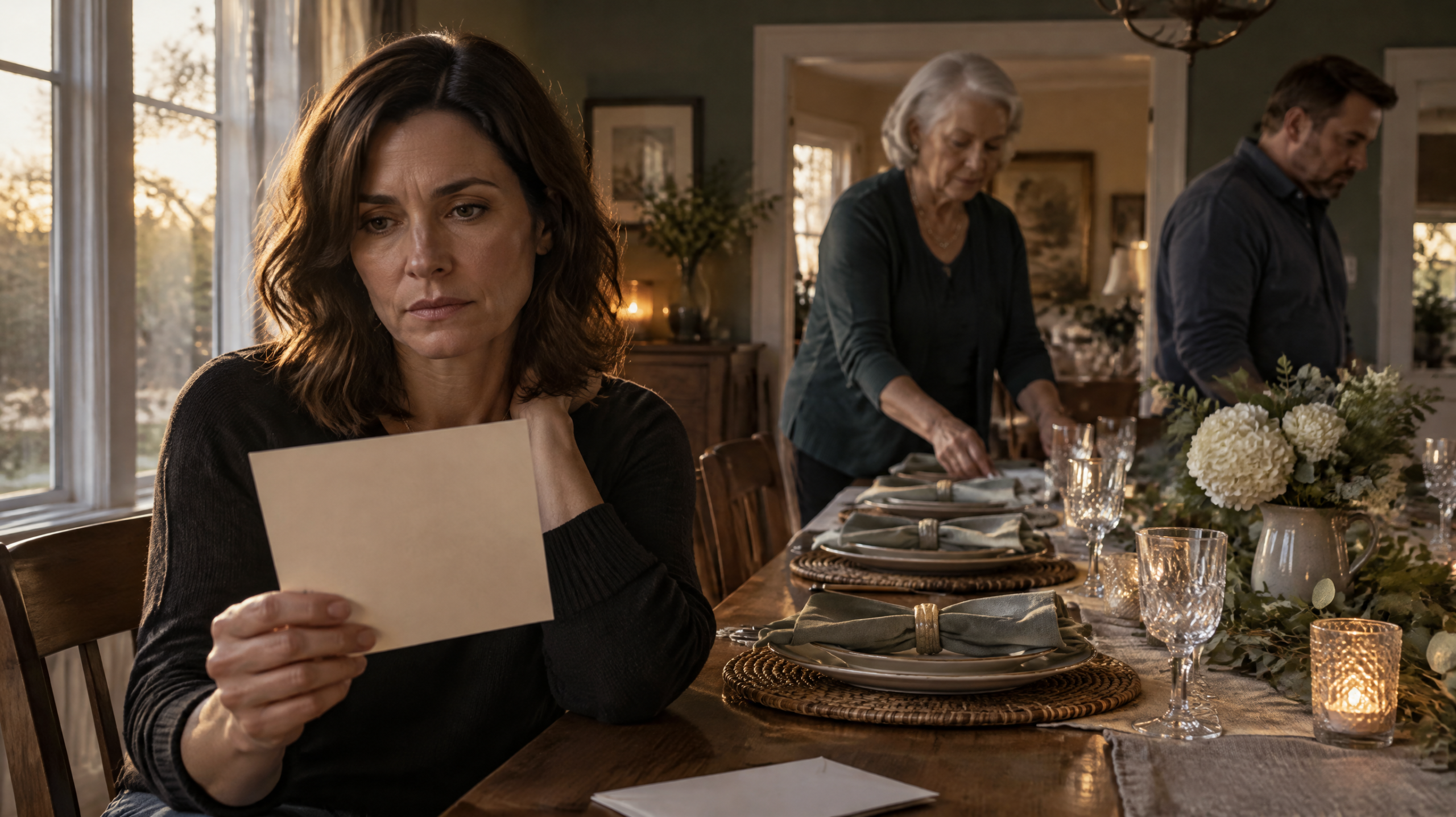
Victor Harrower read the paper aloud while his wife was still setting down the cream jug, and he read it in the voice he used for contracts.
“I, Callum Vane, of the Old Rope Walk, confirm that I hold no claim, legal or equitable, against Kestrel Marine Limited, its land, its buildings, or its goodwill.”
The jug touched the rim of Rosalind’s saucer and stayed there. Nobody moved it.
Fourteen months I had been eating Sunday dinner in that house. Fourteen months of being handed the wrong glass, of Rosalind asking whether my van was parked where the neighbours could see it, of Victor explaining the marina business to me slowly, as though I had come in from the rain with a shovel. Delia sat beside me with her knee against mine, and afterwards, in the car, she would say, “They’re not like that once you know them,” and I would say I knew, because I wanted it to be true.
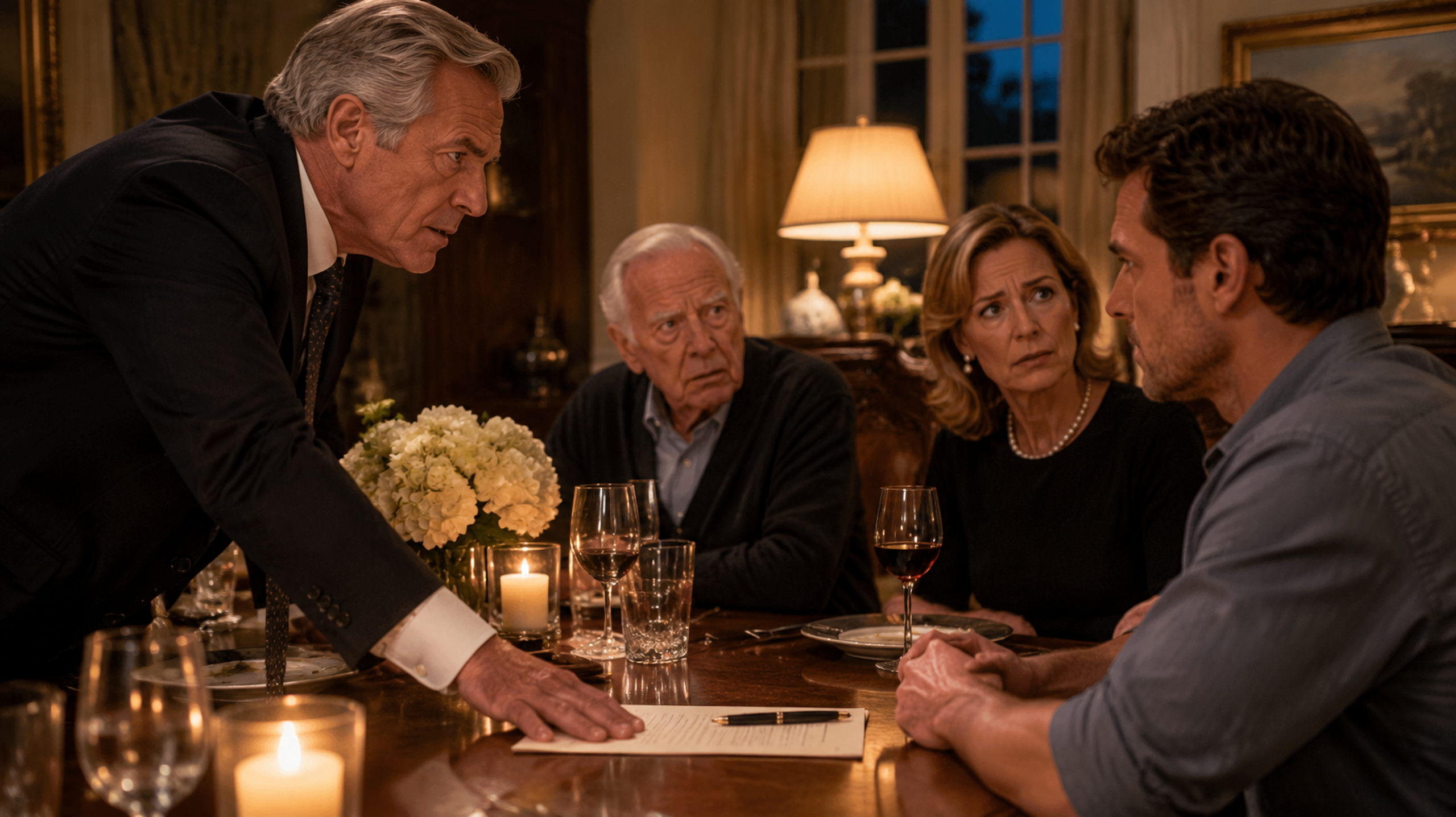
Victor turned the page over and laid it flat.
“There’s a signature line at the bottom, Callum. I’d like it done before dessert.”
I put my fork down. “What is it a declaration of?”
“That you’ve been paid for the work you’ve done at the yard and you’re owed nothing further. It protects the lease application. The harbour authority asks for clean paperwork on anyone with a financial interest in the site.”
I had a subcontract for the pontoon rails. Twelve thousand pounds, half of it already invoiced. I had never had an interest in anything of his except his daughter, and I said so, and Victor smiled at me the way a man smiles at a bad joke in a meeting.
Then his father spoke.
Bernard Harrower had said nothing all evening. He sat at the head of the table with his napkin folded in his lap and his hands on top of it, and I had assumed, as everyone else there seemed to assume, that he was somewhere else. He was eighty-eight. There were days he called Delia by her grandmother’s name. That night he had eaten his soup unaided and asked twice for the salt, and I had thought that was the whole of it.
He said, “Tomas Vane. The paint store.”
The room went quiet in a way I had never heard a room go quiet. His hand was shaking on the napkin.
I said, “That’s my grandfather.”
“I know whose grandfather he is,” Bernard said, and then Victor was on his feet.
“Dad. Dad, you’re confusing names again, you do this, you did it with the doctor on Tuesday.” He waved one hand through the air as though he could clear smoke out of it. “Come on. Bernard. Look at me.”
Bernard looked at his son. I have thought about that look more than anything else from that night. He looked tired and entirely present, and then he let himself be turned, and Rosalind took his arm and Delia took the other, and they walked him out of the dining room and up the stairs. He was still talking on the landing. I could not make out the words.
Victor poured himself the last of the wine.
“He does that,” he said. “Names from fifty years ago come back to him before the ones from this morning. It’s the illness.”
“My grandfather worked in your paint store from 1977 to 1981,” I said. “I’ve known that since I was a boy.”
“No, he didn’t.”
“He did.”
“Callum.” He set the bottle down. “I’ve had the payroll, I’ve had the insurance files, I’ve had all of it through my hands for thirty years. No Vane ever worked at Kestrel Marine. I’d remember.”
Rosalind came back down alone and stood in the doorway, and I asked her, because somebody in that house had to answer a straight question.
“Bernard is confusing 1979 with something he saw on television,” she said. “There was a programme about a fire. He watched it twice. He gets the two things muddled.”
There was no programme. I don’t know how I knew that, but I did, the way you know a weld has not taken by the sound of it.
I left without signing. Delia came out to the van with me and stood in the cold with her arms folded and said, “He’s old, Callum. He’s not well,” and I said I knew, and drove home with my hands too tight on the wheel.